







Question: Question 4 - Multi-periodic inventory (8 marks) A retailer operates 365 days per year. The total annual demand for its product is 100,000 units with
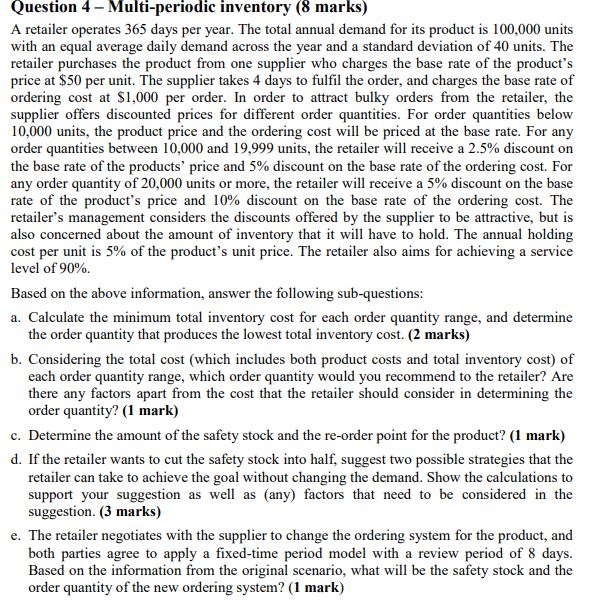
Question 4 - Multi-periodic inventory (8 marks) A retailer operates 365 days per year. The total annual demand for its product is 100,000 units with an equal average daily demand across the year and a standard deviation of 40 units. The retailer purchases the product from one supplier who charges the base rate of the product's price at $50 per unit. The supplier takes 4 days to fulfil the order, and charges the base rate of ordering cost at $1,000 per order. In order to attract bulky orders from the retailer, the supplier offers discounted prices for different order quantities. For order quantities below 10,000 units, the product price and the ordering cost will be priced at the base rate. For any order quantities between 10,000 and 19,999 units, the retailer will receive a 2.5% discount on the base rate of the products' price and 5% discount on the base rate of the ordering cost. For any order quantity of 20,000 units or more, the retailer will receive a 5% discount on the base rate of the product's price and 10% discount on the base rate of the ordering cost. The retailer's management considers the discounts offered by the supplier to be attractive, but is also concerned about the amount of inventory that it will have to hold. The annual holding cost per unit is 5% of the product's unit price. The retailer also aims for achieving a service level of 90%. Based on the above information, answer the following sub-questions: a. Calculate the minimum total inventory cost for each order quantity range, and determine the order quantity that produces the lowest total inventory cost. ( 2 marks) b. Considering the total cost (which includes both product costs and total inventory cost) of each order quantity range, which order quantity would you recommend to the retailer? Are there any factors apart from the cost that the retailer should consider in determining the order quantity? (1 mark) c. Determine the amount of the safety stock and the re-order point for the product? (1 mark) d. If the retailer wants to cut the safety stock into half, suggest two possible strategies that the retailer can take to achieve the goal without changing the demand. Show the calculations to support your suggestion as well as (any) factors that need to be considered in the suggestion. (3 marks) e. The retailer negotiates with the supplier to change the ordering system for the product, and both parties agree to apply a fixed-time period model with a review period of 8 days. Based on the information from the original scenario, what will be the safety stock and the order quantity of the new ordering system? (1 mark)
Step by Step Solution
There are 3 Steps involved in it

Get step-by-step solutions from verified subject matter experts
 Study Help