







Question: QUESTION 4. Part a) Explain the stall-on-branch strategy for implementing the 'beq' instruction. Explain this strategy for the two approaches of implementing the 'beq' (in
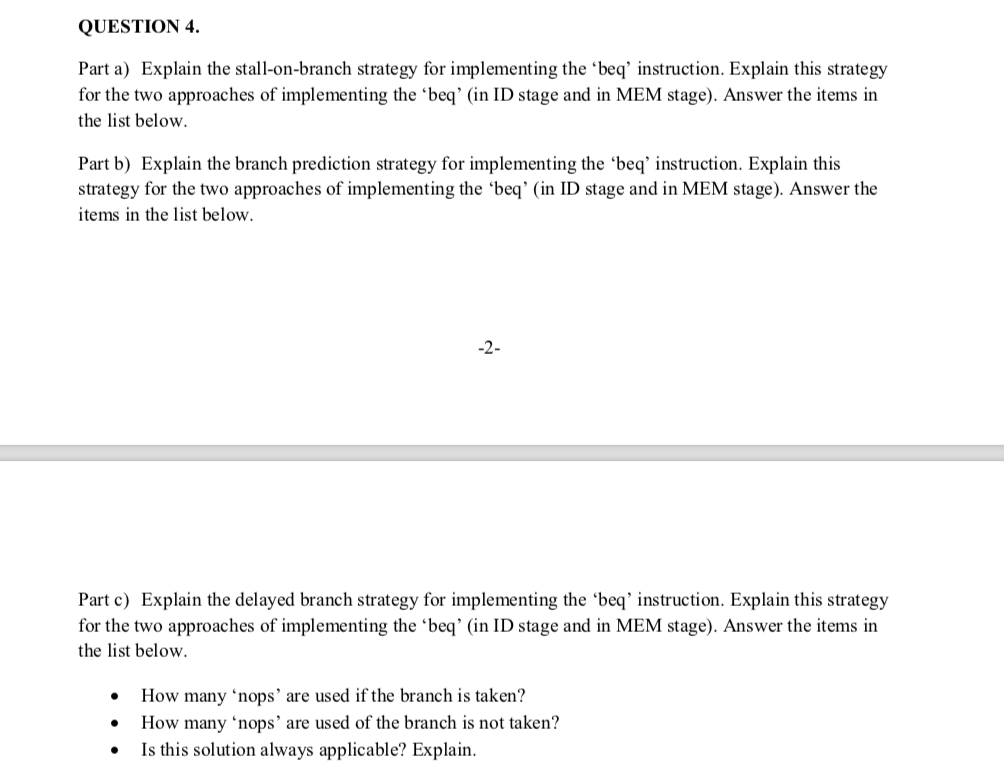
QUESTION 4. Part a) Explain the stall-on-branch strategy for implementing the 'beq' instruction. Explain this strategy for the two approaches of implementing the 'beq' (in ID stage and in MEM stage). Answer the items in the list below Part b) Explain the branch prediction strategy for implementing the beq' instruction. Explain this strategy for the two approaches of implementing the 'beq' (in ID stage and in MEM stage). Answer the items in the list below. Part c) Explain the delayed branch strategy for implementing the beq, instruction. Explain this strategy for the two approaches of implementing the 'beq' (in ID stage and in MEM stage). Answer the items in the list below. How many 'nops' are used if the branch is taken? How many 'nops' are used of the branch is not taken? Is this solution always applicable? Explain. QUESTION 4. Part a) Explain the stall-on-branch strategy for implementing the 'beq' instruction. Explain this strategy for the two approaches of implementing the 'beq' (in ID stage and in MEM stage). Answer the items in the list below Part b) Explain the branch prediction strategy for implementing the beq' instruction. Explain this strategy for the two approaches of implementing the 'beq' (in ID stage and in MEM stage). Answer the items in the list below. Part c) Explain the delayed branch strategy for implementing the beq, instruction. Explain this strategy for the two approaches of implementing the 'beq' (in ID stage and in MEM stage). Answer the items in the list below. How many 'nops' are used if the branch is taken? How many 'nops' are used of the branch is not taken? Is this solution always applicable? Explain
Step by Step Solution
There are 3 Steps involved in it

Get step-by-step solutions from verified subject matter experts
 Study Help