Question: Question 4 - Short answers - (15 points) - a. (10 pts.) What approach would you take to evaluate and consequently recommend or reject) the
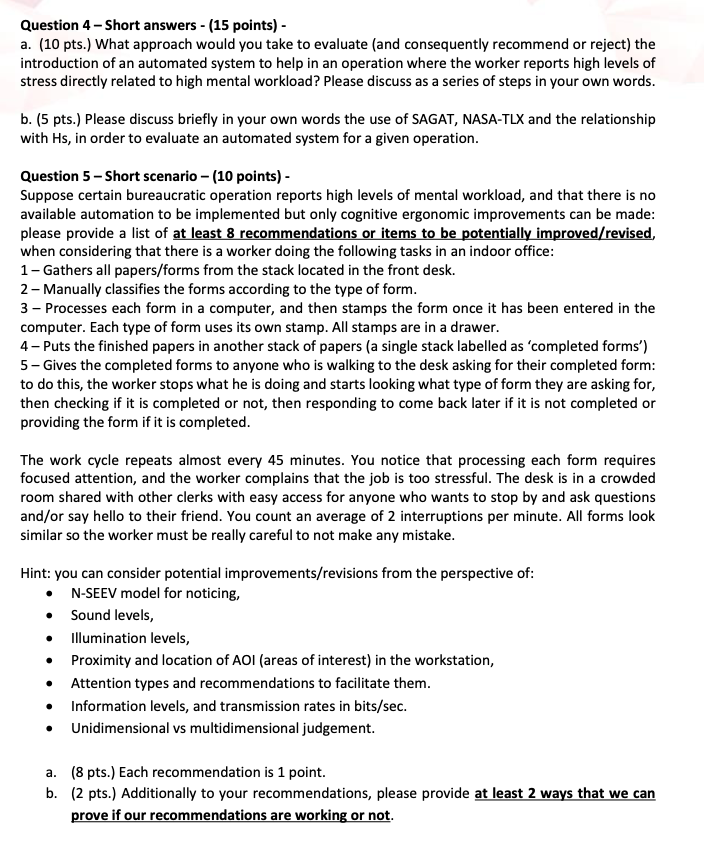
Question 4 - Short answers - (15 points) - a. (10 pts.) What approach would you take to evaluate and consequently recommend or reject) the introduction of an automated system to help in an operation where the worker reports high levels of stress directly related to high mental workload? Please discuss as a series of steps in your own words. b. (5 pts. Please discuss briefly in your own words the use of SAGAT, NASA-TLX and the relationship with Hs, in order to evaluate an automated system for a given operation. Question 5 - Short scenario - (10 points) - Suppose certain bureaucratic operation reports high levels of mental workload, and that there is no available automation to be implemented but only cognitive ergonomic improvements can be made: please provide a list of at least 8 recommendations or items to be potentially improved/revised, when considering that there is a worker doing the following tasks in an indoor office: 1 - Gathers all papers/forms from the stack located in the front desk. 2 - Manually classifies the forms according to the type of form. 3 - Processes each form in a computer, and then stamps the form once it has been entered in the computer. Each type of form uses its own stamp. All stamps are in a drawer. 4- Puts the finished papers in another stack of papers (a single stack labelled as 'completed forms') 5- Gives the completed forms to anyone who is walking to the desk asking for their completed form: to do this, the worker stops what he is doing and starts looking what type of form they are asking for, then checking if it is completed or not, then responding to come back later if it is not completed or providing the form if it is completed. The work cycle repeats almost every 45 minutes. You notice that processing each form requires focused attention, and the worker complains that the job is too stressful. The desk is in a crowded room shared with other clerks with easy access for anyone who wants to stop by and ask questions and/or say hello to their friend. You count an average of 2 interruptions per minute. All forms look similar so the worker must be really careful to not make any mistake. Hint: you can consider potential improvements/revisions from the perspective of: N-SEEV model for noticing, Sound levels, illumination levels, Proximity and location of A01 (areas of interest) in the workstation, Attention types and recommendations to facilitate them. Information levels, and transmission rates in bits/sec. Unidimensional vs multidimensional judgement. . . a. (8 pts.) Each recommendation is 1 point. b. (2 pts.) Additionally to your recommendations, please provide at least 2 ways that we can prove if our recommendations are working or not. Question 4 - Short answers - (15 points) - a. (10 pts.) What approach would you take to evaluate and consequently recommend or reject) the introduction of an automated system to help in an operation where the worker reports high levels of stress directly related to high mental workload? Please discuss as a series of steps in your own words. b. (5 pts. Please discuss briefly in your own words the use of SAGAT, NASA-TLX and the relationship with Hs, in order to evaluate an automated system for a given operation. Question 5 - Short scenario - (10 points) - Suppose certain bureaucratic operation reports high levels of mental workload, and that there is no available automation to be implemented but only cognitive ergonomic improvements can be made: please provide a list of at least 8 recommendations or items to be potentially improved/revised, when considering that there is a worker doing the following tasks in an indoor office: 1 - Gathers all papers/forms from the stack located in the front desk. 2 - Manually classifies the forms according to the type of form. 3 - Processes each form in a computer, and then stamps the form once it has been entered in the computer. Each type of form uses its own stamp. All stamps are in a drawer. 4- Puts the finished papers in another stack of papers (a single stack labelled as 'completed forms') 5- Gives the completed forms to anyone who is walking to the desk asking for their completed form: to do this, the worker stops what he is doing and starts looking what type of form they are asking for, then checking if it is completed or not, then responding to come back later if it is not completed or providing the form if it is completed. The work cycle repeats almost every 45 minutes. You notice that processing each form requires focused attention, and the worker complains that the job is too stressful. The desk is in a crowded room shared with other clerks with easy access for anyone who wants to stop by and ask questions and/or say hello to their friend. You count an average of 2 interruptions per minute. All forms look similar so the worker must be really careful to not make any mistake. Hint: you can consider potential improvements/revisions from the perspective of: N-SEEV model for noticing, Sound levels, illumination levels, Proximity and location of A01 (areas of interest) in the workstation, Attention types and recommendations to facilitate them. Information levels, and transmission rates in bits/sec. Unidimensional vs multidimensional judgement. . . a. (8 pts.) Each recommendation is 1 point. b. (2 pts.) Additionally to your recommendations, please provide at least 2 ways that we can prove if our recommendations are working or not









 Study Help