







Question: QUESTION 4 The table below is used for Questions 4 and 5. It contains three estimated regressions, which were computed in 2007 using data on
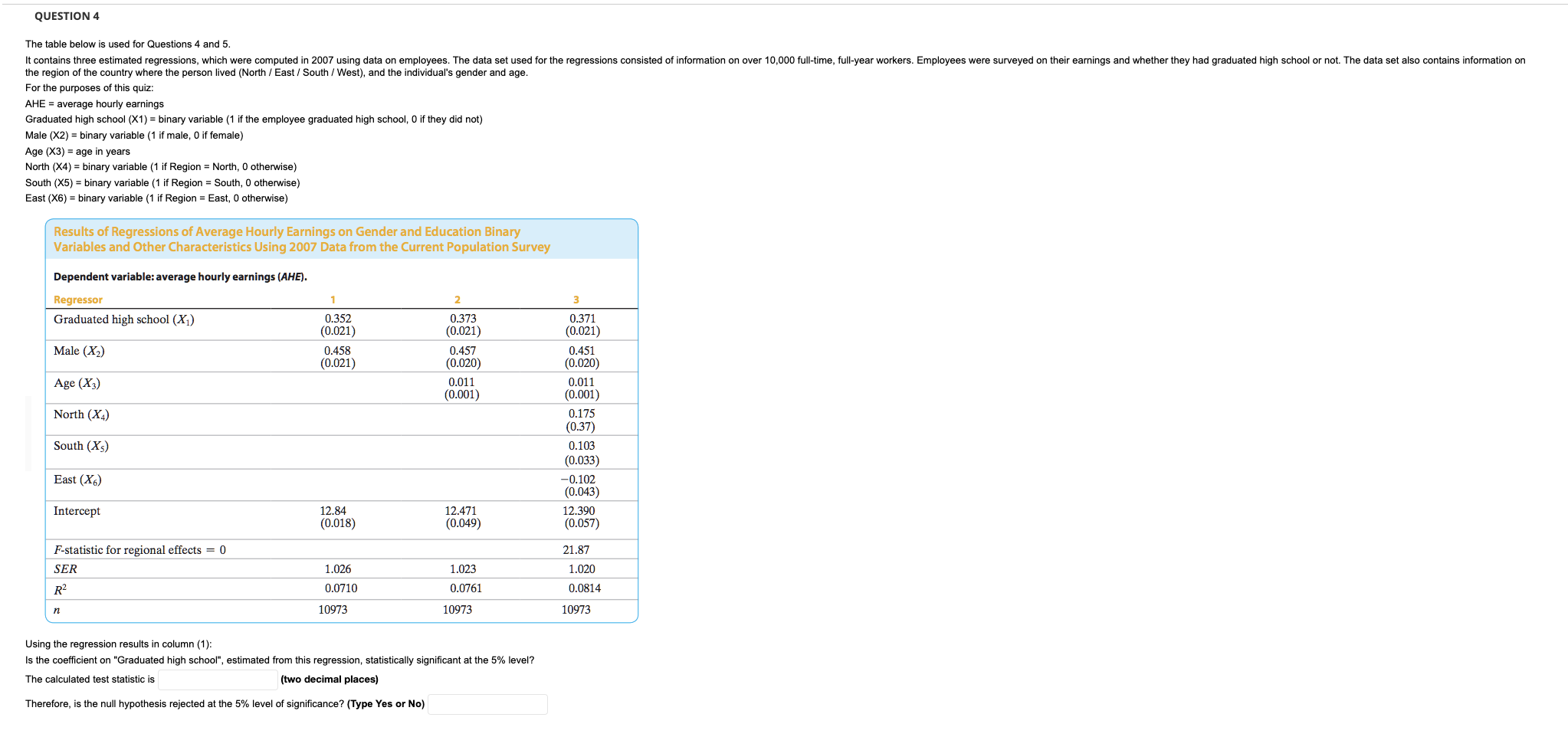
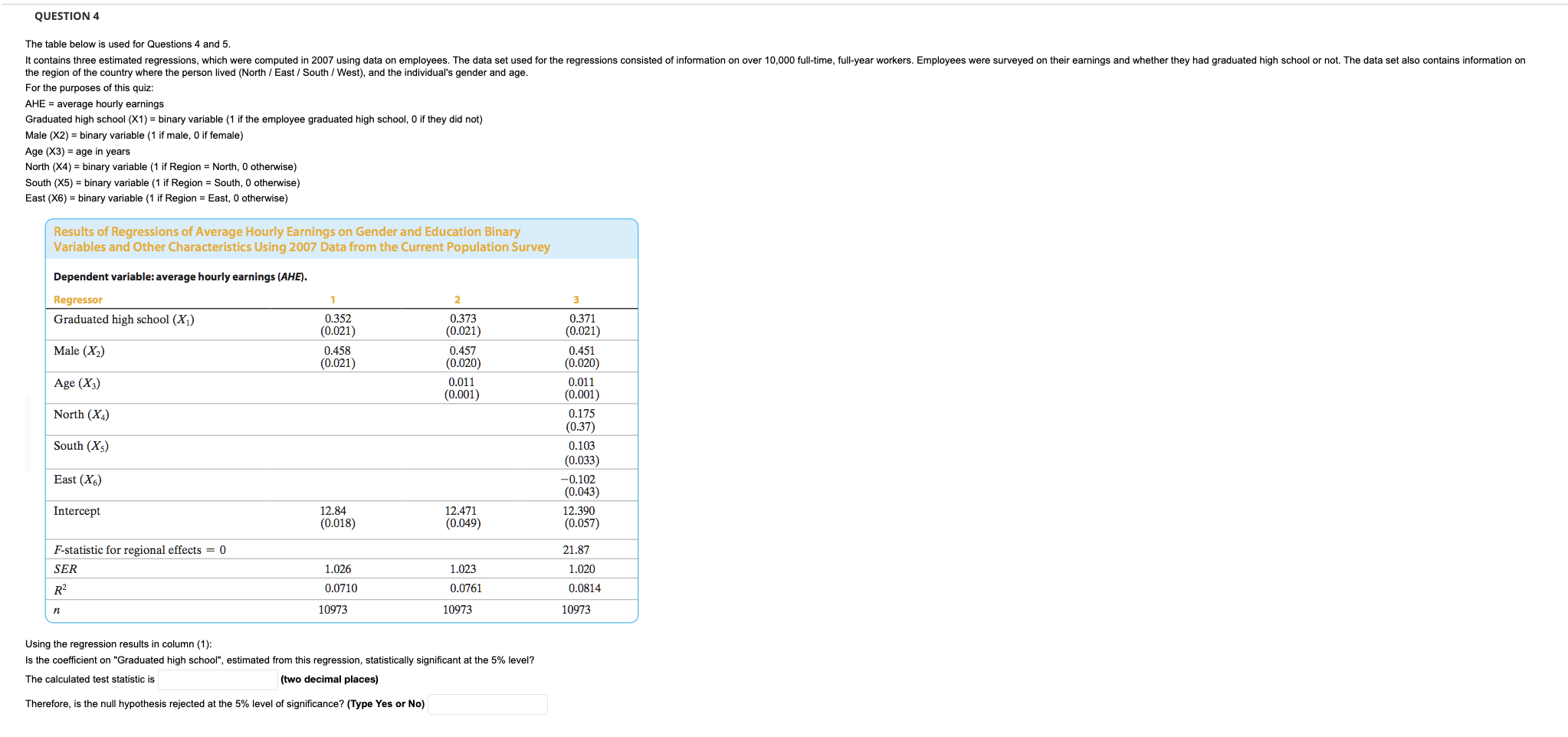
QUESTION 4 The table below is used for Questions 4 and 5. It contains three estimated regressions, which were computed in 2007 using data on employees. The data set used for the regressions consisted of information on over 10,000 full-time, full-year workers. Employees were surveyed on their earnings and whether they had graduated high school or not. The data set also contains information on the region of the country where the person lived (North / East / South / West), and the individual's gender and age. For the purposes of this quiz: AHE = average hourly earnings Graduated high school (X1) = binary variable (1 if the employee graduated high school, 0 if they did not) Male (X2) = binary variable (1 if male, 0 if female) Age (X3) = age in years North (X4) = binary variable (1 if Region = North, 0 otherwise) South (X5) = binary variable (1 if Region = South, 0 otherwise) East (X6) = binary variable (1 if Region = East, 0 otherwise) Results of Regressions of Average Hourly Earnings on Gender and Education Binary Variables and Other Characteristics Using 2007 Data from the Current Population Survey Dependent variable: average hourly earnings (AHE). Regressor Graduated high school (X1) 0.352 0.373 0.371 (0.021) 0.021) (0.021) Male (X2) 0.458 0.457 0.451 (0.021) (0.020) (0.020 Age (X3) 0.011 0.011 (0.001) (0.001 North (X4) 0.175 (0.37) South (X5) 0.103 (0.033) East (X6) -0.102 (0.043) Intercept 12.84 12.471 12.390 (0.018) (0.049) (0.057) F-statistic for regional effects = 0 21.87 SER 1.026 1.023 1.020 R2 0.0710 0.0761 0.0814 10973 1097 10973 Using the regression results in column (1): Is the coefficient on "Graduated high school", estimated from this regression, statistically significant at the 5% level? The calculated test statistic is (two decimal places) Therefore, is the null hypothesis rejected at the 5% level of significance? (Type Yes or No)
Step by Step Solution
There are 3 Steps involved in it

Get step-by-step solutions from verified subject matter experts
 Study Help