Question: Question 4: Using comments from the case below to illustrate your answer, explain what economic processes constrain the development or redesign of the kiwifruit harvest.
Question 4: Using comments from the case below to illustrate your answer, explain what economic processes constrain the development or redesign of the kiwifruit harvest.
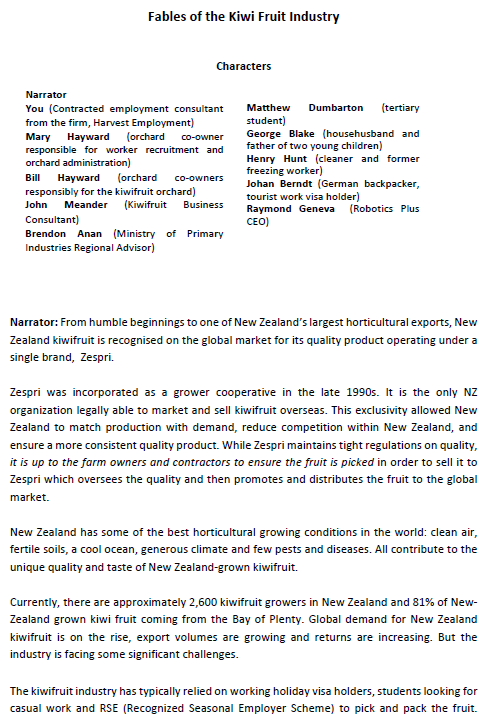
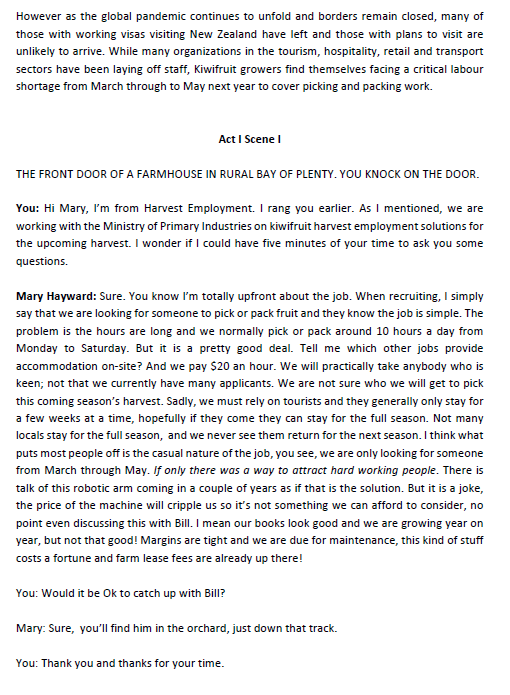
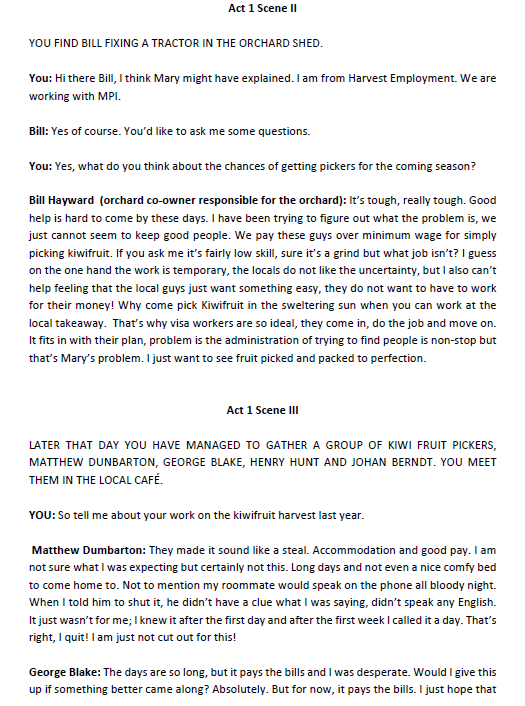
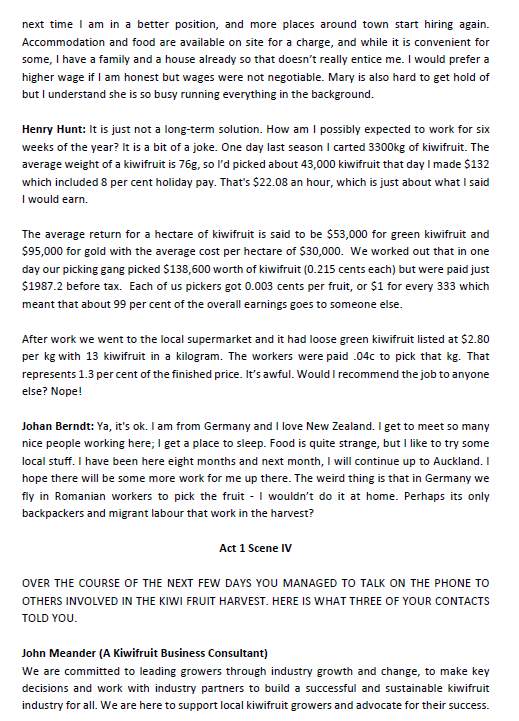
Fables of the Kiwi Fruit Industry Characters Narrator You (Contracted employment consultant from the firm, Harvest Employment) Mary Hayward (orchard co-owner responsible for worker recruitment and orchard administration) Bill Hayward (orchard co-owners responsibly for the kiwifruit orchard) John Meander (Kiwifruit Business Consultant) Brendon Anan (Ministry of Primary Industries Regional Advisor) Matthew Dumbarton (tertiary student) George Blake (househusband and father of two young children) Henry Hunt (cleaner and former freezing worker) Johan Berndt (German backpacker, tourist work visa holder) Raymond Geneva (Robotics Plus CEO) Narrator: From humble beginnings to one of New Zealand's largest horticultural exports, New Zealand kiwifruit is recognised on the global market for its quality product operating under a single brand, Zespri. Zespri was incorporated as a grower cooperative in the late 1990s. It is the only NZ organization legally able to market and sell kiwifruit overseas. This exclusivity allowed New Zealand to match production with demand, reduce competition within New Zealand, and ensure a more consistent quality product. While Zespri maintains tight regulations on quality, it is up to the farm owners and contractors to ensure the fruit is picked in order to sell it to Zespri which oversees the quality and then promotes and distributes the fruit to the global market New Zealand has some of the best horticultural growing conditions in the world: clean air, fertile soils, a cool ocean, generous climate and few pests and diseases. All contribute to the unique quality and taste of New Zealand-grown kiwifruit. Currently, there are approximately 2,600 kiwifruit growers in New Zealand and 81% of New- Zealand grown kiwi fruit coming from the Bay of Plenty. Global demand for New Zealand kiwifruit is on the rise, export volumes are growing and returns are increasing. But the industry is facing some significant challenges. The kiwifruit industry has typically relied on working holiday visa holders, students looking for casual work and RSE (Recognized Seasonal Employer Scheme) to pick and pack the fruit. However as the global pandemic continues to unfold and borders remain closed, many of those with working visas visiting New Zealand have left and those with plans to visit are unlikely to arrive. While many organizations in the tourism, hospitality, retail and transport sectors have been laying off staff, Kiwifruit growers find themselves facing a critical labour shortage from March through to May next year to cover picking and packing work. Act 1 Scene THE FRONT DOOR OF A FARMHOUSE IN RURAL BAY OF PLENTY. YOU KNOCK ON THE DOOR. You: Hi Mary, I'm from Harvest Employment. I rang you earlier. As I mentioned, we are working with the Ministry of Primary Industries on kiwifruit harvest employment solutions for the upcoming harvest. I wonder if I could have five minutes of your time to ask you some questions. Mary Hayward: Sure. You know I'm totally upfront about the job. When recruiting, I simply say that we are looking for someone to pick or pack fruit and they know the job is simple. The problem is the hours are long and we normally pick or pack around 10 hours a day from Monday to Saturday. But it is a pretty good deal. Tell me which other jobs provide accommodation on-site? And we pay $20 an hour. We will practically take anybody who is keen; not that we currently have many applicants. We are not sure who we will get to pick this coming season's harvest. Sadly, we must rely on tourists and they generally only stay for a few weeks at a time, hopefully if they come they can stay for the full season. Not many locals stay for the full season, and we never see them return for the next season. I think what puts most people off is the casual nature of the job, you see, we are only looking for someone from March through May. If only there was a way to attract hard working people. There is talk of this robotic arm coming in a couple of years as if that is the solution. But it is a joke, the price of the machine will cripple us so it's not something we can afford to consider, no point even discussing this with Bill. I mean our books look good and we are growing year on year, but not that good! Margins are tight and we are due for maintenance, this kind of stuff costs a fortune and farm lease fees are already up there! You: Would it be Ok to catch up with Bill? Mary: Sure, you'll find him in the orchard, just down that track. You: Thank you and thanks for your time. Act 1 Scene II YOU FIND BILL FIXING A TRACTOR IN THE ORCHARD SHED. You: Hi there Bill, I think Mary might have explained. I am from Harvest Employment. We are working with MPI. Bill: Yes of course. You'd like to ask me some questions. You: Yes, what do you think about the chances of getting pickers for the coming season? Bill Hayward (orchard co-owner responsible for the orchard): It's tough, really tough. Good help is hard to come by these days. I have been trying to figure out what the problem is, we just cannot seem to keep good people. We pay these guys over minimum wage for simply picking kiwifruit. If you ask me it's fairly low skill, sure it's a grind but what job isn't? I guess on the one hand the work is temporary, the locals do not like the uncertainty, but I also can't help feeling that the local guys just want something easy, they do not want to have to work for their money! Why come pick Kiwifruit in the sweltering sun when you can work at the local takeaway. That's why visa workers are so ideal, they come in, do the job and move on. It fits in with their plan, problem is the administration of trying to find people is non-stop but that's Mary's problem. I just want to see fruit picked and packed to perfection. Act 1 Scene III LATER THAT DAY YOU HAVE MANAGED TO GATHER A GROUP OF KIWI FRUIT PICKERS, MATTHEW DUNBARTON, GEORGE BLAKE, HENRY HUNT AND JOHAN BERNDT. YOU MEET THEM IN THE LOCAL CAF. YOU: So tell me about your work on the kiwifruit harvest last year. Matthew Dumbarton: They made it sound like a steal. Accommodation and good pay. I am not sure what I was expecting but certainly not this. Long days and not even a nice comfy bed to come home to. Not to mention my roommate would speak on the phone all bloody night. When I told him to shut it, he didn't have a clue what I was saying, didn't speak any English. It just wasn't for me; I knew it after the first day and after the first week I called it a day. That's right, I quit! I am just not cut out for this! George Blake: The days are so long, but it pays the bills and I was desperate. Would I give this up if something better came along? Absolutely. But for now, it pays the bills. I just hope that next time I am in a better position, and more places around town start hiring again. Accommodation and food are available on site for a charge, and while it is convenient for some, I have a family and a house already so that doesn't really entice me. I would prefer a higher wage if I am honest but wages were not negotiable. Mary is also hard to get hold of but I understand she is so busy running everything in the background. Henry Hunt: It is just not a long-term solution. How am I possibly expected to work for six weeks of the year? It is a bit of a joke. One day last season I carted 3300kg of kiwifruit. The average weight of a kiwifruit is 76g, so I'd picked about 43,000 kiwifruit that day I made $132 which included 8 per cent holiday pay. That's $22.08 an hour, which is just about what I said I would earn. The average return for a hectare of kiwifruit is said to be $53,000 for green kiwifruit and $95,000 for gold with the average cost per hectare of $30,000. We worked out that in one day our picking gang picked $138,600 worth of kiwifruit (0.215 cents each) but were paid just $1987.2 before tax. Each of us pickers got 0.003 cents per fruit, or $1 for every 333 which meant that about 99 per cent of the overall earnings goes to someone else. After work we went to the local supermarket and it had loose green kiwifruit listed at $2.80 per kg with 13 kiwifruit in a kilogram. The workers were paid .04c to pick that kg. That represents 1.3 per cent of the finished price. It's awful. Would I recommend the job to anyone else? Nope! Johan Berndt: Ya, it's ok. I am from Germany and I love New Zealand. I get to meet so many nice people working here; I get a place to sleep. Food is quite strange, but I like to try some local stuff. I have been here eight months and next month, I will continue up to Auckland. I hope there will be some more work for me up there. The weird thing is that in Germany we fly in Romanian workers to pick the fruit - I wouldn't do it at home. Perhaps its only backpackers and migrant labour that work in the harvest? Act 1 Scene IV OVER THE COURSE OF THE NEXT FEW DAYS YOU MANAGED TO TALK ON THE PHONE TO OTHERS INVOLVED IN THE KIWI FRUIT HARVEST. HERE IS WHAT THREE OF YOUR CONTACTS TOLD YOU. John Meander (A Kiwifruit Business Consultant) We are committed to leading growers through industry growth and change, to make key decisions and work with industry partners to build a successful and sustainable kiwifruit industry for all. We are here to support local kiwifruit growers and advocate for their success. One of our key focus areas is our labour and education portfolio where we focus on attracting and retaining members of the industry as well as identifying future labour requirements. We have predicted major shortfalls in employment for the industry this coming season. Raymond Geneva (Robotics Plus CEO) Automating picking and packing is the solution to labour shortages. With Auckland and Waikato University we have built this robotic arm. We are still in prototyping phase, hoping to release to the market in a few years. The idea is that the machine will be able to pick, sort and pack kiwifruit. It works by gently picking the fruit by moving along beneath the vines. The machine is also able to work all night and in any conditions. It will be so much better than human labour. Brendon Anan (Ministry of Primary Industries Regional Advisor) It is unlikely that seasonal workers will be let into the country in the foreseeable future and certainly not for the 2021 harvest. Industries need to do a better job of attracting local talent. With rising unemployment, locals need to be recruited first. Please note: The information in the above case is drawn from publicly available sources but has been altered and fictionalized for the purposes of this case study









 Study Help