





Question: Question 4.1 (7 marks) Learning objectives: . Describe how to determine the magnitude and direction of two and three-dimensional vectors. . Apply vector concepts to
Question 4.1 (7 marks) Learning objectives: .
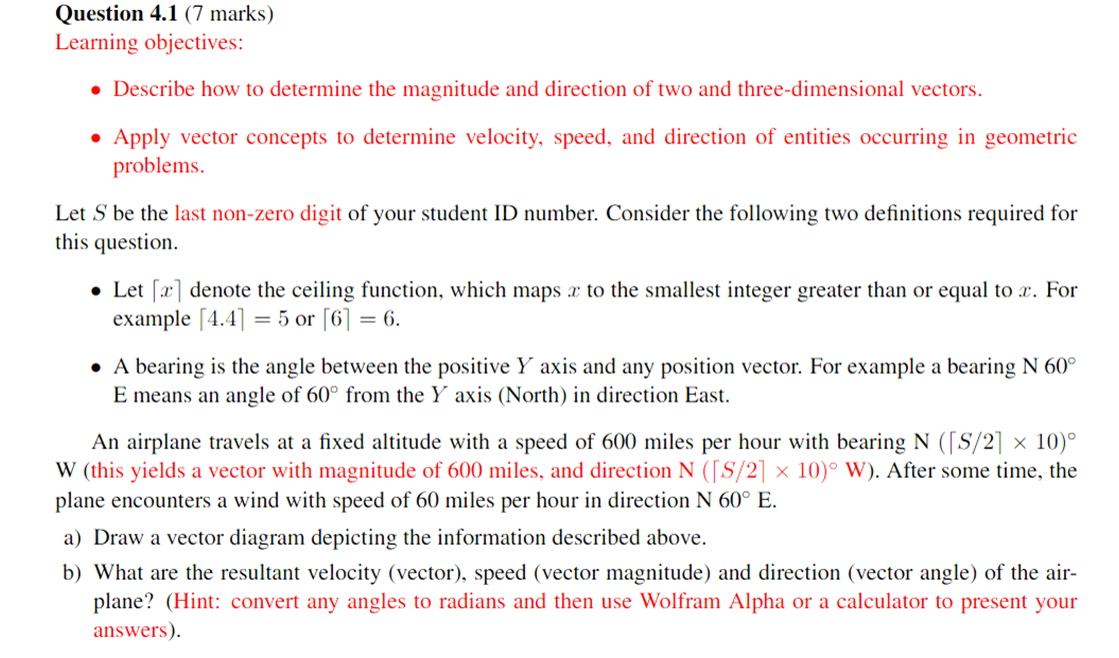
Question 4.1 (7 marks) Learning objectives: . Describe how to determine the magnitude and direction of two and three-dimensional vectors. . Apply vector concepts to determine velocity, speed, and direction of entities occurring in geometric problems. Let S be the last non-zero digit of your student ID number. Consider the following two definitions required for this question. . Let [x ] denote the ceiling function, which maps ax to the smallest integer greater than or equal to r. For example [4.4] = 5 or [6] = 6. . A bearing is the angle between the positive Y axis and any position vector. For example a bearing N 60 E means an angle of 60 from the Y axis (North) in direction East. An airplane travels at a fixed altitude with a speed of 600 miles per hour with bearing N ([S/2] x 10) W (this yields a vector with magnitude of 600 miles, and direction N ([S/2] x 10) W). After some time, the plane encounters a wind with speed of 60 miles per hour in direction N 60 E. a) Draw a vector diagram depicting the information described above. b) What are the resultant velocity (vector), speed ( vector magnitude) and direction (vector angle) of the air- plane? (Hint: convert any angles to radians and then use Wolfram Alpha or a calculator to present your answers)

Step by Step Solution

There are 3 Steps involved in it

1 Expert Approved Answer
Step: 1 Unlock blur-text-image

Question Has Been Solved by an Expert!

Get step-by-step solutions from verified subject matter experts

Step: 2 Unlock
Step: 3 Unlock

Students Have Also Explored These Related Mathematics Questions!