







Question: Question 4.6. With the practical PD controller from (4.11), calculate the transfer function from Xd(s) to X(s) in Fig. 4.5. The transfer function with the
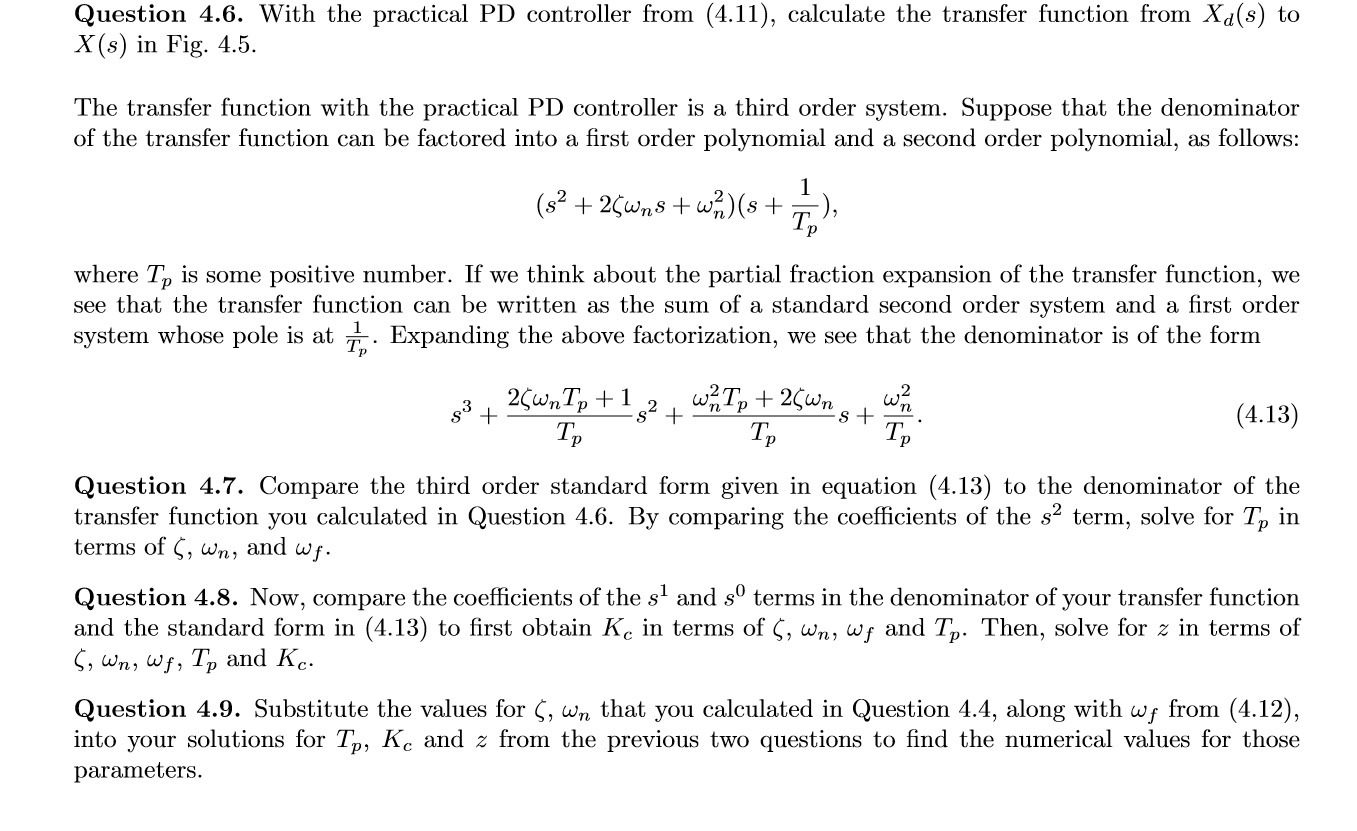
Question 4.6. With the practical PD controller from (4.11), calculate the transfer function from Xd(s) to X(s) in Fig. 4.5. The transfer function with the practical PD controller is a third order system. Suppose that the denominator of the transfer function can be factored into a rst order polynomial and a second order polynomial, as follows: (32 + 2Cwns + wKs + ), where Tp is some positive number. If we think about the partial fraction expansion of the transfer function, we see that the transfer function can be written as the sum of a standard second order system and a rst order system whose pole is at Tip. Expanding the above factorization, we see that the denominator is of the form 33 + 2CwnTp +132 + wTp + 20%.? + (LP'2' (4.13) Tr Tn TP Question 4.7. Compare the third order standard form given in equation (4.13) to the denominator of the transfer function you calculated in Question 4.6. By comparing the coefcients of the 32 term, solve for Tp in terms of C, tan, and wf. Question 4.8. Now, compare the coefcients of the s1 and 50 terms in the denominator of your transfer function and the standard form in (4.13) to rst obtain KC in terms of C, (on, wf and T1,. Then, solve for z in terms of C, mm id}, T? and KC. Question 4.9. Substitute the values for C, can that you calculated in Question 4.4, along with wf from (4.12), into your solutions for Tp, KC and z from the previous two questions to nd the numerical values for those parameters
Step by Step Solution
There are 3 Steps involved in it

Get step-by-step solutions from verified subject matter experts
 Study Help