







Question: question 4-9 2 4. You've just completed a pilot run of 10 units of a major produci atid fouse he he a. Acconding to the
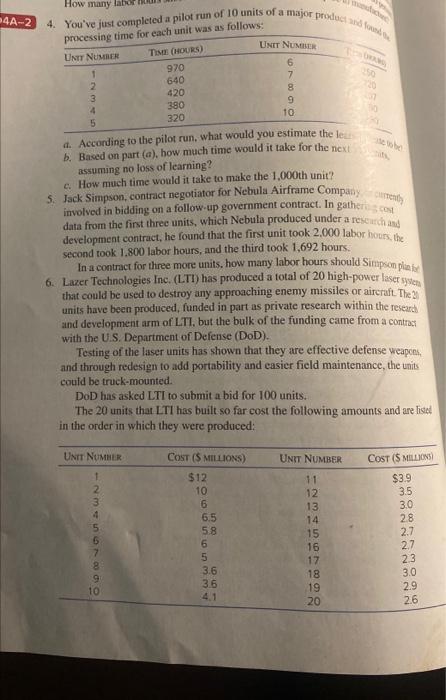
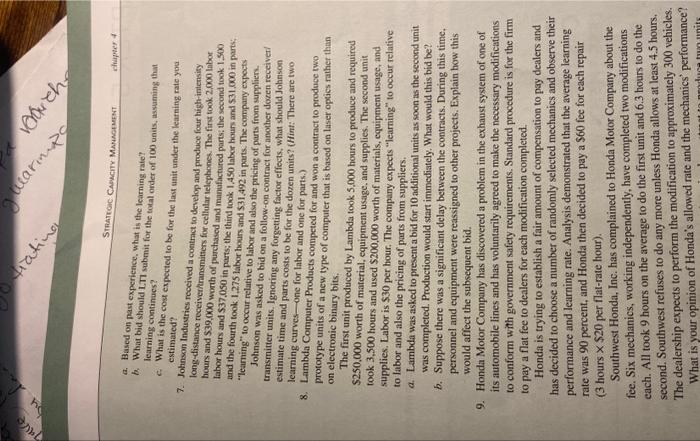
2 4. You've just completed a pilot run of 10 units of a major produci atid fouse he he a. Acconding to the pilot run, what would you esmmate the led b. Based on part (a), how much time would it take for the nexi. assumuing no loss of learning? c. How much time wonld it take to make the 1,000th unit? 5. Jack Simpson, contract negotiator for Nebula Airframe Company altrenily involved in bidding on a follow-up government contract. In gatheri. scoy data from the first three units, which Nebula produced under a rescinch and development contract, he found that the first unit took 2,000 labor hours, the second took 1.800 labor hours, and the third took 1,692 hours. In a contract for three more units, how many labor hours should Sinpson pitafid. 6. Lazer Technologies Inc. (LTI) has produced a total of 20 high-pover laser systenthat could be used to destroy any approaching enemy missiles or aircrat The? units have been produced, funded in part as private research within the researd and development arm of LTT, but the bulk of the funding came from a contras with the U.S. Department of Defense (DoD). Testing of the laser units has shown that they are effective defense weapos. and through redesign to add portability and easicr field maintenance, the units could be truck-mounted. DoD has asked LTI to submit a bid for 100 units. The 20 units that LTI has built so far cost the followine amounts and are fos a. Based on past experience, what is the learning rate? b. What bid should LTI submit for the total order of 100 units, assuming that learning continues? c. What is the cost expected to be for the lact unit under the learning rate you estimated? 7. Johnson Industries received a contract to develop and produce four high-intensity long-distance receiverhmanmitters for cellular lelephones. The firs took 2.000 libor hours and $39,000 worth of purchased and manufactured parts: the second took 1,500 labor hours and $37,050 in parts; the thind took 1,450 laber hours and $31,000 in parts: and the fourth took 1,275 labor hours and $31.492 in perts. The compary expects "learning" to occur relative to labor and also the pricing of parts from supplien. Johnson was asked to bid on a follow-on contract for another doven receivetl transmitter units. Ignoring any forgetting factor effects, what should Johnson estimate time and parts costs to be for the dozen units? (Hint: There are two learning curves one for labor and one for parts.) 8. Lambda Computer Products competed for and won a contract to produce two prototype units of a new type of computer that is based on laser opties rather then on electronic binary bits. The first unit produced by Lambda took 5,000 hours to produce and required $250,000 worth of material, equipment usage, and supplies. The second unit. took 3,500 hours and used $200,000 worth of materials, equipment wage, and supplies. Labor is $30 per bour. The company expects "learning" to occur relative to labor and also the pricing of parts from suppliers. a. Lambda was asked to present a bid for 10 additional units as soon as the second unit was completed. Production would start immediately. What would this bid be? b. Suppose there was a significant delay between the contracts. During this time, personnel and equipment were reassigned to other projects. Explain how this would affect the subsequent bid. 9. Honda Motor Company has discovered a problem in the exhaust system of one of its automobile lines and has voluntarily agreed to make the necessary modifications to conform with government safety requirements. Standard procedure is for the firm to pay a flat fee to dealers for each modification completed. Honda is trying to establish a fair amount of compensation to pay dealers and has decided to choose a number of randomly selected mechanics and observe their performance and learning rate. Analysis demonstrated that the average learning rate was 90 percent, and Honda then decided to pay a $60 fee for each repair ( 3 hours $20 per flat-rate hour). Southwest Honda, Inc. has complained to Honda Motor Company about the fee. Six mechanics, working independently, have completed two modifications each. All took 9 hours on the average to do the first unit and 6.3 hours to do the second. Southwest refuses to do any more unless Honda allows at least 4.5 hours. The dealership expects to perform the modification to approximately 300 vehicles. What is your opinion of Honda's allowed rate and the mechanics' performance? 2 4. You've just completed a pilot run of 10 units of a major produci atid fouse he he a. Acconding to the pilot run, what would you esmmate the led b. Based on part (a), how much time would it take for the nexi. assumuing no loss of learning? c. How much time wonld it take to make the 1,000th unit? 5. Jack Simpson, contract negotiator for Nebula Airframe Company altrenily involved in bidding on a follow-up government contract. In gatheri. scoy data from the first three units, which Nebula produced under a rescinch and development contract, he found that the first unit took 2,000 labor hours, the second took 1.800 labor hours, and the third took 1,692 hours. In a contract for three more units, how many labor hours should Sinpson pitafid. 6. Lazer Technologies Inc. (LTI) has produced a total of 20 high-pover laser systenthat could be used to destroy any approaching enemy missiles or aircrat The? units have been produced, funded in part as private research within the researd and development arm of LTT, but the bulk of the funding came from a contras with the U.S. Department of Defense (DoD). Testing of the laser units has shown that they are effective defense weapos. and through redesign to add portability and easicr field maintenance, the units could be truck-mounted. DoD has asked LTI to submit a bid for 100 units. The 20 units that LTI has built so far cost the followine amounts and are fos a. Based on past experience, what is the learning rate? b. What bid should LTI submit for the total order of 100 units, assuming that learning continues? c. What is the cost expected to be for the lact unit under the learning rate you estimated? 7. Johnson Industries received a contract to develop and produce four high-intensity long-distance receiverhmanmitters for cellular lelephones. The firs took 2.000 libor hours and $39,000 worth of purchased and manufactured parts: the second took 1,500 labor hours and $37,050 in parts; the thind took 1,450 laber hours and $31,000 in parts: and the fourth took 1,275 labor hours and $31.492 in perts. The compary expects "learning" to occur relative to labor and also the pricing of parts from supplien. Johnson was asked to bid on a follow-on contract for another doven receivetl transmitter units. Ignoring any forgetting factor effects, what should Johnson estimate time and parts costs to be for the dozen units? (Hint: There are two learning curves one for labor and one for parts.) 8. Lambda Computer Products competed for and won a contract to produce two prototype units of a new type of computer that is based on laser opties rather then on electronic binary bits. The first unit produced by Lambda took 5,000 hours to produce and required $250,000 worth of material, equipment usage, and supplies. The second unit. took 3,500 hours and used $200,000 worth of materials, equipment wage, and supplies. Labor is $30 per bour. The company expects "learning" to occur relative to labor and also the pricing of parts from suppliers. a. Lambda was asked to present a bid for 10 additional units as soon as the second unit was completed. Production would start immediately. What would this bid be? b. Suppose there was a significant delay between the contracts. During this time, personnel and equipment were reassigned to other projects. Explain how this would affect the subsequent bid. 9. Honda Motor Company has discovered a problem in the exhaust system of one of its automobile lines and has voluntarily agreed to make the necessary modifications to conform with government safety requirements. Standard procedure is for the firm to pay a flat fee to dealers for each modification completed. Honda is trying to establish a fair amount of compensation to pay dealers and has decided to choose a number of randomly selected mechanics and observe their performance and learning rate. Analysis demonstrated that the average learning rate was 90 percent, and Honda then decided to pay a $60 fee for each repair ( 3 hours $20 per flat-rate hour). Southwest Honda, Inc. has complained to Honda Motor Company about the fee. Six mechanics, working independently, have completed two modifications each. All took 9 hours on the average to do the first unit and 6.3 hours to do the second. Southwest refuses to do any more unless Honda allows at least 4.5 hours. The dealership expects to perform the modification to approximately 300 vehicles. What is your opinion of Honda's allowed rate and the mechanics' performance
Step by Step Solution
There are 3 Steps involved in it

Get step-by-step solutions from verified subject matter experts
 Study Help