







Question: QUESTION 5 ( 1 1 ) The primary database, consisting of 1 0 0 observations on 1 8 separate variables, is based on a market
QUESTION
The primary database, consisting of observations on separate variables, is based on a market segmentation study of HBAT customers. HBAT sells paper products to two market segments: the newsprint industry and the magazine industry. Also, paper products are sold to these market segments either directly to the customer or indirectly through a broker. Two types of information were collected in the surveys. The first type of information was perceptions of HBAT's performance on
STA
attributes. These attributes, developed through focus groups, a pretest, and used in previous studies, are the most influential in the selection of suppliers in the paper industry. Respondents included purchasing managers of firms buying from HBAT, and they rated HBAT on each of the attributes using a scale, with being "Excellent" and being "Poor". The second type of information relates to purchase outcomes and business relationships eg satisfaction with HBAT and whether the firm would consider a strategic alliancepartnership with HBAT A third type of information is available from HBAT's data warehouse and includes information such as size of customer and length of purchase relationship.
Exploratory factor analysis can identify the structure of a set of variables as well as provide a process for data reduction. In our example, the perceptions of HBAT on attributes X to X are examined for the following reasons:
Data Summarization with Interpretation Understand whether these perceptions can be "grouped". Even the relatively small number of perceptions examined here presents a complex picture of separate correlations. By grouping the perceptions and then engaging in the steps of factor interpretation, HBAT will be able to see the big picture in terms of understanding its customers and what dimensions the customers think about HBAT.
Data Reduction Reduce the variables to a smaller number of composite factors. If the variables can be represented in a smaller number of composite variables, then the other multivariate techniques can be made more parsimonious. Of course, this approach assumes that a certain degree of underlying order exists in the data being analysed.
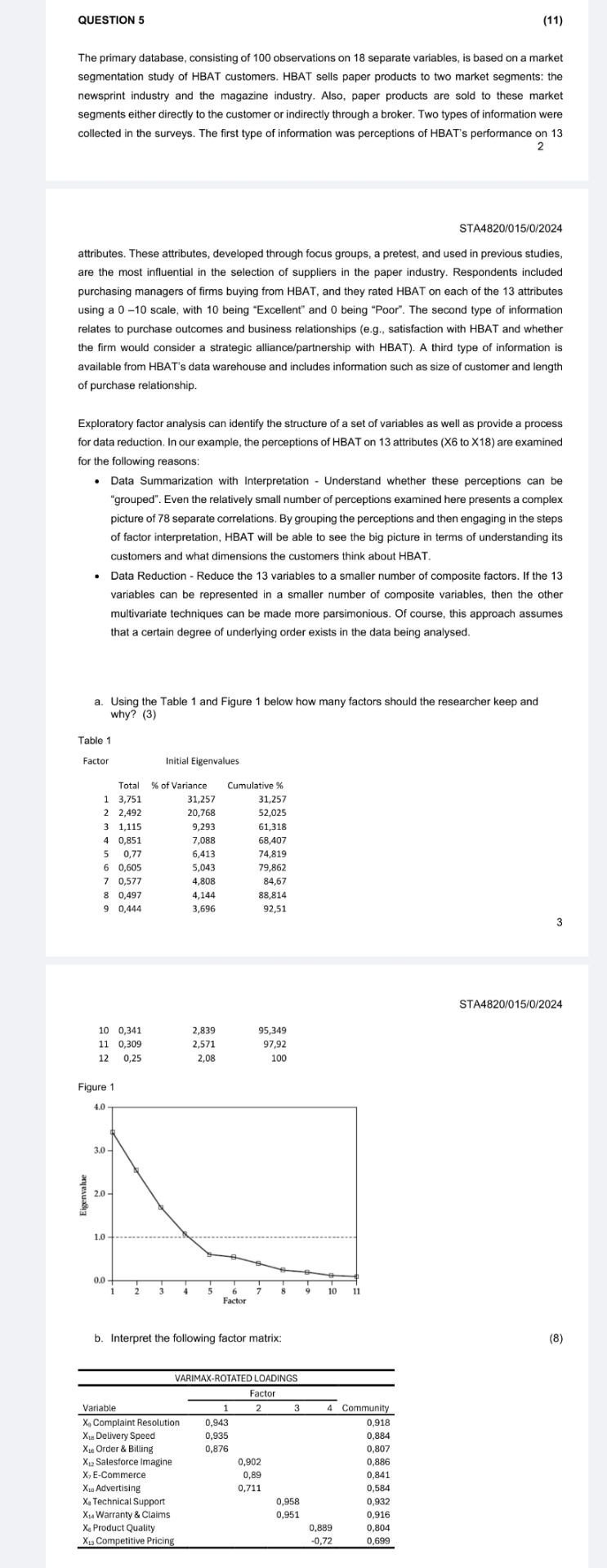
a Using the Table and Figure below how many factors should the researcher keep and why?
Table
tableFactorInitial EigenvaluesTotal, of Variance,Cumulative
b Interpret the following factor matrix:
tableVARIMAXROTATED LOADINGSVariableFactor,Community Complaint Resolution, Delivery Speed, Order & Billing, Salestorce Imagine,,Commerce,, Advertising,, Technical Support,,, Warranty & Claims,,, Product Quality,,,, Competitive Pricing,,,,
Step by Step Solution
There are 3 Steps involved in it
1 Expert Approved Answer
Step: 1 Unlock

Question Has Been Solved by an Expert!
Get step-by-step solutions from verified subject matter experts
Step: 2 Unlock
Step: 3 Unlock
 Study Help