



Question: Question 5 (10 points): Consider the following hypothetical difference-in-differences results concerning the average of hours worked in big-box stores between North and South Dakota before
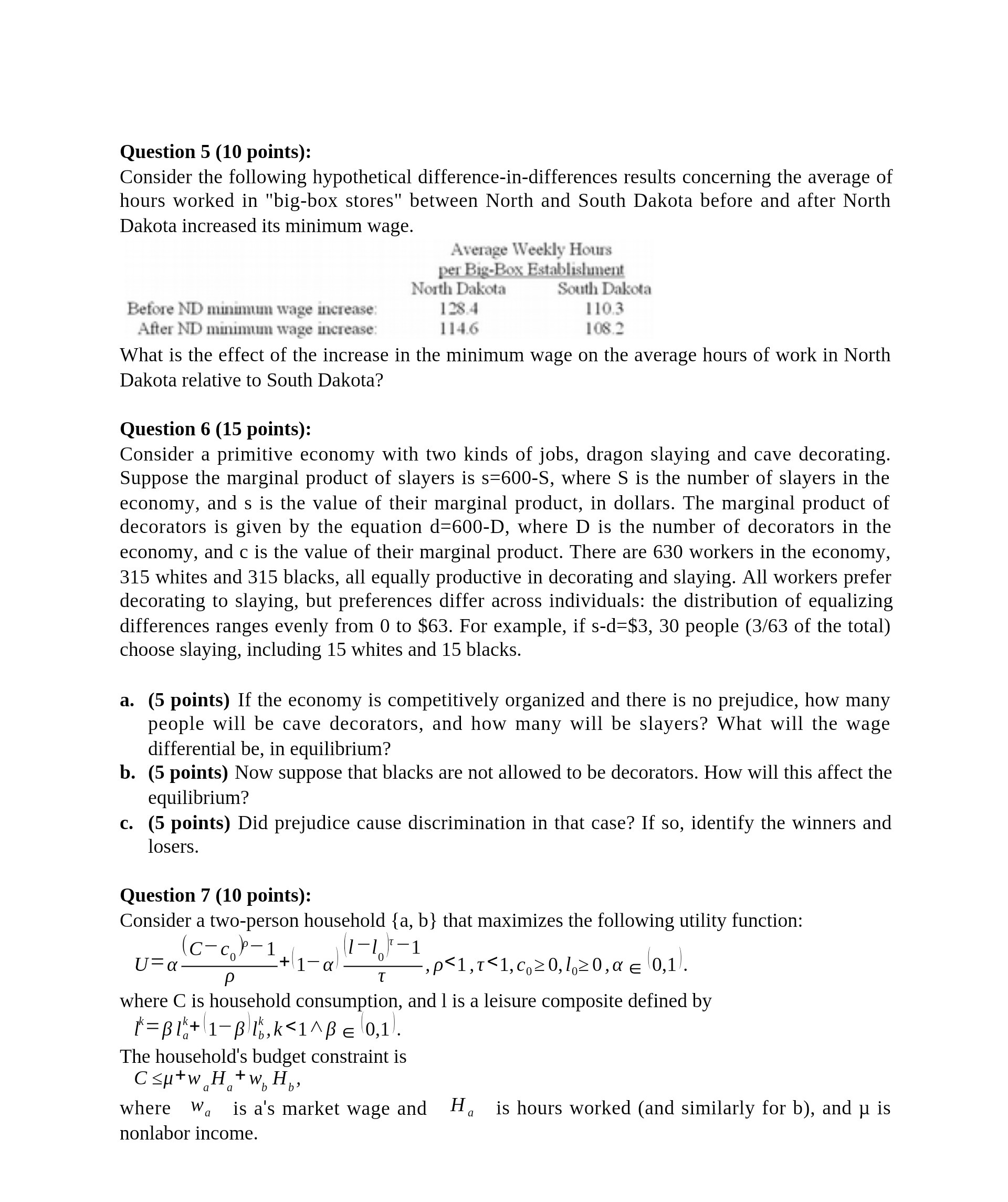
Question 5 (10 points): Consider the following hypothetical difference-in-differences results concerning the average of hours worked in "big-box stores" between North and South Dakota before and after North Dakota increased its minimum wage. Arc-lag: Weekly Home North Dakota South Dakota Before ND nmmmun was: Income I28 4 l l0 3 Aer ND mummun wage Inctem l H 6 ICE 2 What is the effect of the increase in the minimum wage on the average hours of work in North Dakota relative to South Dakota? Question 6 (15 points): Consider a primitive economy with two kinds of jobs, dragon slaying and cave decorating. Suppose the marginal product of slayers is 5:6005, where S is the number of slayers in the economy, and s is the value of their marginal product, in dollars. The marginal product of decorators is given by the equation d=600D, where D is the number of decorators in the economy, and c is the value of their marginal product. There are 630 workers in the economy, 315 whites and 315 blacks, all equally productive in decorating and slaying. All workers prefer decorating to slaying, but preferences differ across individuals: the distribution of equalizing differences ranges evenly from 0 to $63. For example, if s-d=$3, 30 people (3/63 of the total) choose slaying, including 15 whites and 15 blacks. a. (5 points) If the economy is competitively organized and there is no prejudice, how many people will be cave decorators, and how many will be slayers? What will the wage differential be, in equilibrium? b. (5 points) Now suppose that blacks are not allowed to be decorators. How will this affect the equilibrium? c. (5 points) Did prejudice cause discrimination in that case? If so, identify the winners and losers. Question 7 (10 points): Consider a two-person household {a, b} that maximizes the following utility function: l 'l r'1 (C CO)" 1+(1_a]( 0) p I where C is household consumption, and l is a leisure composite defined by 1\"=31+(13l1';,k
Step by Step Solution
There are 3 Steps involved in it

Get step-by-step solutions from verified subject matter experts