







Question: QUESTION 5 5.1 IDENTIFY AND ELABORATE ON THE OBVIOUS RISKS 5.2 WHAT EARLY ACTIONS SHOULD HAVE BEEN TAKEN TO REDUCE THE RISKS? 5.3 DISCUSS SOME
QUESTION 5
5.1 IDENTIFY AND ELABORATE ON THE OBVIOUS RISKS 5.2 WHAT EARLY ACTIONS SHOULD HAVE BEEN TAKEN TO REDUCE THE RISKS? 5.3 DISCUSS SOME PRINCIPLES OF RISKS MANAGEMENT THAT WERE IGNORED
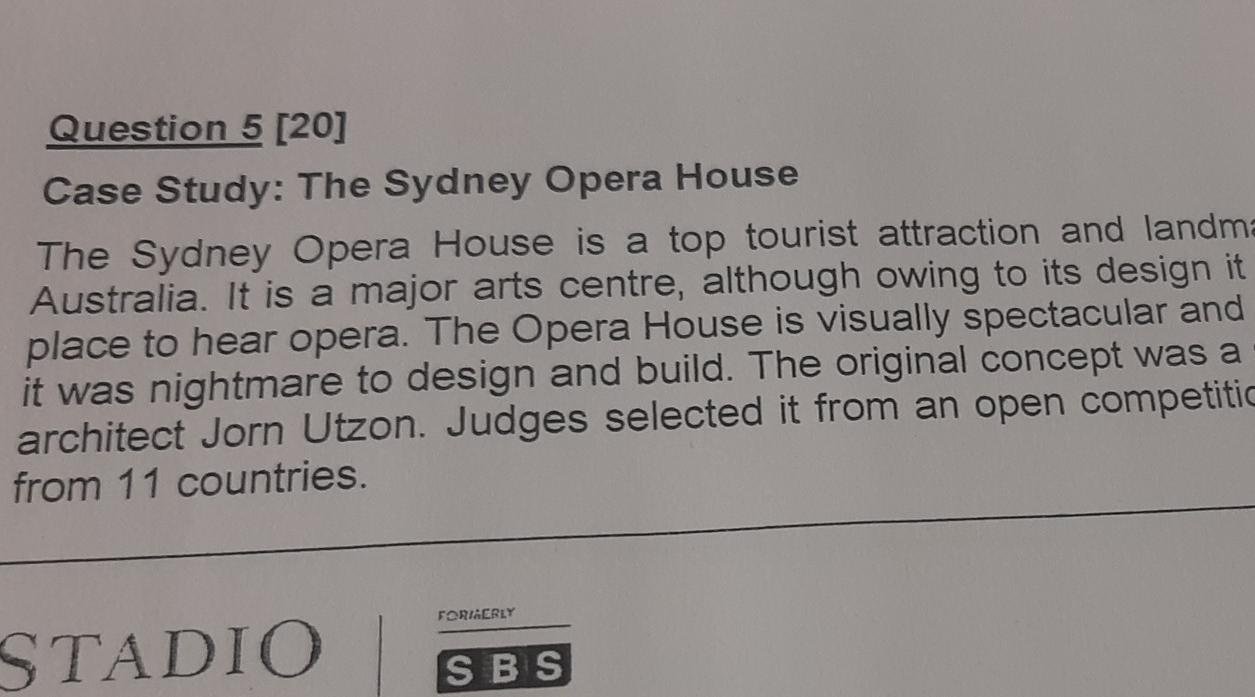
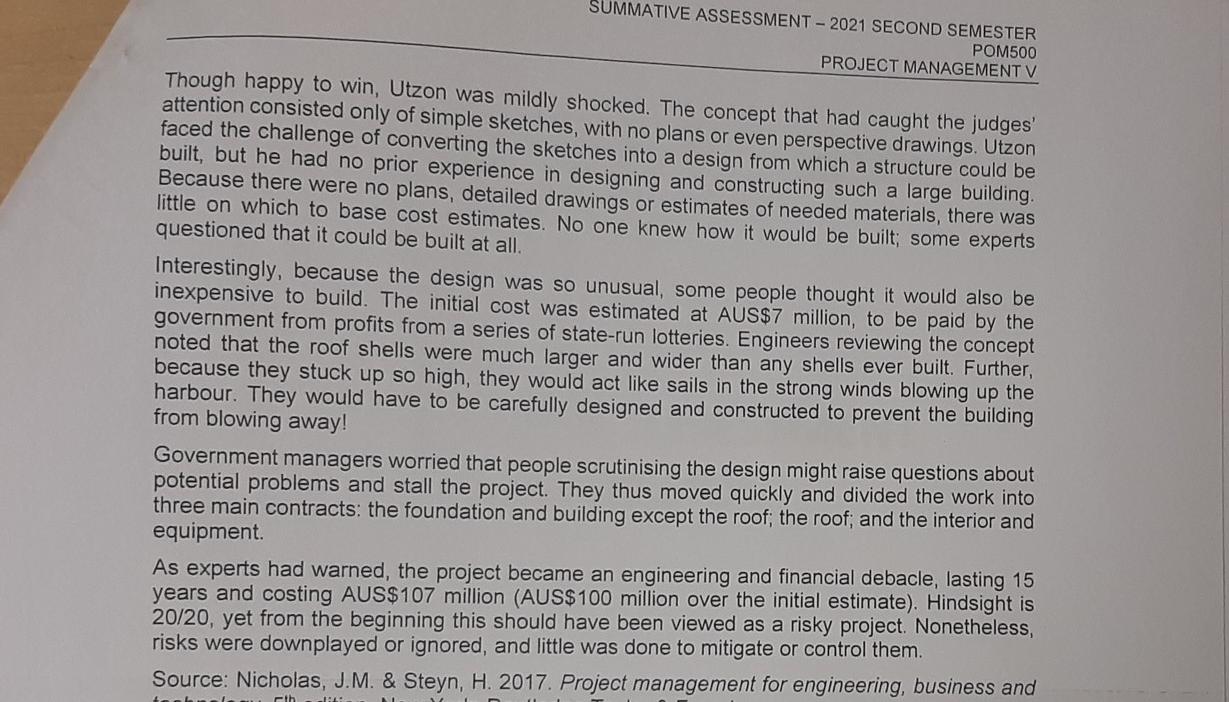
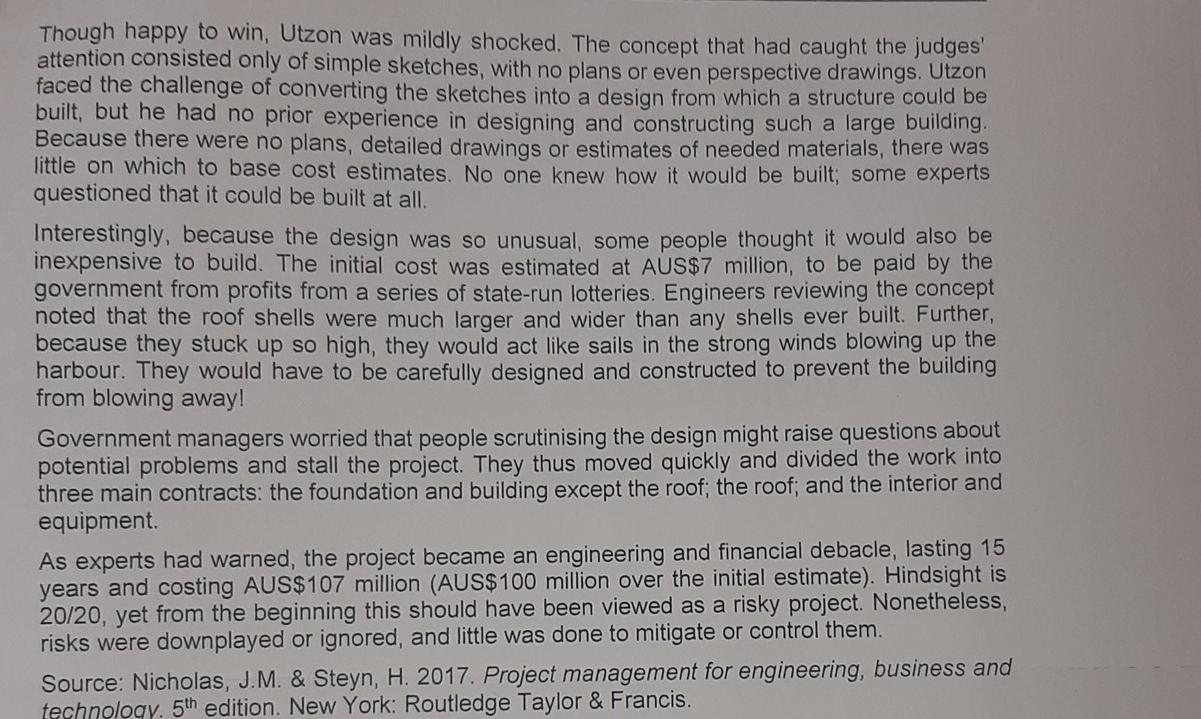
Question 5 [20] Case Study: The Sydney Opera House The Sydney Opera House is a top tourist attraction and landma Australia. It is a major arts centre, although owing to its design it place to hear opera. The Opera House is visually spectacular and it was nightmare to design and build. The original concept was a architect Jorn Utzon. Judges selected it from an open competitic from 11 countries. FORTACRLY STADIO SBS SUMMATIVE ASSESSMENT - 2021 SECOND SEMESTER POM500 PROJECT MANAGEMENT V Though happy to win, Utzon was mildly shocked. The concept that had caught the judges' attention consisted only of simple sketches, with no plans or even perspective drawings. Utzon faced the challenge of converting the sketches into a design from which a structure could be built, but he had no prior experience in designing and constructing such a large building. Because there were no plans, detailed drawings or estimates of needed materials, there was little on which to base cost estimates. No one knew how it would be built; some experts questioned that it could be built at all. Interestingly, because the design was so unusual, some people thought it would also be inexpensive to build. The initial cost was estimated at AUS$7 million, to be paid by the government from profits from a series of state-run lotteries. Engineers reviewing the concept noted that the roof shells were much larger and wider than any shells ever built. Further, because they stuck up so high, they would act like sails in the strong winds blowing up the harbour. They would have to be carefully designed and constructed to prevent the building from blowing away! Government managers worried that people scrutinising the design might raise questions about potential problems and stall the project. They thus moved quickly and divided the work into three main contracts: the foundation and building except the roof; the roof; and the interior and equipment As experts had warned, the project became an engineering and financial debacle, lasting 15 years and costing AUS$107 million (AUS$ 100 million over the initial estimate). Hindsight is 20/20, yet from the beginning this should have been viewed as a risky project. Nonetheless, risks were downplayed or ignored, and little was done to mitigate or control them. Source: Nicholas, J.M. & Steyn, H. 2017. Project management for engineering, business and Though happy to win, Utzon was mildly shocked. The concept that had caught the judges' attention consisted only of simple sketches, with no plans or even perspective drawings. Utzon faced the challenge of converting the sketches into a design from which a structure could be built, but he had no prior experience in designing and constructing such a large building. Because there were no plans, detailed drawings or estimates of needed materials, there was little on which to base cost estimates. No one knew how it would be built; some experts questioned that it could be built at all. Interestingly, because the design was so unusual, some people thought it would also be inexpensive to build. The initial cost was estimated at AUS$7 million, to be paid by the government from profits from a series of state-run lotteries. Engineers reviewing the concept noted that the roof shells were much larger and wider than any shells ever built. Further, because they stuck up so high, they would act like sails in the strong winds blowing up the harbour. They would have to be carefully designed and constructed to prevent the building from blowing away! Government managers worried that people scrutinising the design might raise questions about potential problems and stall the project. They thus moved quickly and divided the work into three main contracts: the foundation and building except the roof; the roof; and the interior and equipment. As experts had warned, the project became an engineering and financial debacle, lasting 15 years and costing AUS$107 million (AUS$ 100 million over the initial estimate). Hindsight is 20/20, yet from the beginning this should have been viewed as a risky project. Nonetheless, risks were downplayed or ignored, and little was done to mitigate or control them. Source: Nicholas, J.M. & Steyn, H. 2017. Project management for engineering, business and technology. 5th edition. New York: Routledge Taylor & Francis
Step by Step Solution
There are 3 Steps involved in it
1 Expert Approved Answer
Step: 1 Unlock

Question Has Been Solved by an Expert!
Get step-by-step solutions from verified subject matter experts
Step: 2 Unlock
Step: 3 Unlock
 Study Help