







Question: Question 5 ( 6 0 points ) Consider the following maze. The successors of each cell are the adjacent cells in the directions North (
Question points
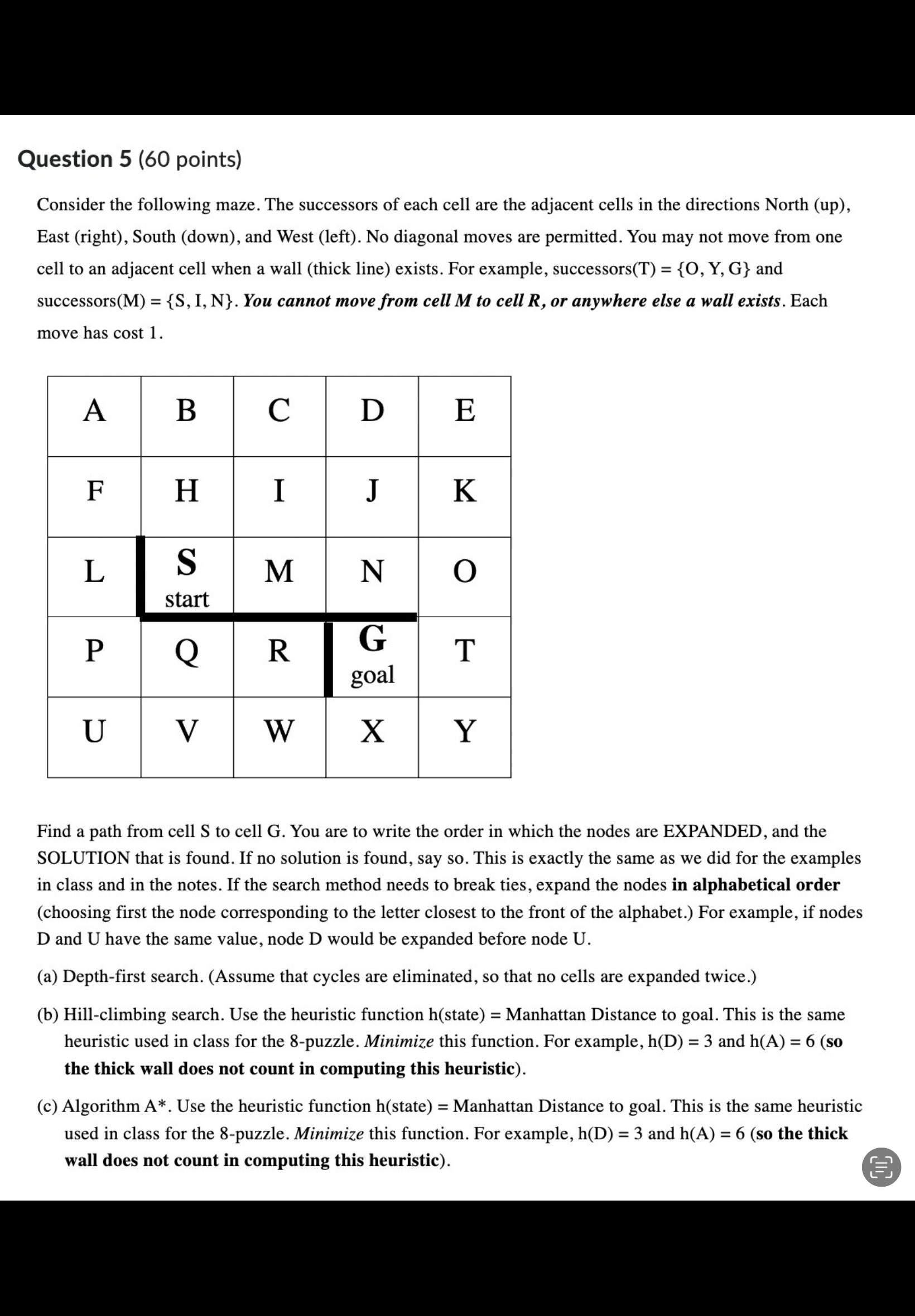
Consider the following maze. The successors of each cell are the adjacent cells in the directions North up
East right South down and West left No diagonal moves are permitted. You may not move from one
cell to an adjacent cell when a wall thick line exists. For example, successors and
successors I, You cannot move from cell M to cell or anywhere else a wall exists. Each
move has cost
Find a path from cell to cell You are to write the order in which the nodes are EXPANDED, and the
SOLUTION that is found. If no solution is found, say so This is exactly the same as we did for the examples
in class and in the notes. If the search method needs to break ties, expand the nodes in alphabetical order
choosing first the node corresponding to the letter closest to the front of the alphabet. For example, if nodes
and have the same value, node would be expanded before node
a Depthfirst search. Assume that cycles are eliminated, so that no cells are expanded twice.
b Hillclimbing search. Use the heuristic function hstate Manhattan Distance to goal. This is the same
heuristic used in class for the puzzle. Minimize this function. For example, and so
the thick wall does not count in computing this heuristic
c Algorithm A Use the heuristic function hstate Manhattan Distance to goal. This is the same heuristic
used in class for the puzzle. Minimize this function. For example, and so the thick
wall does not count in computing this heuristic
Step by Step Solution
There are 3 Steps involved in it
1 Expert Approved Answer
Step: 1 Unlock

Question Has Been Solved by an Expert!
Get step-by-step solutions from verified subject matter experts
Step: 2 Unlock
Step: 3 Unlock
 Study Help