







Question: Question 5 - 7 ( ANSWER ANY TWO * ) * - If you answer 3 , then best of 2 will be considered Q
Question ANSWER ANY TWO If you answer then best of will be considered
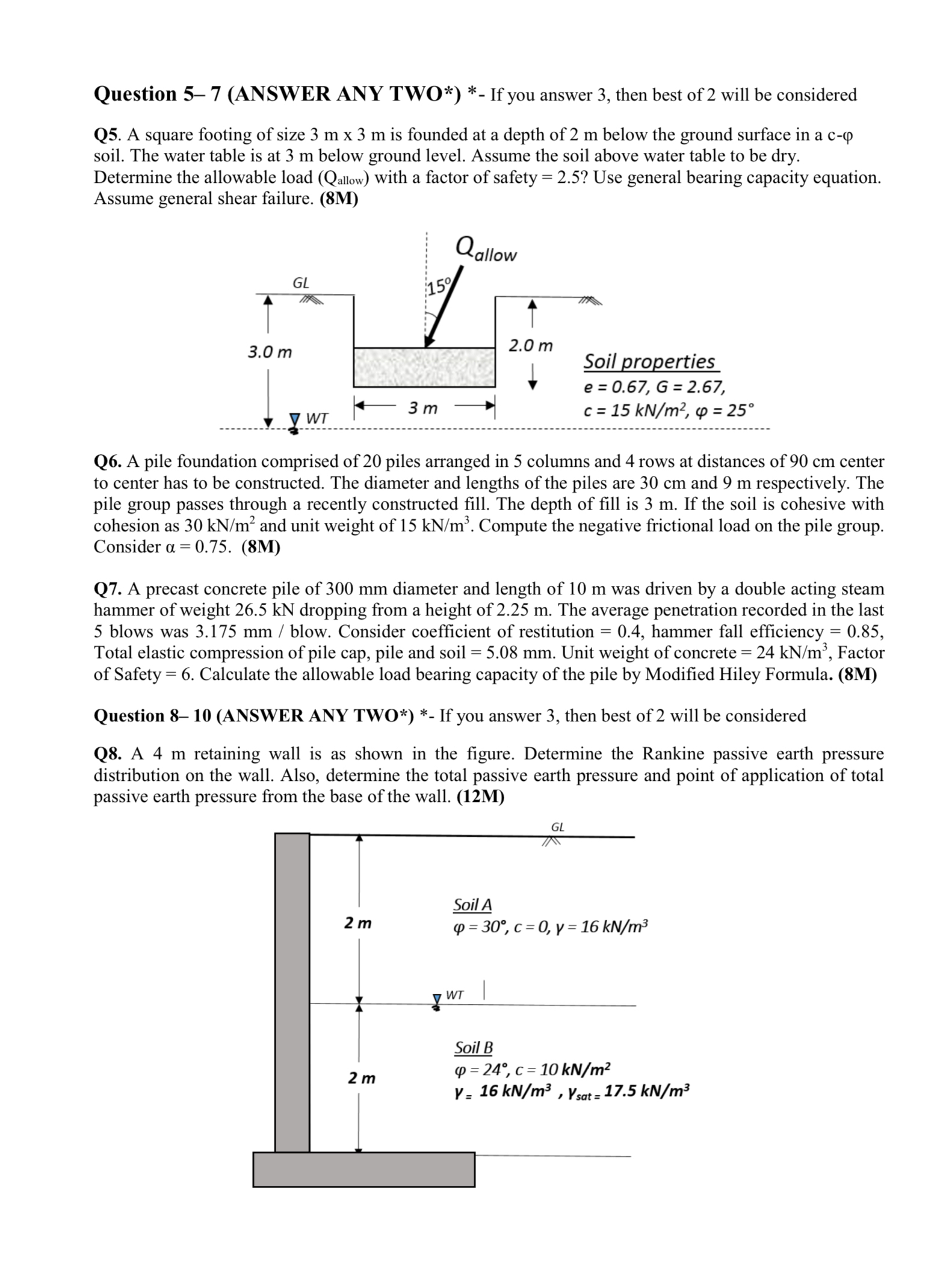
Q A square footing of size is founded at a depth of m below the ground surface in a c soil. The water table is at m below ground level. Assume the soil above water table to be dry. Determine the allowable load with a factor of safety Use general bearing capacity equation. Assume general shear failure. M
Q A pile foundation comprised of piles arranged in columns and rows at distances of cm center to center has to be constructed. The diameter and lengths of the piles are cm and m respectively. The pile group passes through a recently constructed fill. The depth of fill is m If the soil is cohesive with cohesion as and unit weight of Compute the negative frictional load on the pile group. Consider M
Q A precast concrete pile of mm diameter and length of m was driven by a double acting steam hammer of weight kN dropping from a height of m The average penetration recorded in the last blows was blow. Consider coefficient of restitution hammer fall efficiency Total elastic compression of pile cap, pile and soil Unit weight of concrete Factor of Safety Calculate the allowable load bearing capacity of the pile by Modified Hiley Formula. M
Question ANSWER ANY TWO If you answer then best of will be considered
Q A m retaining wall is as shown in the figure. Determine the Rankine passive earth pressure distribution on the wall. Also, determine the total passive earth pressure and point of application of total passive earth pressure from the base of the wall. M
Step by Step Solution
There are 3 Steps involved in it
1 Expert Approved Answer
Step: 1 Unlock

Question Has Been Solved by an Expert!
Get step-by-step solutions from verified subject matter experts
Step: 2 Unlock
Step: 3 Unlock
 Study Help