



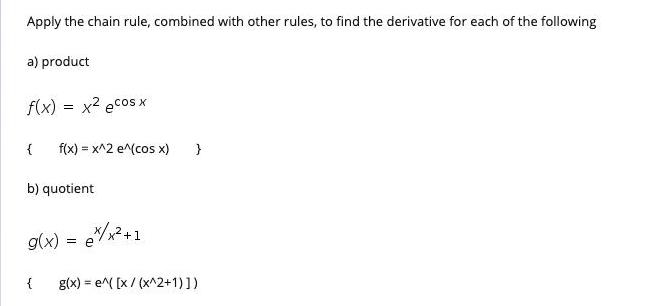
Question: Apply the chain rule, combined with other rules, to find the derivative for each of the following a) product f(x) = x2 ecos x

![g(x) = e^ [x / (x^2+1)]) %3! QUESTION 6 Apply the chain](https://dsd5zvtm8ll6.cloudfront.net/si.experts.images/questions/2021/04/608b64594dfec_ScreenShot20210429at9.58.44PM.png)
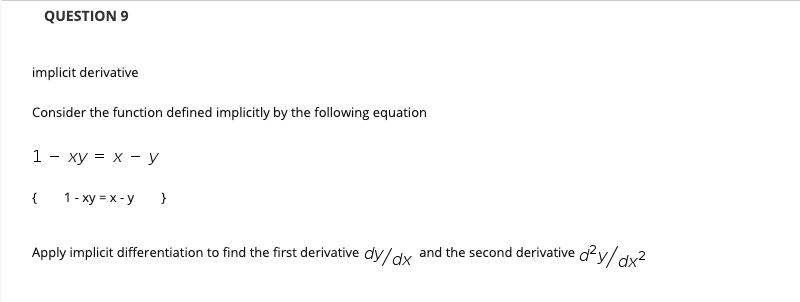
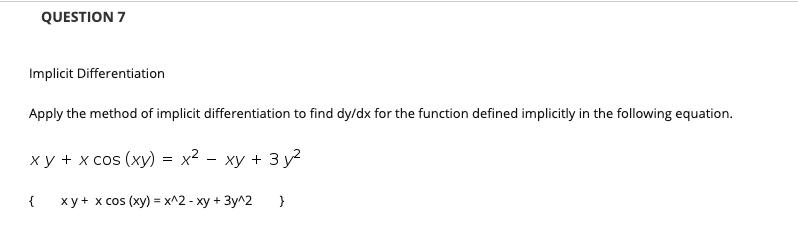
Apply the chain rule, combined with other rules, to find the derivative for each of the following a) product f(x) = x2 ecos x { f(x) = x^2 e^(cos x) } b) quotient g(x) %D { g(x) = e^ [x / (x^2+1)]) %3! QUESTION 6 Apply the chain rule and other rules to find the given derivatives of the function f(x) given by f(x) = sin? (Tx/2) { f(x) = [sin ((pi)x/2) 1^2 %3D f'(x), f"(x), and f"(x) QUESTION 7 Implicit Differentiation Apply the method of implicit differentiation to find dy/dx for the function defined implicitly in the following equation. +x os () %3D 2 - + 3? { xy+ x cos (xy) = x^2 - xy + 3y^2 } %3D QUESTION 8 Implicit derivative Find the equation of the tangent line at (1,3) to the graph of the function defined implicitly in the equation given below. y3 - x3 = 2 x2 y + 2 x y? + 2 { y^3 - x^3 = 2 x^2 y + 2 x y^2 + 2 } QUESTION 9 implicit derivative Consider the function defined implicitly by the following equation 1 - %3D { 1- - } Apply implicit differentiation to find the first derivative dy/dx and the second derivative dy/dx2
Step by Step Solution
3.53 Rating (143 Votes )
There are 3 Steps involved in it

Get step-by-step solutions from verified subject matter experts