







Question: Question 5 Consider an ideal polymer pulling experiment as depicted below. {9 VLEHF L The point at left is taken to be xed and a
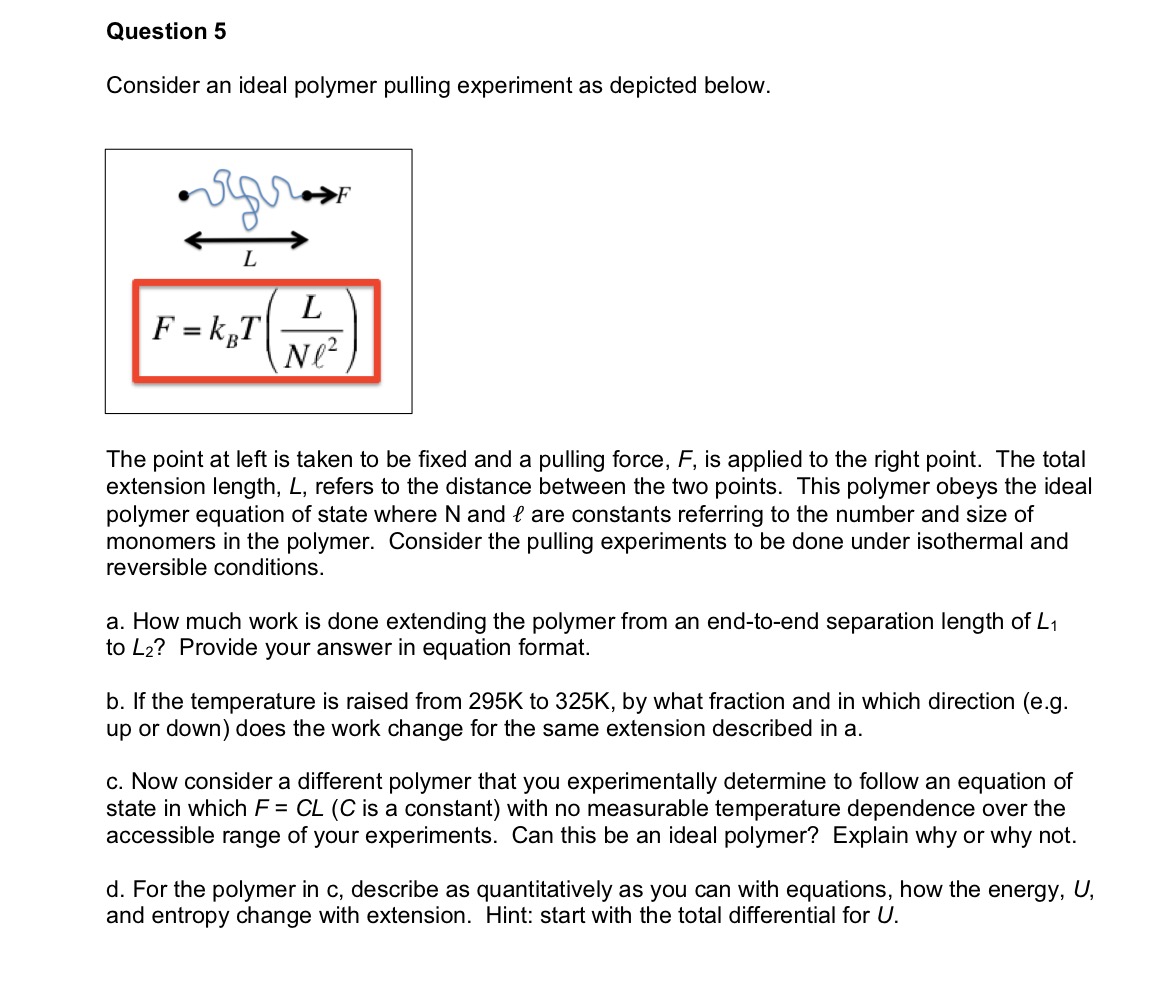
Question 5 Consider an ideal polymer pulling experiment as depicted below. {9 V\\L\\E\\HF L The point at left is taken to be xed and a pulling force, F, is applied to the right point. The total extension length, L, refers to the distance between the two points. This polymer obeys the ideal polymer equation of state where N and 8 are constants referring to the number and size of monomers in the polymer. Consider the pulling experiments to be done under isothermal and reversible conditions. a. How much work is done extending the polymerfrom an end-to-end separation length of L1 to L2? Provide your answer in equation format. b. If the temperature is raised from 295K to 325K, by what fraction and in which direction (e.g. up or down) does the work change for the same extension described in a. c. Now consider a different polymer that you experimentally determine to follow an equation of state in which F = Cl. (C is a constant) with no measurable temperature dependence over the accessible range of your experiments. Can this be an ideal polymer? Explain why or why not. d. For the polymer in c, describe as quantitatively as you can with equations, how the energy, U, and entropy change with extension. Hint: start with the total differential for U
Step by Step Solution
There are 3 Steps involved in it

Get step-by-step solutions from verified subject matter experts
 Study Help