







Question: Question 5 : Discovering Frequent Flyer Groups with DBSCAN ( Density - Based Spatial Clustering of Applications with Noise ) . ( 2 0 points
Question : Discovering Frequent Flyer Groups with DBSCAN DensityBased Spatial Clustering of Applications with Noise points
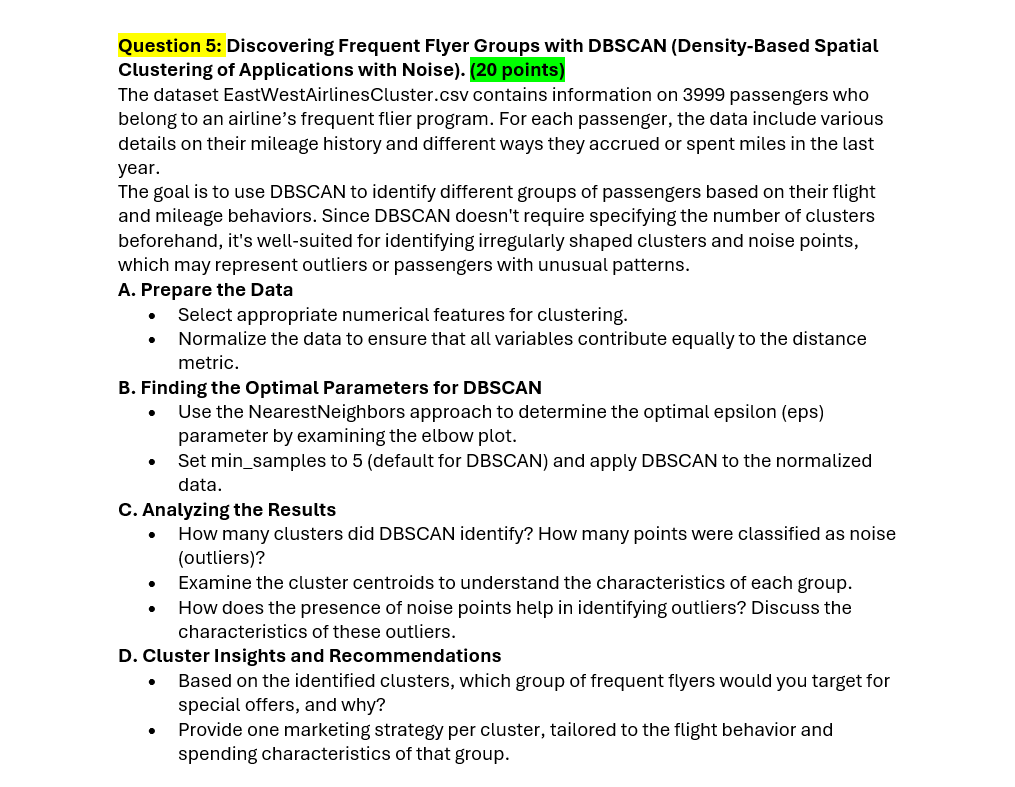
The dataset EastWestAirlinesCluster.csv contains information on passengers who belong to an airline's frequent flier program. For each passenger, the data include various details on their mileage history and different ways they accrued or spent miles in the last year.
The goal is to use DBSCAN to identify different groups of passengers based on their flight and mileage behaviors. Since DBSCAN doesn't require specifying the number of clusters beforehand, it's wellsuited for identifying irregularly shaped clusters and noise points, which may represent outliers or passengers with unusual patterns.
A Prepare the Data
Select appropriate numerical features for clustering.
Normalize the data to ensure that all variables contribute equally to the distance metric.
B Finding the Optimal Parameters for DBSCAN
Use the NearestNeighbors approach to determine the optimal epsilon eps parameter by examining the elbow plot.
Set minsamples to default for DBSCAN and apply DBSCAN to the normalized data.
C Analyzing the Results
How many clusters did DBSCAN identify? How many points were classified as noise outliers
Examine the cluster centroids to understand the characteristics of each group.
How does the presence of noise points help in identifying outliers? Discuss the characteristics of these outliers.
D Cluster Insights and Recommendations
Based on the identified clusters, which group of frequent flyers would you target for special offers, and why?
Provide one marketing strategy per cluster, tailored to the flight behavior and spending characteristics of that group.
Step by Step Solution
There are 3 Steps involved in it
1 Expert Approved Answer
Step: 1 Unlock

Question Has Been Solved by an Expert!
Get step-by-step solutions from verified subject matter experts
Step: 2 Unlock
Step: 3 Unlock
 Study Help