







Question: Question 5: In this question we will discuss the multiplicative properties of the Euler - function. For a given positive integer n let Un
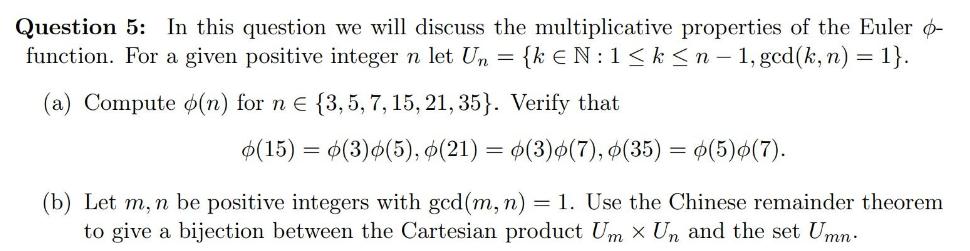
Question 5: In this question we will discuss the multiplicative properties of the Euler - function. For a given positive integer n let Un = {k N:1kn-1, gcd(k, n) = 1}. (a) Compute (n) for n {3,5,7, 15, 21, 35). Verify that (15) = (3)o(5), (21) = (3)o(7), (35) = (5)o(7). (b) Let m, n be positive integers with ged(m, n) = 1. Use the Chinese remainder theorem to give a bijection between the Cartesian product Um x Un and the set Umn. Question 5: In this question we will discuss the multiplicative properties of the Euler - function. For a given positive integer n let Un = {k N:1kn-1, gcd(k, n) = 1}. (a) Compute (n) for n {3,5,7, 15, 21, 35). Verify that (15) = (3)o(5), (21) = (3)o(7), (35) = (5)o(7). (b) Let m, n be positive integers with ged(m, n) = 1. Use the Chinese remainder theorem to give a bijection between the Cartesian product Um x Un and the set Umn. Question 5: In this question we will discuss the multiplicative properties of the Euler - function. For a given positive integer n let Un = {k N:1kn-1, gcd(k, n) = 1}. (a) Compute (n) for n {3,5,7, 15, 21, 35). Verify that (15) = (3)o(5), (21) = (3)o(7), (35) = (5)o(7). (b) Let m, n be positive integers with ged(m, n) = 1. Use the Chinese remainder theorem to give a bijection between the Cartesian product Um x Un and the set Umn. Question 5: In this question we will discuss the multiplicative properties of the Euler - function. For a given positive integer n let Un = {k N:1kn-1, gcd(k, n) = 1}. (a) Compute (n) for n {3,5,7, 15, 21, 35). Verify that (15) = (3)o(5), (21) = (3)o(7), (35) = (5)o(7). (b) Let m, n be positive integers with ged(m, n) = 1. Use the Chinese remainder theorem to give a bijection between the Cartesian product Um x Un and the set Umn. Question 5: In this question we will discuss the multiplicative properties of the Euler - function. For a given positive integer n let Un = {k N:1kn-1, gcd(k, n) = 1}. (a) Compute (n) for n {3,5,7, 15, 21, 35). Verify that (15) = (3)o(5), (21) = (3)o(7), (35) = (5)o(7). (b) Let m, n be positive integers with ged(m, n) = 1. Use the Chinese remainder theorem to give a bijection between the Cartesian product Um x Un and the set Umn. Question 5: In this question we will discuss the multiplicative properties of the Euler - function. For a given positive integer n let Un = {k N:1kn-1, gcd(k, n) = 1}. (a) Compute (n) for n {3,5,7, 15, 21, 35). Verify that (15) = (3)o(5), (21) = (3)o(7), (35) = (5)o(7). (b) Let m, n be positive integers with ged(m, n) = 1. Use the Chinese remainder theorem to give a bijection between the Cartesian product Um x Un and the set Umn.
Step by Step Solution
3.49 Rating (156 Votes )
There are 3 Steps involved in it
The answer provided below has been developed in a clear step by step manner Step 1 a We have Euler f... View full answer

Get step-by-step solutions from verified subject matter experts
 Study Help