







Question: Question 5: Let pi, p2, .. . , Ps, q1.92,.. ..% be real numbes such that each p, is strictly positive, each g, is strictly
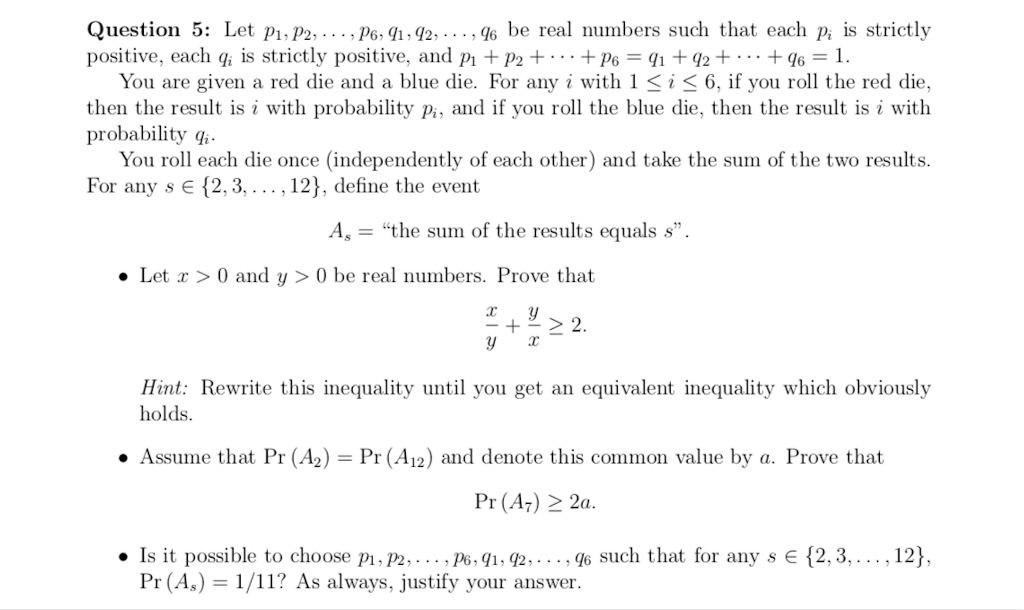
Question 5: Let pi, p2, .. . , Ps, q1.92,.. ..% be real numbes such that each p, is strictly positive, each g, is strictly positive, and Pi + Pe+ . . . +Pc = qi +q2 + . . . +96-1. You are given a red die and a blue die. For any i with 1 0 be real numbers. Prove that Hint: Rewrite this inequality until you get an equivalent inequality which obviously holds. . Assume that Pr (Aa) = Pr (A12) and denote this common value by a. Prove that Pr(A2 2a Is it possible to choose p,p. .. Po192,% such that for any s E [2,3,. ,12) Pr (A1/11? As always, justify your answer Question 5: Let pi, p2, .. . , Ps, q1.92,.. ..% be real numbes such that each p, is strictly positive, each g, is strictly positive, and Pi + Pe+ . . . +Pc = qi +q2 + . . . +96-1. You are given a red die and a blue die. For any i with 1 0 be real numbers. Prove that Hint: Rewrite this inequality until you get an equivalent inequality which obviously holds. . Assume that Pr (Aa) = Pr (A12) and denote this common value by a. Prove that Pr(A2 2a Is it possible to choose p,p. .. Po192,% such that for any s E [2,3,. ,12) Pr (A1/11? As always, justify your
Step by Step Solution
There are 3 Steps involved in it

Get step-by-step solutions from verified subject matter experts
 Study Help