







Question: Question 5: Long Term Discounting (15 points) Assume a project will result in benefits of $50 trillions in 400 years by avoiding an envi- ronmental
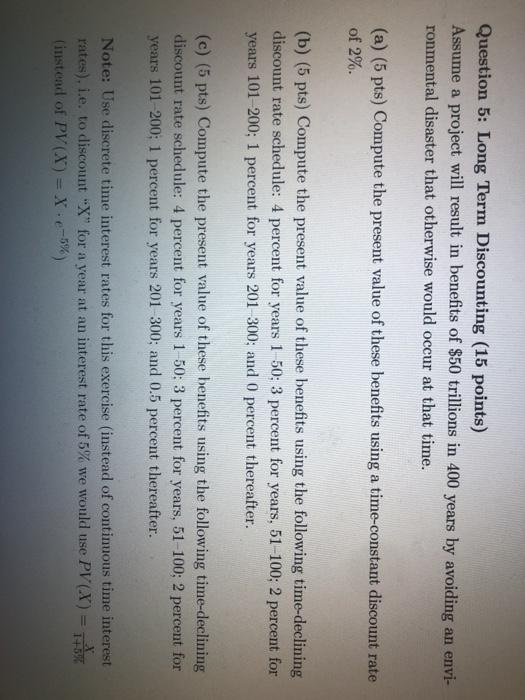
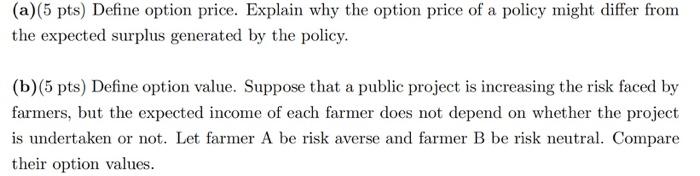
Question 5: Long Term Discounting (15 points) Assume a project will result in benefits of $50 trillions in 400 years by avoiding an envi- ronmental disaster that otherwise would occur at that time. (a) (5 pts) Compute the present value of these benefits using a time-constant discount rate of 2%. (b) (5 pts) Compute the present value of these benefits using the following time-declining discount rate schedule: 4 percent for years 1 50: 3 percent for years, 51-100; 2 percent for years 101-200; 1 percent for years 201-300; and 0 percent thereafter. (c) (5 pts) Compute the present value of these benefits using the following time-declining discount rate schedule: 4 percent for years 1 50: 3 percent for years, 51-100; 2 percent for years 101-200; 1 percent for years 201 300; and 0.5 percent thereafter. Note: Use discrete time interest rates for this exercise (instead of continuous time interest rates), i.e. to discount "X" for a year at an interest rate of 5% we would use PV(X) = 1 (instead of PV(X) = X.e-5%) (a)(5 pts) Define option price. Explain why the option price of a policy might differ from the expected surplus generated by the policy. (b)(5 pts) Define option value. Suppose that a public project is increasing the risk faced by farmers, but the expected income of each farmer does not depend on whether the project is undertaken or not. Let farmer A be risk averse and farmer B be risk neutral. Compare their option values. Question 5: Long Term Discounting (15 points) Assume a project will result in benefits of $50 trillions in 400 years by avoiding an envi- ronmental disaster that otherwise would occur at that time. (a) (5 pts) Compute the present value of these benefits using a time-constant discount rate of 2%. (b) (5 pts) Compute the present value of these benefits using the following time-declining discount rate schedule: 4 percent for years 1 50: 3 percent for years, 51-100; 2 percent for years 101-200; 1 percent for years 201-300; and 0 percent thereafter. (c) (5 pts) Compute the present value of these benefits using the following time-declining discount rate schedule: 4 percent for years 1 50: 3 percent for years, 51-100; 2 percent for years 101-200; 1 percent for years 201 300; and 0.5 percent thereafter. Note: Use discrete time interest rates for this exercise (instead of continuous time interest rates), i.e. to discount "X" for a year at an interest rate of 5% we would use PV(X) = 1 (instead of PV(X) = X.e-5%) (a)(5 pts) Define option price. Explain why the option price of a policy might differ from the expected surplus generated by the policy. (b)(5 pts) Define option value. Suppose that a public project is increasing the risk faced by farmers, but the expected income of each farmer does not depend on whether the project is undertaken or not. Let farmer A be risk averse and farmer B be risk neutral. Compare their option values
Step by Step Solution
There are 3 Steps involved in it

Get step-by-step solutions from verified subject matter experts
 Study Help