







Question: Question 5 ( not for submission, only for Practice ) Suppose the economy currently is in recession, with output lower than the potential level by
Question not for submission, only for Practice
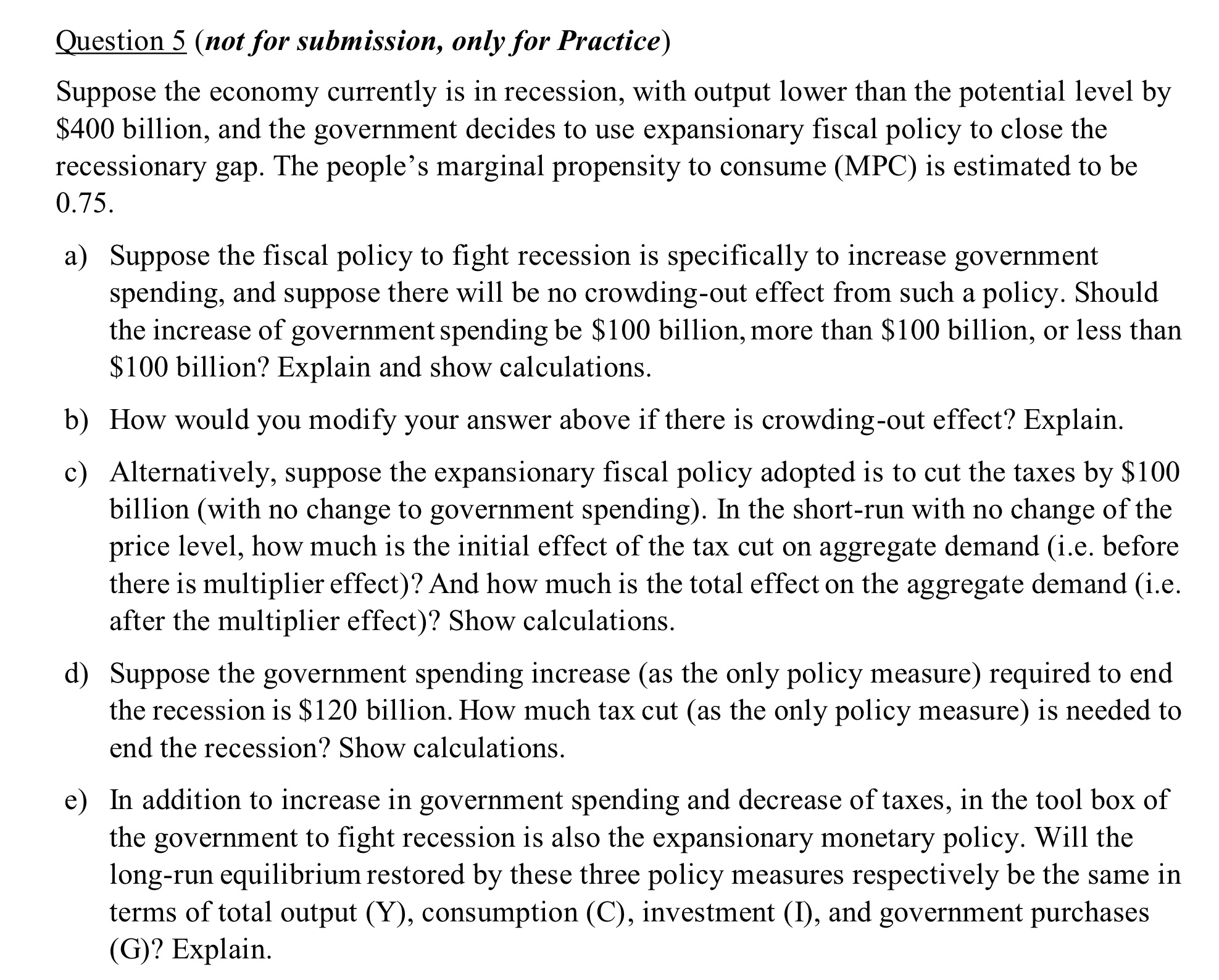
Suppose the economy currently is in recession, with output lower than the potential level by $ billion, and the government decides to use expansionary fiscal policy to close the recessionary gap. The people's marginal propensity to consume MPC is estimated to be
a Suppose the fiscal policy to fight recession is specifically to increase government spending, and suppose there will be no crowdingout effect from such a policy. Should the increase of government spending be $ billion, more than $ billion, or less than $ billion? Explain and show calculations.
b How would you modify your answer above if there is crowdingout effect? Explain.
c Alternatively, suppose the expansionary fiscal policy adopted is to cut the taxes by $ billion with no change to government spending In the shortrun with no change of the price level, how much is the initial effect of the tax cut on aggregate demand ie before there is multiplier effect And how much is the total effect on the aggregate demand ie after the multiplier effect Show calculations.
d Suppose the government spending increase as the only policy measure required to end the recession is $ billion. How much tax cut as the only policy measure is needed to end the recession? Show calculations.
e In addition to increase in government spending and decrease of taxes, in the tool box of the government to fight recession is also the expansionary monetary policy. Will the longrun equilibrium restored by these three policy measures respectively be the same in terms of total output Y consumption C investment I and government purchases G Explain.
Step by Step Solution
There are 3 Steps involved in it
1 Expert Approved Answer
Step: 1 Unlock

Question Has Been Solved by an Expert!
Get step-by-step solutions from verified subject matter experts
Step: 2 Unlock
Step: 3 Unlock
 Study Help