







Question: Question 5 options: A) specific, measurable, attainable, reliable, and time-bound. B) specific, unfixed, attainable, results-oriented and time-bound. C) specific, measurable, attainable, results-oriented, and time-bound. D)
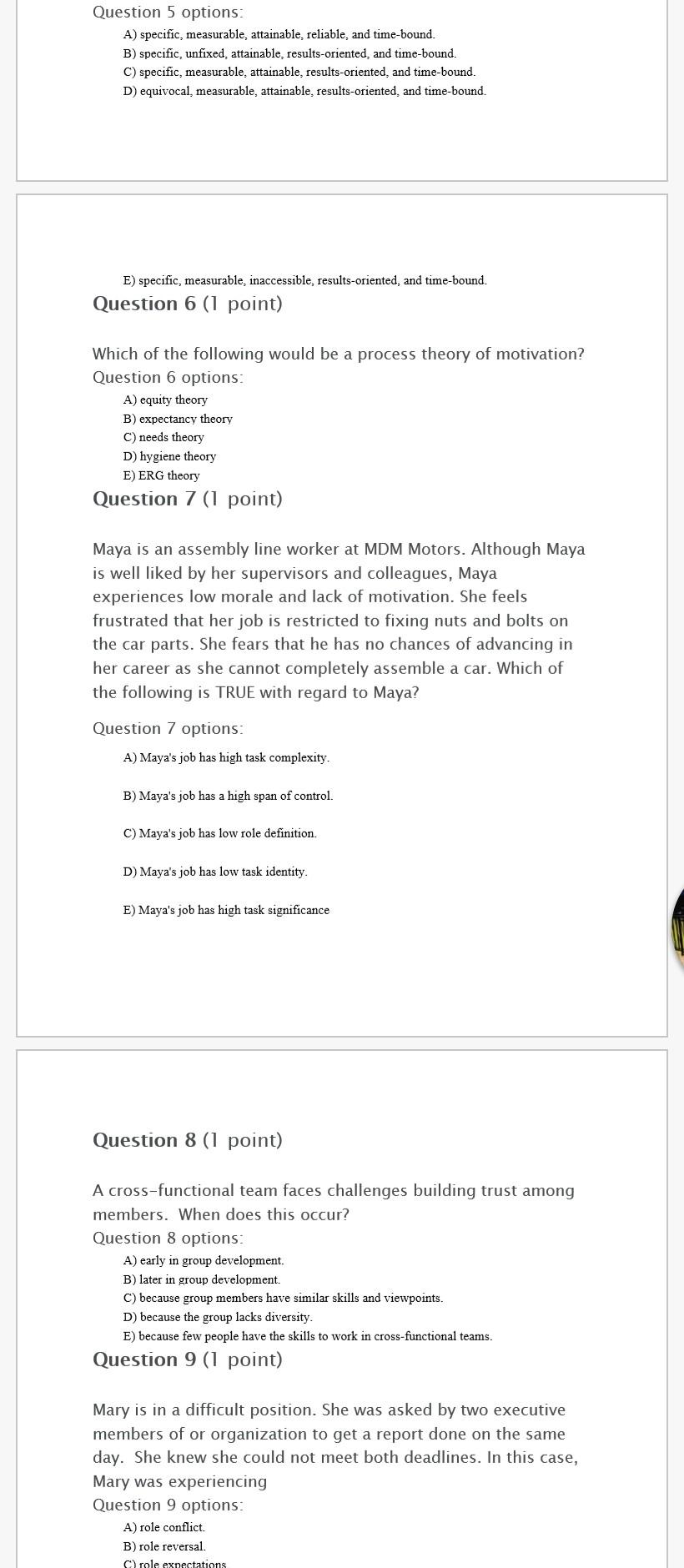
Question 5 options: A) specific, measurable, attainable, reliable, and time-bound. B) specific, unfixed, attainable, results-oriented and time-bound. C) specific, measurable, attainable, results-oriented, and time-bound. D) equivocal, measurable, attainable, results-oriented, and time-bound. E) specific, measurable, inaccessible, results-oriented, and time-bound. Question 6 (1 point) Which of the following would be a process theory of motivation? Question 6 options: A) equity theory B) expectancy theory C) needs theory D) hygiene theory E) ERG theory Question 7 (1 point) Maya is an assembly line worker at MDM Motors. Although Maya is well liked by her supervisors and colleagues, Maya experiences low morale and lack of motivation. She feels frustrated that her job is restricted to fixing nuts and bolts on the car parts. She fears that he has no chances of advancing in her career as she cannot completely assemble a car. Which of the following is TRUE with regard to Maya? Question 7 options: A) Maya's job has high task complexity. B) Maya's job has a high span of control. C) Maya's job has low role definition D) Maya's job has low task identity. E) Maya's job has high task significance Question 8 (1 point) A cross-functional team faces challenges building trust among members. When does this occur? Question 8 options: A) early in group development. B) later in group development. C) because group members have similar skills and viewpoints. D) because the group lacks diversity. E) because few people have the skills to work in cross-functional teams. Question 9 (1 point) Mary is in a difficult position. She was asked by two executive members of or organization to get a report done on the same day. She knew she could not meet both deadlines. In this case, Mary was experiencing Question 9 options: A) role conflict. B) role reversal. C) role expectations
Step by Step Solution
There are 3 Steps involved in it
1 Expert Approved Answer
Step: 1 Unlock

Question Has Been Solved by an Expert!
Get step-by-step solutions from verified subject matter experts
Step: 2 Unlock
Step: 3 Unlock
 Study Help