







Question: Question 5 - Problem Solving -20 Marks 5.1 Consider a 150 Mb/s link that is 800 km long, with a queue large enough to hold
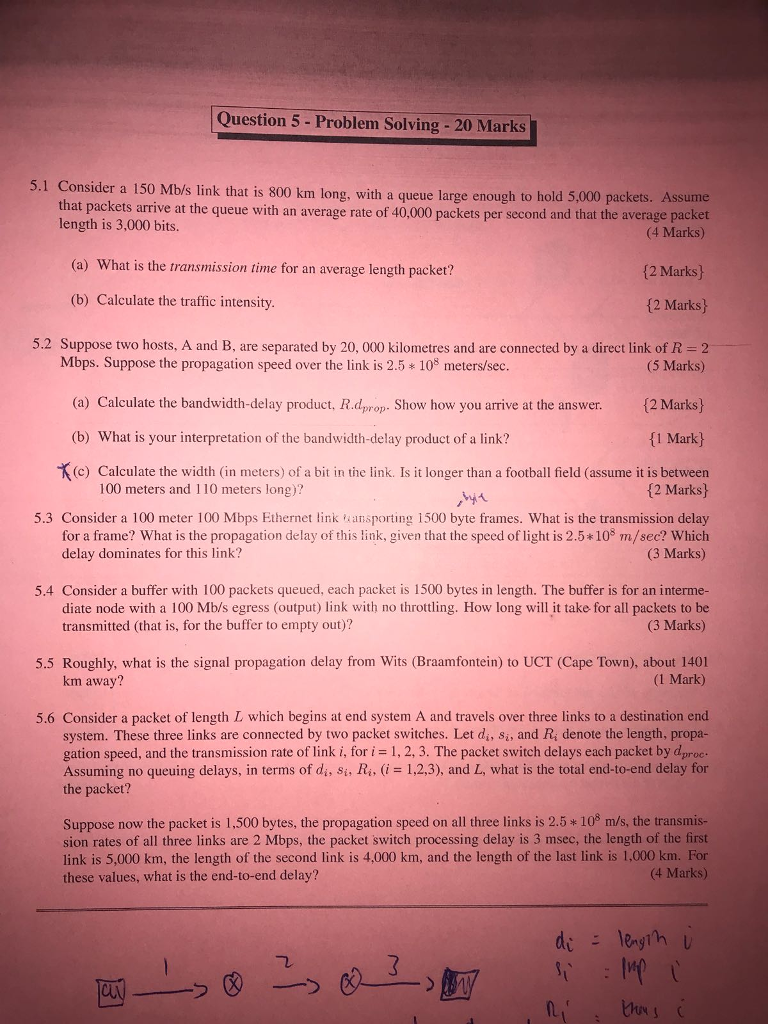
Question 5 - Problem Solving -20 Marks 5.1 Consider a 150 Mb/s link that is 800 km long, with a queue large enough to hold 5,000 pack that packets arrive at the queue with an average rate of 40,000 packets per second and that the average packet length is 3,000 bits. (4 Marks) [2 Marks] 2 Marks) 5.2 Suppose two hosts, A and B, are separated by 20, 000 kilometres and are connected by a direct link of R-2 ) What is the transmission time for an average length packet? (b) Calculate the traffic intensity Mbps. Suppose the propagation speed over the link is 2.5 108 meters/sec (a) Calculate the bandwidth-delay product, R.dprop: Show how you arrive at the answer. (b) What is your interpretation of the bandwidth-delay product of a link? (5 Marks) 2 Marks) 1 Mark) K(c) Calculate the width (in meters) of a bit in the link. Is it longer than a football field (assume it is between [2 Marks 100 meters and 110 meters long)? 5.3 Consider a 100 meter 100 Mbps Ethernet link ansporting 1500 byte frames. What is the transmission delay for a frame? What is the propagation delay of this link, given that the speed of light is 2.5 108 m/sec? Which (3 Marks) delay dominates for this link? 5.4 Consider a buffer with 100 packets queued, each packet is 1500 bytes in length. The buffer is for an interme- diate node with a 100 Mb/s egress (output) link with no throttling. How long will it take for all packets to be (3 Marks) transmitted (that is, for the buffer to empty out)? 5.5 Roughly, what is the signal propagation delay from Wits (Braamfontein) to UCT (Cape Town), about 1401 (1 Mark) km away? 5.6 Consider a packet of length L which begins at end system A and travels over three links to a destination end system. These three links are connected by two packet switches. Let di, si, and Ri denote the length, propa gation speed, and the transmission rate of link i, for i = 1, 2, 3, The packet switch delays each packet by dproc Assuming no queuing delays, in terms of di, Si Ri,(i 1,2,3), and L, what is the total end-to-end delay for the packet? Suppose now the packet is 1,500 bytes, the propagation speed on all three links is 2.5*108 m/s, the transmis- sion rates of all three links are 2 Mbps, the packet switch processing delay is 3 msec, the length of the first link is 5,000 km, the length of the second link is 4,000 km, and the length of the last link is 1,000 km. For these values, what is the end-to-end delay? (4 Marks) Cu Chen
Step by Step Solution
There are 3 Steps involved in it

Get step-by-step solutions from verified subject matter experts
 Study Help