







Question: Question 5. Same facts as Q2 attached in photos, except derive the value of the company and the price per common share using the earnings-based
Question 5.
Same facts as Q2 attached in photos, except derive the value of the company and the price per common share using the earnings-based valuation model.
- Compute residual income (ie abnormal earnings) for the next three years, and verify that residual income is growing at a constant rate. What is that rate?
- Use the residual income (abnormal earnings) model to derive the value of the firm and the
price per common share. compare your answer to the answer you got using the tree cash
flow to equity investors (dividend discount model) in Q2 above.
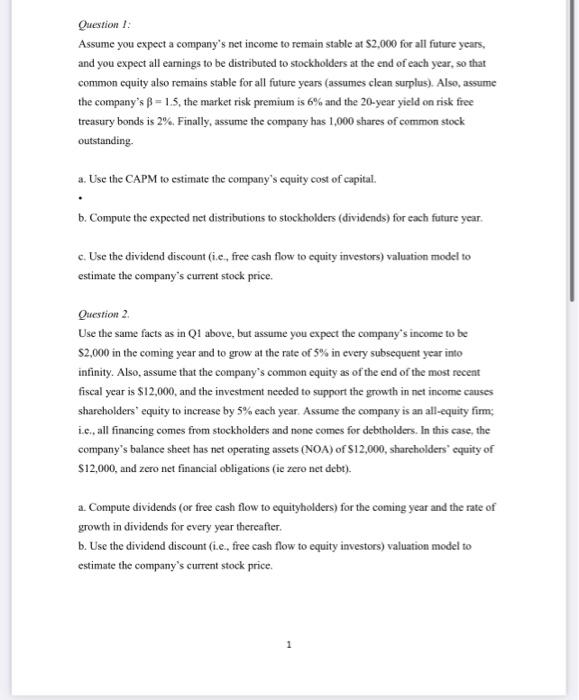
Question 1: Assume you expect a company's net income to remain stable at $2,000 for all future years, and you expect all eamings to be distributed to stockholders at the end of each year, 80 that common equity also remains stable for all future years (assumes clean surplus). Also, assume the company's =1.5, the market risk premium is 6% and the 20 -year yield on risk free treasury bonds is 2%. Finally, assume the company has 1,000 shares of common stock outstanding. a. Use the CAPM to estimate the company's equity cost of capital. b. Compute the expected net distributions to stockholders (dividends) for each future year. c. Use the dividend discount (i.e., free cash flow to equity investors) valuation model to estimate the company's current stock price. Question 2. Use the same facts as in Q1 above, but assume you expect the company's income to be $2,000 in the coming year and to grow at the rate of 5% in every subsequent year into infinity. Also, assume that the company's common equity as of the end of the most recent fiscal year is $12,000, and the investment needed to support the growth in net income causes shareholders' equity to increase by 5% each year. Assume the company is an all-equity firm; i.e., all financing comes from stockholders and none comes for debtholders. In this case, the company's balance sheet has net operating assets (NOA) of $12,000, shareholders' equity of $12,000, and zero net financial obligations (ie zero net debt). a. Compute dividends (or free cash flow to equityholders) for the coming year and the rate of growth in dividends for every year thereafter. b. Use the dividend discount (i.e., free cash flow to equity investors) valuation model to estimate the company's current stock price
Step by Step Solution
There are 3 Steps involved in it

Get step-by-step solutions from verified subject matter experts
 Study Help