







Question: QUESTION 5 The primary database, consisting of 1 0 0 observations on 1 8 separate variables, is based on a market segnentation study of HBAT
QUESTION
The primary database, consisting of observations on separate variables, is based on a market
segnentation study of HBAT customers. HBAT sels paper products to two market segments: the
newsprint industry and the magazine industry. Also, paper products are soid to these market
segnents elther directy to the customer or indirectly through a broker. Two types of infomaton were
collected in the surveys. The first type of information was perceptons of HBAT's performance on
STA
attributes. These atributes, developed through focus groups, a pretest, and used in previous studes,
are the most infuertial in the selection of supplers in the paper industry. Respondents included
purchasing managers of fims buying from HBAT, and they rated HBAT on each of the attributes
using a scale, with beling "Excellent" and belng "Poor". The second type of information
relates to purchase outcomes and business relatonshlps eg satistaction with HBAT and whether
the firm would consider a strateglc allancepartnership with HBAT A third type of information is
avallable from HBAT's data warehouse and includes information such as slze of customer and length
of purchase relationship.
Exploratory factor analysis can identify the structure of a set of variables well provide a process
for data reduction. In our example, the perceptions of HBAT on attributes X to X are examined
for the following reasons:
Data Summarization with Interpretation Understand whether these perceptions can be
"grouped". Even the relatively small number of perceptions examined here presents a complex
plcture of separate correlations. By grouping the perceptions and then engaging in the steps
of factor interpretation, HBAT will be able to see the big plcture in terms of understanding its
customers and what dmensions the customers thinik about HBAT.
Data Reduction Reduce the varlables to a smaler number of composite factors. If the
variables can be represented in a smaller number of composite variables, then the other
muitivariate techniques can be made more parsimonious. Of course, this approach assumes
that a certain degree of underiying order exists in the data belng analysed.
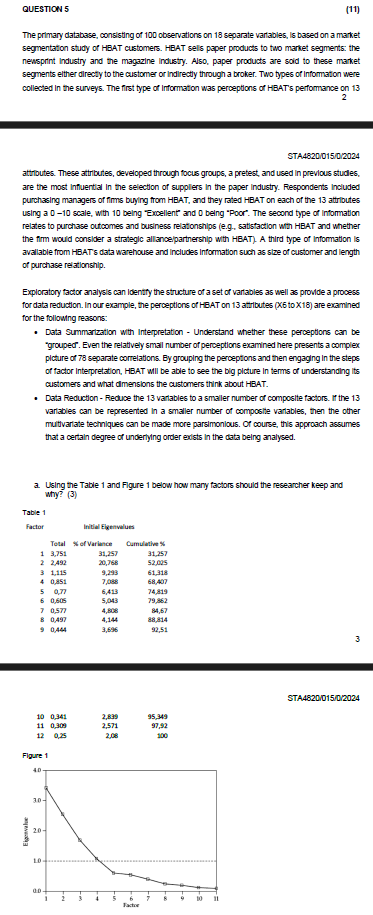
a Using the Table and Figure below how many factors should the researcher keep and
why?
Table
Step by Step Solution
There are 3 Steps involved in it
1 Expert Approved Answer
Step: 1 Unlock

Question Has Been Solved by an Expert!
Get step-by-step solutions from verified subject matter experts
Step: 2 Unlock
Step: 3 Unlock
 Study Help