







Question: Question 5 (Trading rules in limit order books). This question is based on lectures 13-14. The goal is to make sure we understand how trading
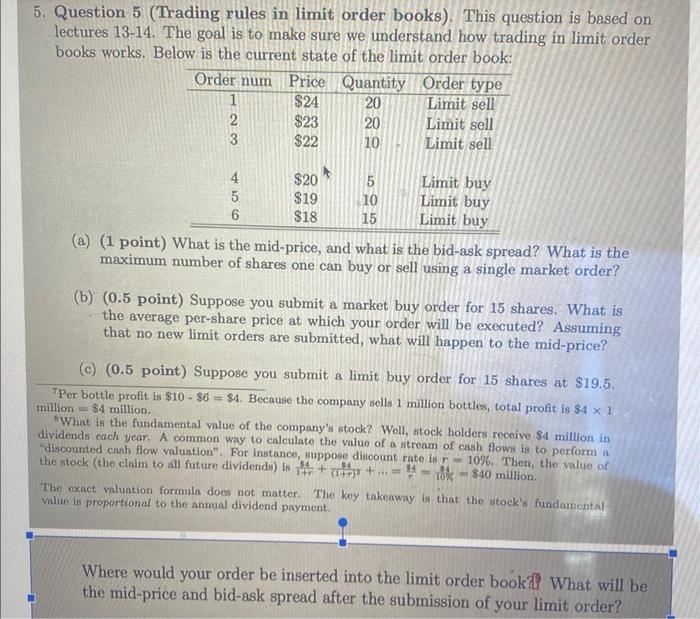
Question 5 (Trading rules in limit order books). This question is based on lectures 13-14. The goal is to make sure we understand how trading in limit order books works. Below is the current state of the limit order book: (a) (1 point) What is the mid-price, and what is the bid-ask spread? What is the maximum number of shares one can buy or sell using a single market order? (b) (0.5 point) Suppose you submit a market buy order for 15 shares. What is the average per-share price at which your order will be executed? Assuming that no new limit orders are submitted, what will happen to the mid-price? (c) (0.5 point) Suppose you submit a limit buy order for 15 shares at $19.5. "Per bottle profit is $10$6=$4. Because the company sells 1 million bottles, total profit is $41 million =$4 million. "What is the fundamental value of the company's stock? Woll, stock bolders receive \$4 million in dividends cach year. A common way to calculate the value of a stroam of cash flows is to perform in a "discounted cash flow valuation". For instance, guppose discount rate is r=10%. Then, the value of the stock (the claim to all future dividends) is 1+r14+(1+r)r14+=54=10/54=$40 million. The exact valuation formuln does not matter. The key takeaway is that the stock'b fundamintal value is proportional to the annual dividend payment. Where would your order be inserted into the limit order book?l What will be the mid-price and bid-ask spread after the submission of your limit order
Step by Step Solution
There are 3 Steps involved in it

Get step-by-step solutions from verified subject matter experts
 Study Help