







Question: Question 6 (10 points). For the compound in question 5 , the observed exact mass is 303.1462. Check your structure above. Now, compute the deviation

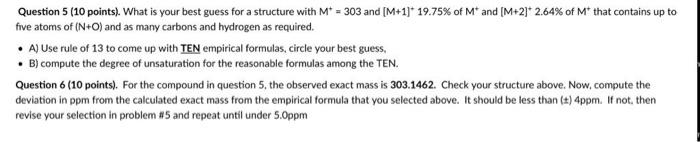
Question 6 (10 points). For the compound in question 5 , the observed exact mass is 303.1462. Check your structure above. Now, compute the deviation in ppm from the calculated exact mass from the empirical formula that you selected above. It should be less than (t)4ppm. If not, then revise your selection in problem #5 and repeat until under 5.0ppm The excel sheet is meant to help you check YOUR OWN WORK in a few of the above. It is not to provide the answer. You might want to take a look at the formula's in the sheet so as to understand the computations. You can modify this one or make your own excel sheet to help you with unknown You can recreate my excel calculation sheet on your own using tables 1.3&1.4. Question 5 (10 points). What is your best guess for a structure with M+=303 and [M+1]+19.75% of M+and [M+2]+2.64% of M+that contains up th five atoms of (N+O) and as many carbons and hydrogen as required. - A) Use rule of 13 to come up with TEN empirical formulas, circle your best guess, - B) compute the degree of unsaturation for the reasonable formulas among the TEN. Question 6 (10 points). For the compound in question 5 , the observed exact mass is 303.1462. Check your structure above. Now, compute the deviation in ppm from the calculated exact mass from the empirical formula that you selected above. It should be less than (t) 4ppm. If not, then revise your selection in problem 5 and repeat until under 5.0ppm
Step by Step Solution
There are 3 Steps involved in it

Get step-by-step solutions from verified subject matter experts
 Study Help