







Question: Question 6 - 2 0 marks You should be able to answer this question after studying Unit 5 . A box of fruit of mass
Question marks
You should be able to answer this question after studying Unit
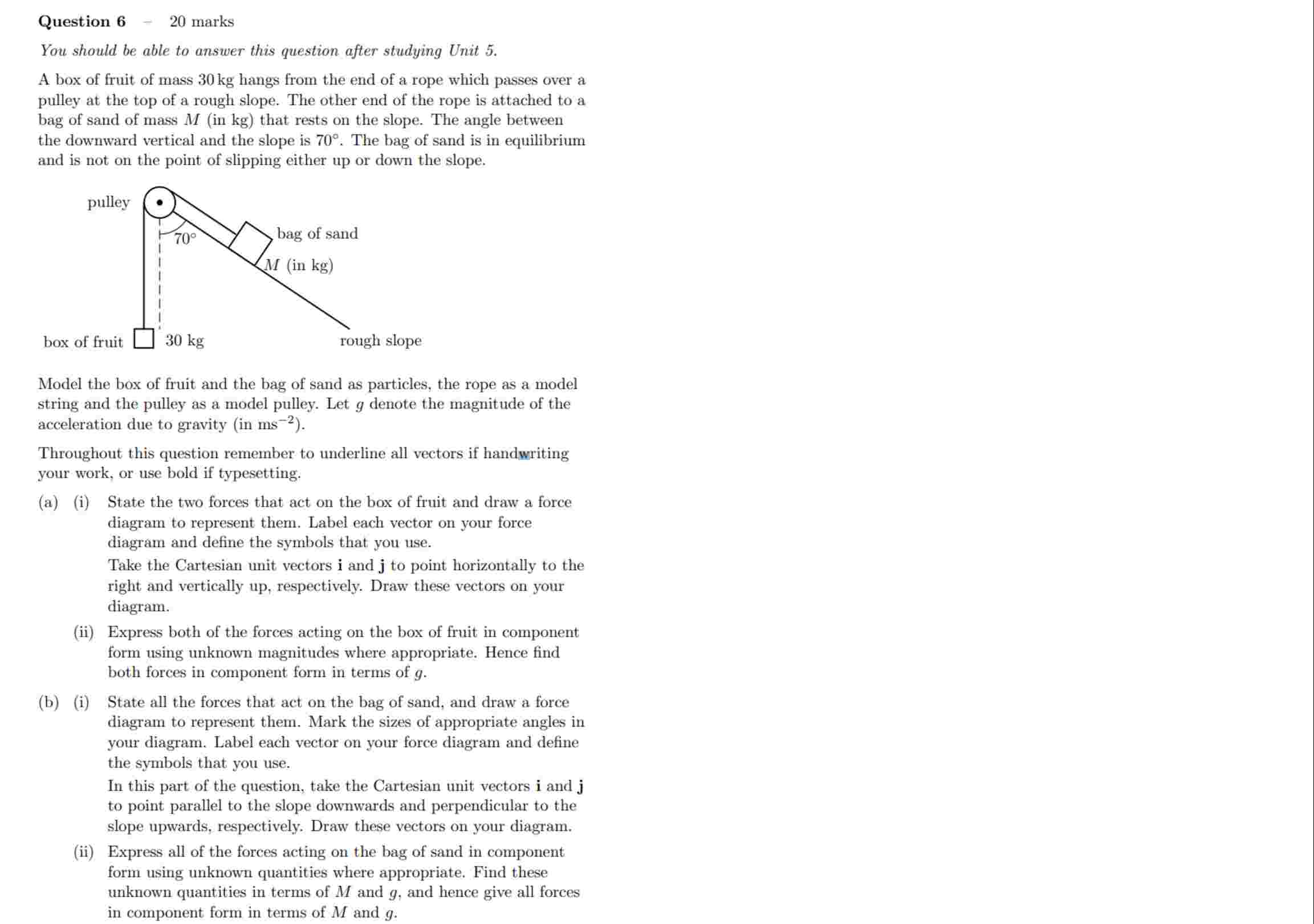
A box of fruit of mass kg hangs from the end of a rope which passes over a pulley at the top of a rough slope. The other end of the rope is attached to a bag of sand of mass M in kg that rests on the slope. The angle between the downward vertical and the slope is circ The bag of sand is in equilibrium and is not on the point of slipping either up or down the slope.
bc
Model the box of fruit and the bag of sand as particles, the rope as a model string and the pulley as a model pulley. Let g denote the magnitude of the acceleration due to gravity in mathrmms
Throughout this question remember to underline all vectors if handwriting your work, or use bold if typesetting.
ai State the two forces that act on the box of fruit and draw a force diagram to represent them. Label each vector on your force diagram and define the symbols that you use.
Take the Cartesian unit vectors mathbfi and mathbfj to point horizontally to the right and vertically up respectively. Draw these vectors on your diagram.
ii Express both of the forces acting on the box of fruit in component form using unknown magnitudes where appropriate. Hence find both forces in component form in terms of g
bi State all the forces that act on the bag of sand, and draw a force diagram to represent them. Mark the sizes of appropriate angles in your diagram. Label each vector on your force diagram and define the symbols that you use.
In this part of the question, take the Cartesian unit vectors mathbfi and mathbfj to point parallel to the slope downwards and perpendicular to the slope upwards, respectively. Draw these vectors on your diagram.
ii Express all of the forces acting on the bag of sand in component form using unknown quantities where appropriate. Find these unknown quantities in terms of M and g and hence give all forces in component form in terms of M and g
Step by Step Solution
There are 3 Steps involved in it
1 Expert Approved Answer
Step: 1 Unlock

Question Has Been Solved by an Expert!
Get step-by-step solutions from verified subject matter experts
Step: 2 Unlock
Step: 3 Unlock
 Study Help