







Question: Question 6 [35 marks] Consider the following strategic situation that has been enacted in a recent experiment: Participants are grouped into groups of n participants.
![Question 6 [35 marks] Consider the following strategic situation that has](https://s3.amazonaws.com/si.experts.images/answers/2024/06/667542809aece_76866754280611e6.jpg)
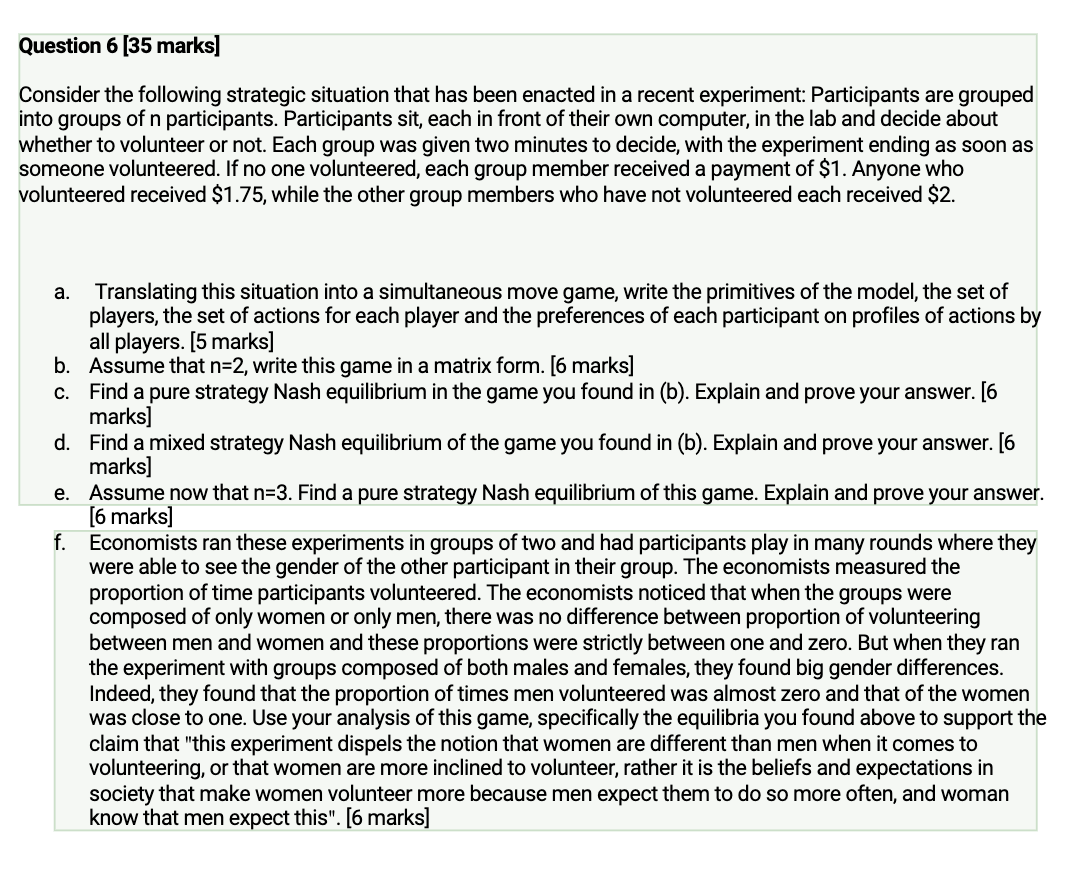
Question 6 [35 marks] Consider the following strategic situation that has been enacted in a recent experiment: Participants are grouped into groups of n participants. Participants sit, each in front of their own computer, in the lab and decide about whether to volunteer or not. Each group was given two minutes to decide, with the experiment ending as soon as someone volunteered. If no one volunteered, each group member received a payment of $1. Anyone who volunteered received $1.75, while the other group members who have not volunteered each received $2. a. Translating this situation into a simultaneous move game, write the primitives of the model, the set of players, the set of actions for each player and the preferences of each participant on profiles of actions by all players. [5 marks] Assume that n=2, write this game in a matrix form. [6 marks] Find a pure strategy Nash equilibrium in the game you found in (b). Explain and prove your answer. [6 marks] Find almixed strategy Nash equilibrium of the game you found in (b). Explain and prove your answer. [6 marks Assume now that n=3. Find a pure strategy Nash equilibrium of this game. Explain and prove your answer. [6 marks] Economists ran these experiments in groups of two and had participants play in many rounds where they were able to see the gender of the other participant in their group. The economists measured the proportion of time participants volunteered. The economists noticed that when the groups were composed of only women or only men, there was no difference between proportion of volunteering between men and women and these proportions were strictly between one and zero. But when they ran the experiment with groups composed of both males and females, they found big gender differences. Indeed, they found that the proportion of times men volunteered was almost zero and that of the women was close to one. Use your analysis of this game, specifically the equilibria you found above to support the claim that "this experiment dispels the notion that women are different than men when it comes to volunteering, or that women are more inclined to volunteer, rather it is the beliefs and expectations in society that make women volunteer more because men expect them to do so more often, and woman know that men expect this\". [6 marks]
Step by Step Solution
There are 3 Steps involved in it

Get step-by-step solutions from verified subject matter experts
 Study Help