







Question: Question 6 ( a ) In a network using Go - Back - N ARQ protocol with m = 6 , the maximum window size
Question
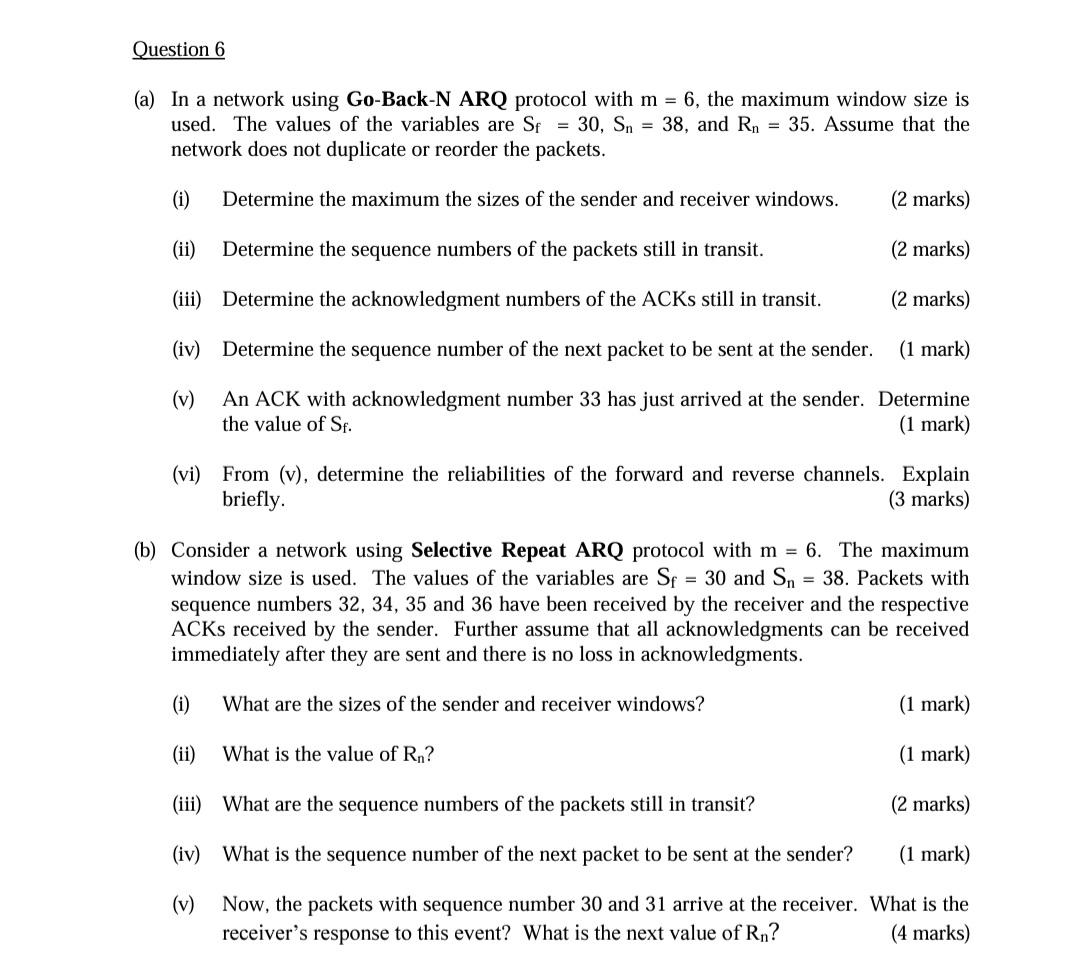
a In a network using GoBackN ARQ protocol with the maximum window size is used. The values of the variables are and Assume that the network does not duplicate or reorder the packets.
i Determine the maximum the sizes of the sender and receiver windows.
marks
ii Determine the sequence numbers of the packets still in transit.
marks
iii Determine the acknowledgment numbers of the ACKs still in transit.
marks
iv Determine the sequence number of the next packet to be sent at the sender
mark
v An ACK with acknowledgment number has just arrived at the sender Determine the value of
mark
vi From v determine the reliabilities of the forward and reverse channels. Explain briefly.
marks
b Consider a network using Selective Repeat ARQ protocol with The maximum window size is used. The values of the variables are and Packets with sequence numbers and have been received by the receiver and the respective ACKs received by the sender Further assume that all acknowledgments can be received immediately after they are sent and there is no loss in acknowledgments.
i What are the sizes of the sender and receiver windows?
mark
ii What is the value of
mark
iii What are the sequence numbers of the packets still in transit?
marks
iv What is the sequence number of the next packet to be sent at the sender
mark
v Now, the packets with sequence number and arrive at the receiver. What is the receiver's response to this event? What is the next value of
marks
Step by Step Solution
There are 3 Steps involved in it
1 Expert Approved Answer
Step: 1 Unlock

Question Has Been Solved by an Expert!
Get step-by-step solutions from verified subject matter experts
Step: 2 Unlock
Step: 3 Unlock
 Study Help