







Question: Question 6. Client-server systems and inter-process communica- tions. (20 marks) (a) Outline using your preferred programming language how two nodes on a network can communicate.
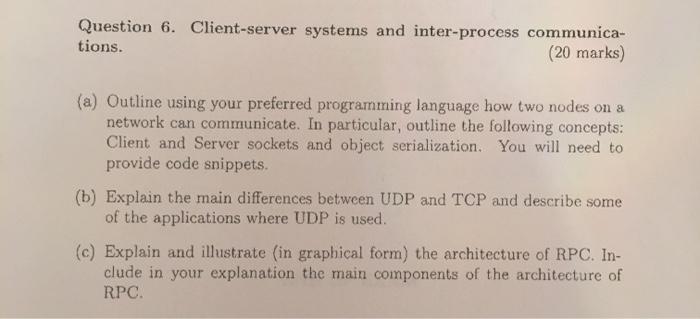
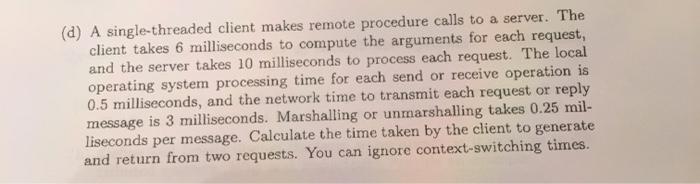
Question 6. Client-server systems and inter-process communica- tions. (20 marks) (a) Outline using your preferred programming language how two nodes on a network can communicate. In particular, outline the following concepts: Client and Server sockets and object serialization. You will need to provide code snippets. (b) Explain the main differences between UDP and TCP and describe some of the applications where UDP is used. (c) Explain and illustrate (in graphical form) the architecture of RPC. In- clude in your explanation the main components of the architecture of RPC (d) A single-threaded client makes remote procedure calls to a server. The client takes 6 milliseconds to compute the arguments for each request, and the server takes 10 milliseconds to process each request. The local operating system processing time for each send or receive operation is 0.5 milliseconds, and the network time to transmit each request or reply message is 3 milliseconds. Marshalling or unmarshalling takes 0.25 mil- liseconds per message. Calculate the time taken by the client to generate and return from two requests. You can ignore context switching times. Question 6. Client-server systems and inter-process communica- tions. (20 marks) (a) Outline using your preferred programming language how two nodes on a network can communicate. In particular, outline the following concepts: Client and Server sockets and object serialization. You will need to provide code snippets. (b) Explain the main differences between UDP and TCP and describe some of the applications where UDP is used. (c) Explain and illustrate (in graphical form) the architecture of RPC. In- clude in your explanation the main components of the architecture of RPC (d) A single-threaded client makes remote procedure calls to a server. The client takes 6 milliseconds to compute the arguments for each request, and the server takes 10 milliseconds to process each request. The local operating system processing time for each send or receive operation is 0.5 milliseconds, and the network time to transmit each request or reply message is 3 milliseconds. Marshalling or unmarshalling takes 0.25 mil- liseconds per message. Calculate the time taken by the client to generate and return from two requests. You can ignore context switching times
Step by Step Solution
There are 3 Steps involved in it

Get step-by-step solutions from verified subject matter experts
 Study Help