



Question: QUESTION 6 How many tables are created from the E-R diagram in Fig. 3? a. 6 b. 3 c. 4 d. 5 1 points QUESTION
QUESTION 6
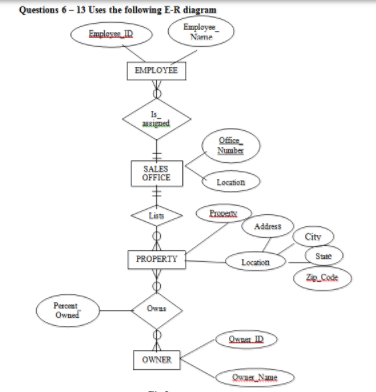
How many tables are created from the E-R diagram in Fig. 3?
| a. | 6 | |
| b. | 3 | |
| c. | 4 | |
| d. | 5 |
1 points
QUESTION 7
Consider the following statement:
Alter table employee
Add constraint employee_office_number_fk foreign key(office_number)
References sales_office(office_number);
Which of the following is true for the above statement?
| a. | The statement guarantees a unique identifier for the office_number column of the office table. | |
| b. | The statement provides a foreign key constraint for the office_number column of the office table. | |
| c. | The statement provides a foreign key constraint for the office_number column of the employee table | |
| d. | Both b and c are correct |
1 points
QUESTION 8
Consider the following statement:
Alter table owns
Add constraint owns_property_owner_id_pk primary key(property,owner_id);
Which of the following is true for the above statement?
| a. | The statement is unnecessary because the owns table is not implemented. | |
| b. | Builds composite primary key based on the property and owner_id fields of the owns table. | |
| c. | Is syntactically incorrect the primary key can only be built on one column | |
| d. | The statement is unnecessary because of the one-to-many relationship between owns and property. |
QUESTION 9
Consider that the employee table has the following schema (The desc command displays the columns in the same order as shown below):
Employee(Employee_ID,Employee_name,office_number)
Assume that all Primary key/Foreign key constraints have been created on all tables as illustrated on the E-R diagram.
What does the following command do? (Assume that no other rows have 1806 as the employee_id)
Insert into employee
Values(1806,Jim Davis, NULL);
| a. | Correctly inserts a new row into the employee table (no error messages displayed) | |
| b. | Displays an error message (Foreign key constraint violated) but inserts the data anyway | |
| c. | Displays that a NOT NULL constraint (employee_office_number_nn) was violated and does not insert the row. | |
| d. | Displays an error message because no columns of any table are ever allowed to be NULL |
QUESTION 10
Consider the following statement:
Delete from owns;
Assume that all Primary key/Foreign key constraints have been created on all tables as illustrated on the E-R diagram.
Which of the following is true of the above statement:
| a. | Correctly deletes all records of owns table (no error message displayed) | |
| b. | Violates foreign key constraints implemented on owns table (error message is displayed) and does not delete any records | |
| c. | Violates rule that you can never delete all records from a table (error message is displayed ) and does not delete any records | |
| d. | None of the above |
1 points
QUESTION 11
Consider the following statement:
delete from sales_office;
Assume that all Primary key/Foreign key constraints have been created on all tables as illustrated on the E-R diagram. Assume all tables are fully populated with data.
Which of the following is true?
| a. | Correctly deletes all record of office table (no error message displayed) | |
| b. | Violates foreign key constraint implemented on Employee table | |
| c. | Violates foreign key constraint implemented on Property table | |
| d. | Both b and c are correct |
QUESTION 12
Consider the following statement:
Insert into owns
Values(1215,101,50);
Where 1215 represents the property id, 101 is the owner id, and 50 is the percent owned. Which of the following statements is true:
| a. | The property id 1215 must be the primary key for a row in the property table | |
| b. | The owner id 101 must be the primary key for a row in the owner table. | |
| c. | The value of 50 must be Not Null | |
| d. | a and b are true |
1 points
QUESTION 13
Consider the following statement:
Update owns
Set owner_id = NULL;
Which of the following statements are true?
| a. | The Primary key constraint is violated because Primary keys cannot be NULL | |
| b. | Is illegal because no column in a database can ever by NULL | |
| c. | Is illegal because update statements always require a where clause | |
| d. | All of the above |
Questions 6-13 Uses the following E-R diagram EMPLOYEE Is, 382 Office SALES OFFICE Location Address City PROPERTY State Locatioa Zip Code Percent OWNER
Step by Step Solution
There are 3 Steps involved in it

Get step-by-step solutions from verified subject matter experts