Question: Question 6 In the section, applying the balance scorecard method to your own Human Capital what are the 4 questions asked? Explain how the questions
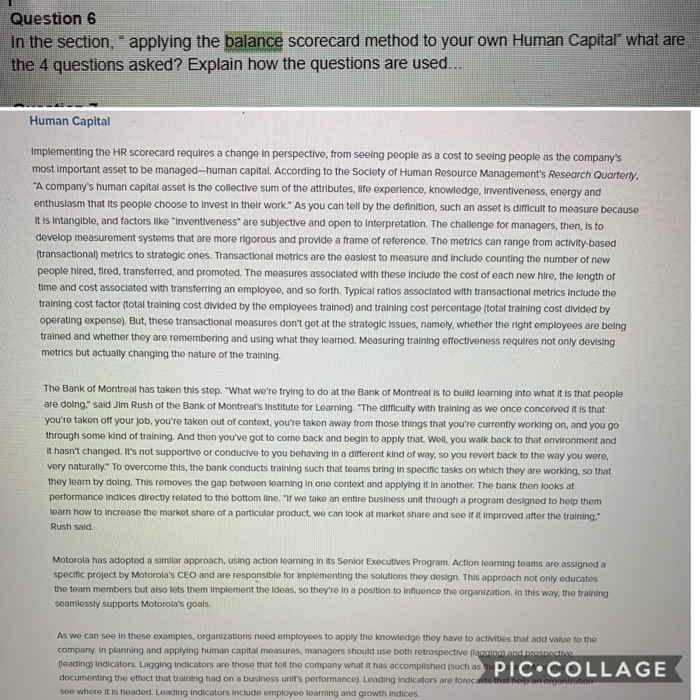
Question 6 In the section," applying the balance scorecard method to your own Human Capital" what are the 4 questions asked? Explain how the questions are used... Human Capital Implementing the HR scorecard requires a change in perspective, from seeing people as a cost to seeing people as the company's most important asset to be managed-human capital. According to the Society of Human Resource Management's Research Quarterly, "A company's human capital asset is the collective sum of the attributes, Ilfo experience, knowledge, inventiveness, energy and enthusiasm that its people choose to invest in their work." As you can tell by the definition, such an asset is difficult to measure because It is intangible, and factors like "inventiveness are subjective and open to Interpretation. The challenge for managers, then, is to develop measurement systems that are more rigorous and provide a frame of reference. The metrics can range from activity-based (transactional) metrics to strategic ones. Transactional metrics are the easiest to measure and include counting the number of new people hired, fired, transferred, and promoted. The measures associated with these include the cost of each new hire, the length of time and cost associated with transferring an employee, and so forth. Typical ratios associated with transactional metrics include the training cost factor (total training cost divided by the employees trained) and training cost percentage (total training cost divided by operating expense). But, these transactional measures don't get at the strategic Issues, namely, whether the right employees are being trained and whether they are remembering and using what they learned. Measuring training effectiveness requires not only devising metrics but actually changing the nature of the training. The Bank of Montreal has taken this step. "What we're trying to do at the Bank of Montreal is to build learning into what it is that people are doing" said Jim Rush of the Bank of Montreal's Institute for Learning. The difficulty with training as we once conceived it is that you're taken off your job, you're taken out of context, you're taken away from those things that you're currently working on, and you go through some kind of training. And then you've got to come back and begin to apply that. Well, you walk back to that environment and it hasn't changed. It's not supportive or conducive to you behaving in a different kind of way, so you revert back to the way you were, very naturally." To overcome this, the bank conducts training such that teams bring in specific tasks on which they are working, so that they learn by doing. This removes the gap betwoon learning in one context and applying it in another. The bank then looks at performance Indices directly related to the bottom line. "If we take an entire business unit through a program designed to help them learn how to Increase the market share of a particular product, we can look at market share and see if it improved after the training." Rush sald. Motorola has adopted a similar approach, using action learning in its Senior Executives Program. Action learning teams are assigned a specific project by Motorola's CEO and are responsible for implementing the solutions they design. This approach not only educates the team members but also lets them implement the ideas, so they're in a position to influence the organization. In this way, the training seamlessly supports Motorola's goals. As we can see in these examples, organizations need employees to apply the knowledge they have to activities that add value to the company. In planning and applying human capital measures, managers should use both retrospective lagginal and prospective leading) Indicators. Lagging indicators are those that tell the company what it has accomplished (such as documenting the effect that training had on a business unit's performance). Leading indicators are forecasts that he see where it is headed. Leading indicators include employee learning and growth indices PIC.COLLAGE Question 6 In the section," applying the balance scorecard method to your own Human Capital" what are the 4 questions asked? Explain how the questions are used... Human Capital Implementing the HR scorecard requires a change in perspective, from seeing people as a cost to seeing people as the company's most important asset to be managed-human capital. According to the Society of Human Resource Management's Research Quarterly, "A company's human capital asset is the collective sum of the attributes, Ilfo experience, knowledge, inventiveness, energy and enthusiasm that its people choose to invest in their work." As you can tell by the definition, such an asset is difficult to measure because It is intangible, and factors like "inventiveness are subjective and open to Interpretation. The challenge for managers, then, is to develop measurement systems that are more rigorous and provide a frame of reference. The metrics can range from activity-based (transactional) metrics to strategic ones. Transactional metrics are the easiest to measure and include counting the number of new people hired, fired, transferred, and promoted. The measures associated with these include the cost of each new hire, the length of time and cost associated with transferring an employee, and so forth. Typical ratios associated with transactional metrics include the training cost factor (total training cost divided by the employees trained) and training cost percentage (total training cost divided by operating expense). But, these transactional measures don't get at the strategic Issues, namely, whether the right employees are being trained and whether they are remembering and using what they learned. Measuring training effectiveness requires not only devising metrics but actually changing the nature of the training. The Bank of Montreal has taken this step. "What we're trying to do at the Bank of Montreal is to build learning into what it is that people are doing" said Jim Rush of the Bank of Montreal's Institute for Learning. The difficulty with training as we once conceived it is that you're taken off your job, you're taken out of context, you're taken away from those things that you're currently working on, and you go through some kind of training. And then you've got to come back and begin to apply that. Well, you walk back to that environment and it hasn't changed. It's not supportive or conducive to you behaving in a different kind of way, so you revert back to the way you were, very naturally." To overcome this, the bank conducts training such that teams bring in specific tasks on which they are working, so that they learn by doing. This removes the gap betwoon learning in one context and applying it in another. The bank then looks at performance Indices directly related to the bottom line. "If we take an entire business unit through a program designed to help them learn how to Increase the market share of a particular product, we can look at market share and see if it improved after the training." Rush sald. Motorola has adopted a similar approach, using action learning in its Senior Executives Program. Action learning teams are assigned a specific project by Motorola's CEO and are responsible for implementing the solutions they design. This approach not only educates the team members but also lets them implement the ideas, so they're in a position to influence the organization. In this way, the training seamlessly supports Motorola's goals. As we can see in these examples, organizations need employees to apply the knowledge they have to activities that add value to the company. In planning and applying human capital measures, managers should use both retrospective lagginal and prospective leading) Indicators. Lagging indicators are those that tell the company what it has accomplished (such as documenting the effect that training had on a business unit's performance). Leading indicators are forecasts that he see where it is headed. Leading indicators include employee learning and growth indices PIC.COLLAGE









 Study Help