







Question: question # 6 : invert ( d ) Given a Using concepts which you were specifically told not to use - 1 0 0 %
question #: invert d
Given a Using concepts which you were specifically told not to use
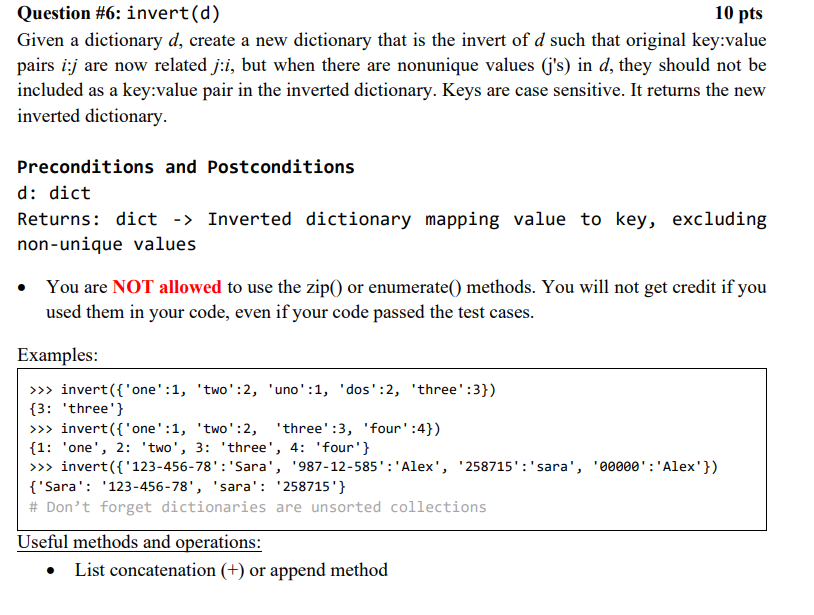
Use of global variables, break or continue statements in loops while these statements are useful to provide multiple exit points in loops, they are highly abused when starting to program instead of defining a meaningful continuation condition. None of the problems in this course involve complex exit points, hence, their use is prohibited in all components of this coursedictionary create a new dictionary that is the invert of such that original key:value
pairs : are now related : but when there are nonunique values js in they should not be
included as a key:value pair in the inverted dictionary. Keys are case sensitive It returns the new
inverted dictionary.
Preconditions and Postconditions
d: dict
Returns: dict Inverted dictionary mapping value to key, excluding
nonunique values
You are NOT allowed to use the zip or enumerate methods. You will not get credit if you
used them in your code, even if your code passed the test cases.
Examples:
invertone: 'two': 'uno': 'dos': 'three':
: 'three'
invertone: 'two': 'three': 'four':
Step by Step Solution
There are 3 Steps involved in it
1 Expert Approved Answer
Step: 1 Unlock

Question Has Been Solved by an Expert!
Get step-by-step solutions from verified subject matter experts
Step: 2 Unlock
Step: 3 Unlock
 Study Help