





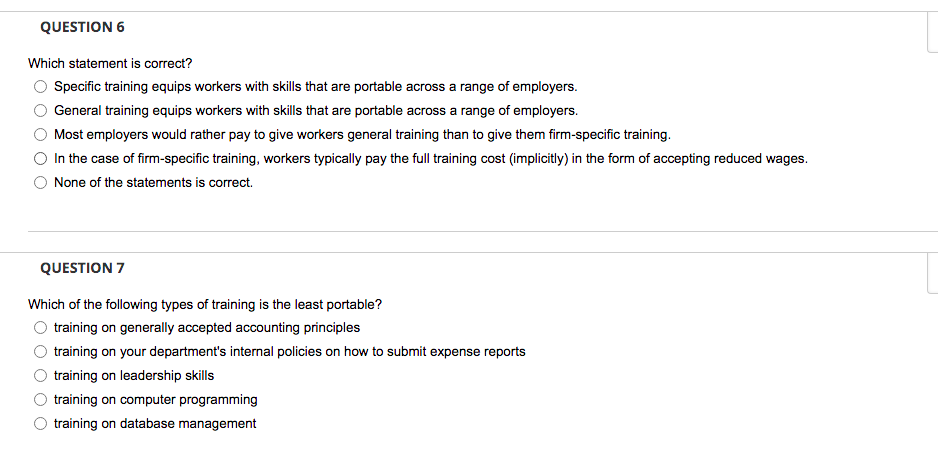
Question: QUESTION 6 Which statement is correct? Specific training equips workers with skills that are portable across a range of employers. General training equips workers with
QUESTION 6 Which statement is correct? SpecificQUESTION 6 Which statement is correct? Specific

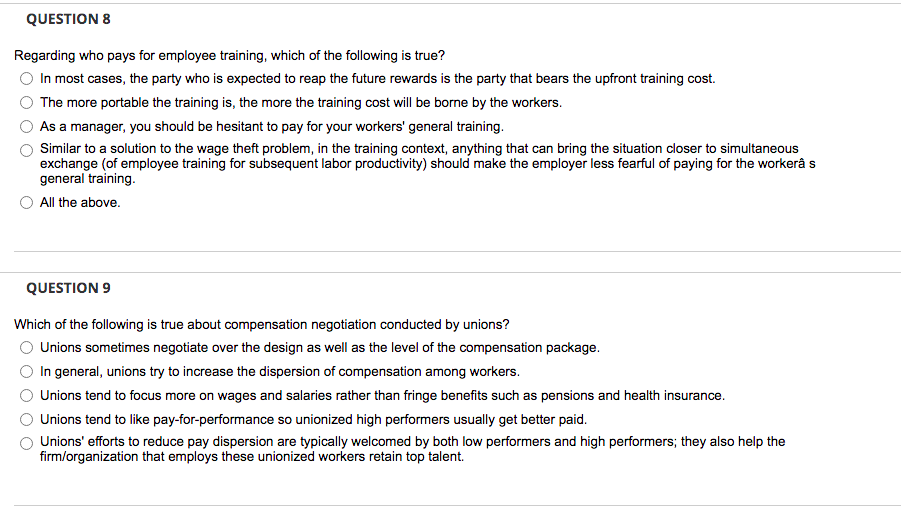
QUESTION 6 Which statement is correct? Specific training equips workers with skills that are portable across a range of employers. General training equips workers with skills that are portable across a range of employers. Most employers would rather pay to give workers general training than to give them firm-specific training. In the case of firm-specific training, workers typically pay the full training cost (implicitly) in the form of accepting reduced wages. None of the statements is correct. QUESTION 7 Which of the following types of training is the least portable? training on generally accepted accounting principles training on your department's internal policies on how to submit expense reports training on leadership skills training on computer programming training on database management QUESTION 8 Regarding who pays for employee training, which of the following is true? In most cases, the party who is expected to read the future rewards is the party that bears the upfront training cost. The more portable the training is, the more the training cost will be borne by the workers. As a manager, you should be hesitant to pay for your workers' general training. Similar to a solution to the wage theft problem, in the training context, anything that can bring the situation closer to simultaneous exchange of employee training for subsequent labor productivity) should make the employer less fearful of paying for the workers general training. All the above. QUESTIONS Which of the following is true about compensation negotiation conducted by unions? Unions sometimes negotiate over the design as well as the level of the compensation package. In general, unions try to increase the dispersion of compensation among workers. Unions tend to focus more on wages and salaries rather than fringe benefits such as pensions and health insurance. Unions tend to like pay-for-performance so unionized high performers usually get better paid. Unions' efforts to reduce pay dispersion are typically welcomed by both low performers and high performers; they also help the firm/organization that employs these unionized workers retain top talent

Step by Step Solution

There are 3 Steps involved in it

1 Expert Approved Answer
Step: 1 Unlock blur-text-image

Question Has Been Solved by an Expert!

Get step-by-step solutions from verified subject matter experts

Step: 2 Unlock
Step: 3 Unlock

Students Have Also Explored These Related General Management Questions!