



Question: Question 7 (0.8 points) In All Your Worth, Harvard Professor Warren writes, When you have some money in the bank, you can relax. In other
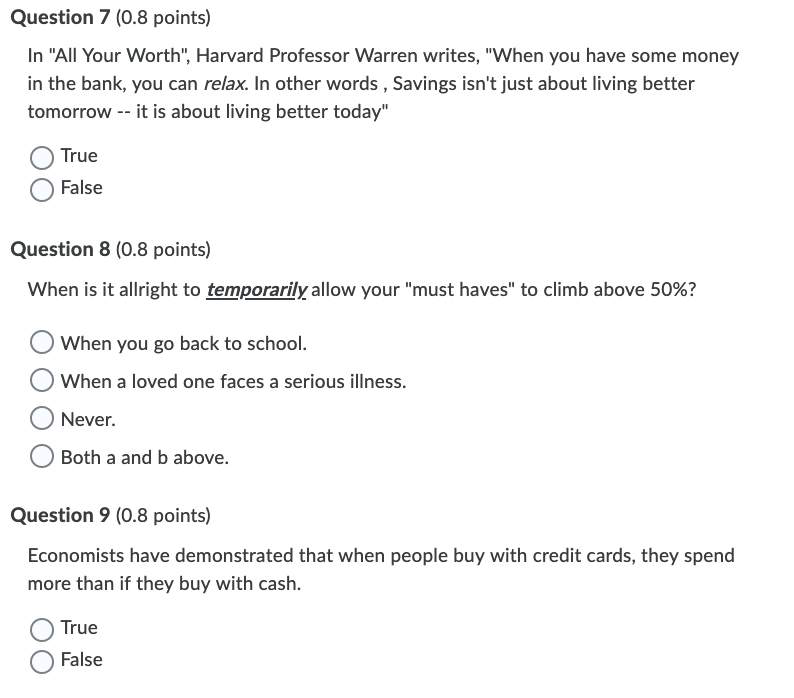
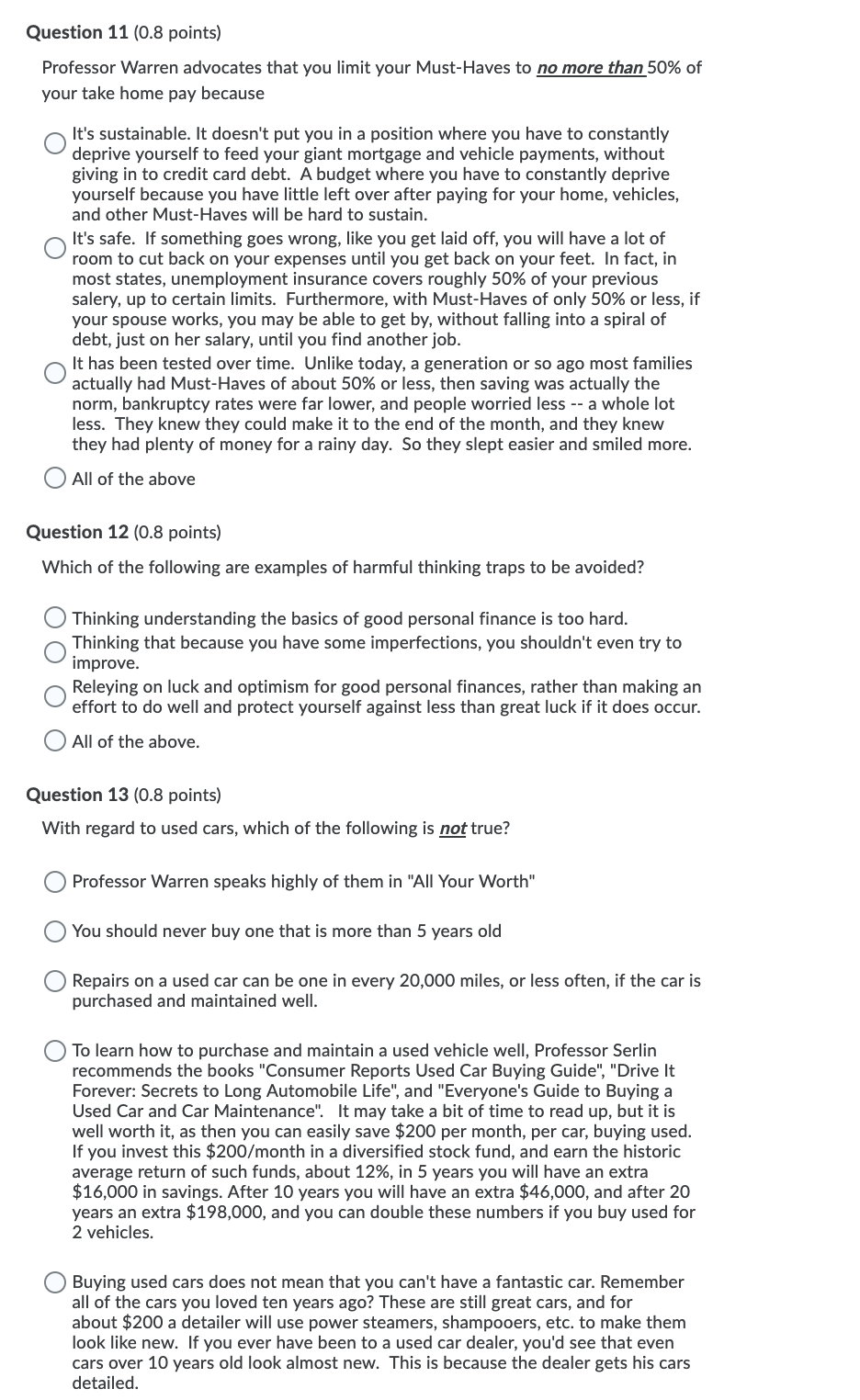
Question 7 (0.8 points) In "All Your Worth", Harvard Professor Warren writes, "When you have some money in the bank, you can relax. In other words , Savings isn't just about living better tomorrow -- it is about living better today" True False Question 8 (0.8 points) When is it allright to temporarily allow your "must haves" to climb above 50%? When you go back to school. When a loved one faces a serious illness. Never. Both a and b above. Question 9 (0.8 points) Economists have demonstrated that when people buy with credit cards, they spend more than if they buy with cash. True False Question 11 (0.8 points) Professor Warren advocates that you limit your Must-Haves to no more than 50% of your take home pay because It's sustainable. It doesn't put you in a position where you have to constantly deprive yourself to feed your giant mortgage and vehicle payments, without giving in to credit card debt. A budget where you have to constantly deprive yourself because you have little left over after paying for your home, vehicles, and other Must-Haves will be hard to sustain. It's safe. If something goes wrong, like you get laid off, you will have a lot of room to cut back on your expenses until you get back on your feet. In fact, in most states, unemployment insurance covers roughly 50% of your previous salery, up to certain limits. Furthermore, with Must-Haves of only 50% or less, if your spouse works, you may be able to get by, without falling into a spiral of debt, just on her salary, until you find another job. It has been tested over time. Unlike today, a generation or so ago most families actually had Must-Haves of about 50% or less, then saving was actually the norm, bankruptcy rates were far lower, and people worried less -- a whole lot less. knew they could make it to the end of the month, and they knew they had plenty of money for a rainy day. So they slept easier and smiled more. O All of the above Question 12 (0.8 points) Which of the following are examples of harmful thinking traps to be avoided? Thinking understanding the basics of good personal finance is too hard. Thinking that because you have some imperfections, you shouldn't even try to improve. Releying on luck and optimism for good personal finances, rather than making an effort to do well and protect yourself against less than great luck if it does occur. O All of the above. Question 13 (0.8 points) With regard to used cars, which of the following is not true? Professor Warren speaks highly of them in "All Your Worth" You should never buy one that is more than 5 years old Repairs on a used car can be one in every 20,000 miles, or less often, if the car is purchased and maintained well. To learn how to purchase and maintain a used vehicle well, Professor Serlin recommends the books "Consumer Reports Used Car Buying Guide", "Drive It Forever: Secrets to Long Automobile Life", and "Everyone's Guide to Buying a Used Car and Car Maintenance". It may take a bit of time to read up, but it is well worth it, as then you can easily save $200 per month, per car, buying used. If you invest this $200/month in a diversified stock fund, and earn the historic average return of such funds, about 12%, in 5 years you will have an extra $16,000 in savings. After 10 years you will have an extra $46,000, and after 20 years an extra $198,000, and you can double these numbers if you buy used for 2 vehicles. Buying used cars does not mean that you can't have a fantastic car. Remember all of the cars you loved ten years ago? These are still great cars, and for about $200 a detailer will use power steamers, shampooers, etc. to make them look like new. If you ever have been to a used car dealer, you'd see that even cars over 10 years old look almost new. This is because the dealer gets his cars detailed
Step by Step Solution
There are 3 Steps involved in it

Get step-by-step solutions from verified subject matter experts