







Question: Question 7 1. 3 Consider the class definition shown below. Notice that some lines have been replaced by descriptions (in angle brackets) of the code
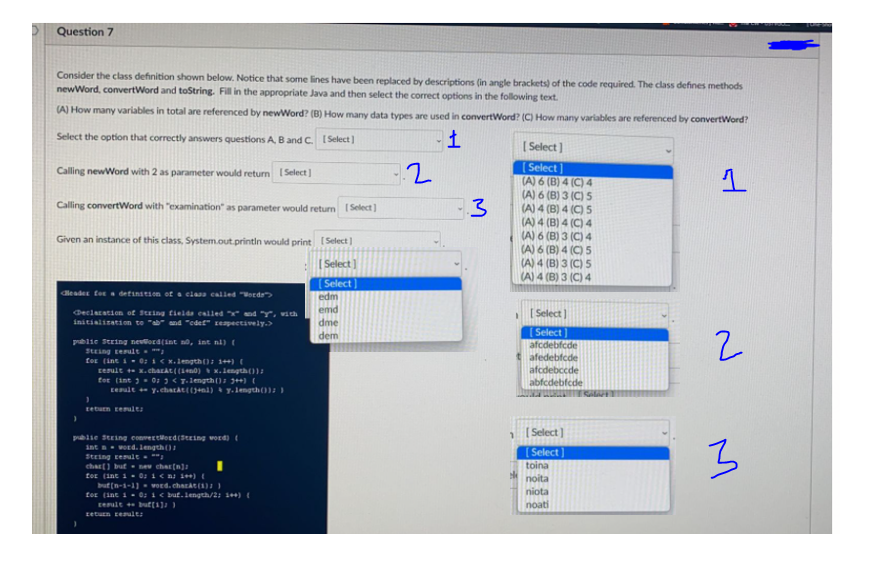
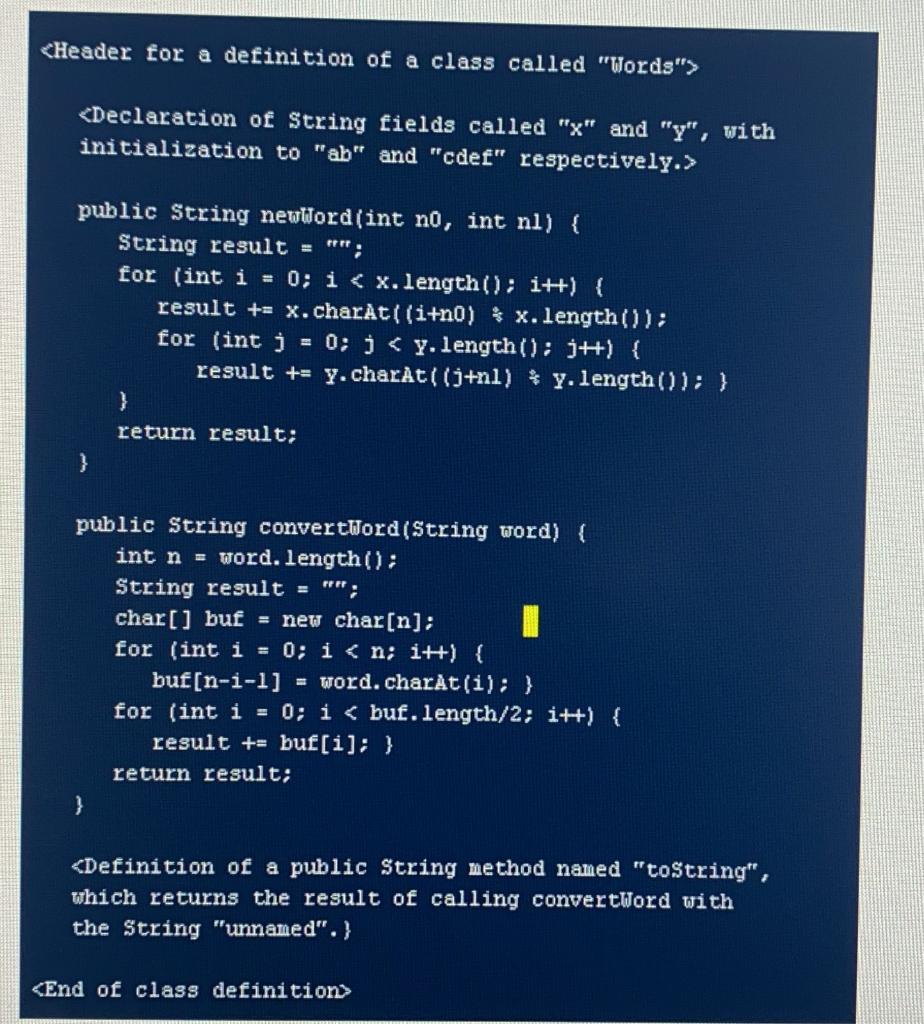
Question 7 1. 3 Consider the class definition shown below. Notice that some lines have been replaced by descriptions (in angle brackets) of the code required. The class defines methods newWord, convertWord and toString. Fill in the appropriate Java and then select the correct options in the following text. (A) How many variables in total are referenced by newWord? (B) How many data types are used in convertWord? (C) How many variables are referenced by convertWord? Select the option that correctly answers questions A, B and C. (Select] Select] Select Calling newWord with 2 as parameter would return (Select] 12 (A) 6 (B) 4 (C) 4 (A) 6 (B) 3 C) 5 Calling convertWord with "examination" as parameter would return Select) (A) 4 (B) 4 (C) 5 (A) 4 (B) 4 (C) 4 (A) 6 (B) 3 (C) 4 Given an instance of this class, System.out.println would print Select (A) 6 (B) 4 (C) 5 Select] (A) 4 (B) 3 C) 5 (A) 4 (B) 3 (C) 4 Select leads to a disson of a class called de edm Get station of Sing Cields called yd Y. with emd [Select] initialisation to ab and det egetely-> dme (Select dem public String neidint n, int nl) afcdebfcde Sting cesult tafedebfcde for (int i = 0; i
Step by Step Solution
There are 3 Steps involved in it

Get step-by-step solutions from verified subject matter experts
 Study Help