







Question: Question 7. For the optimization problem described at Question 3: - Explicitly consider the possibility of corner point solutions for mu that it might be
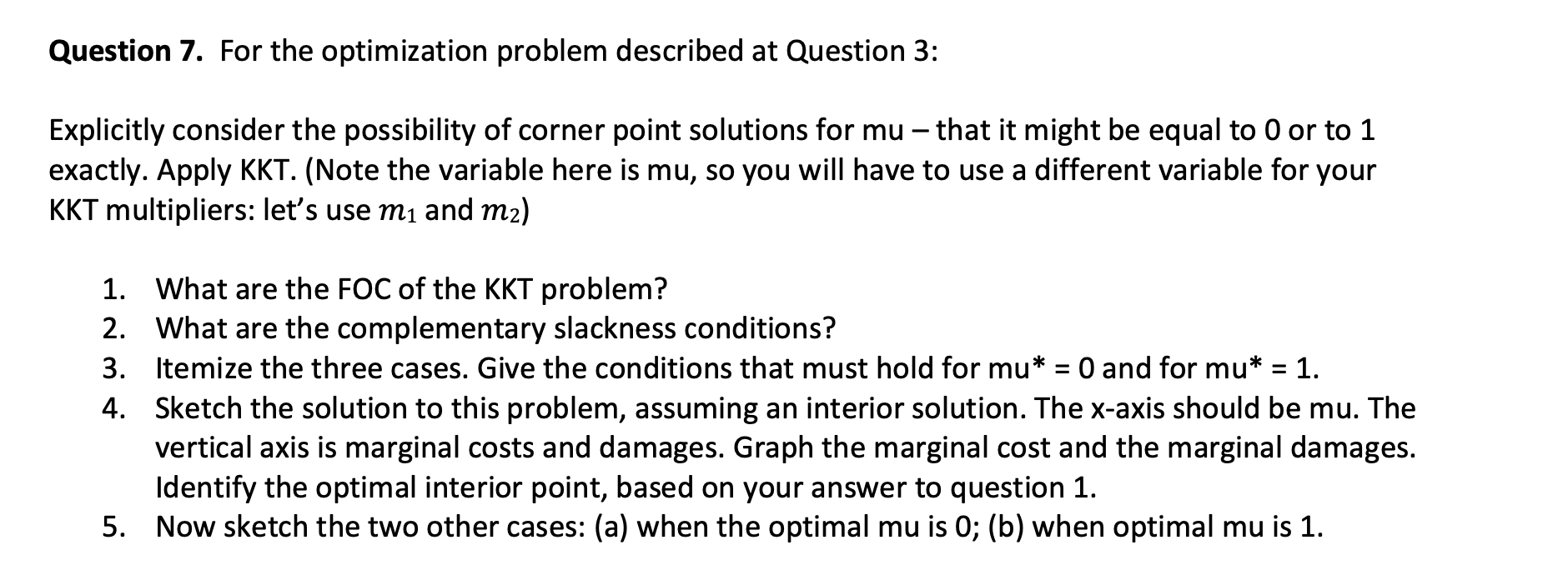
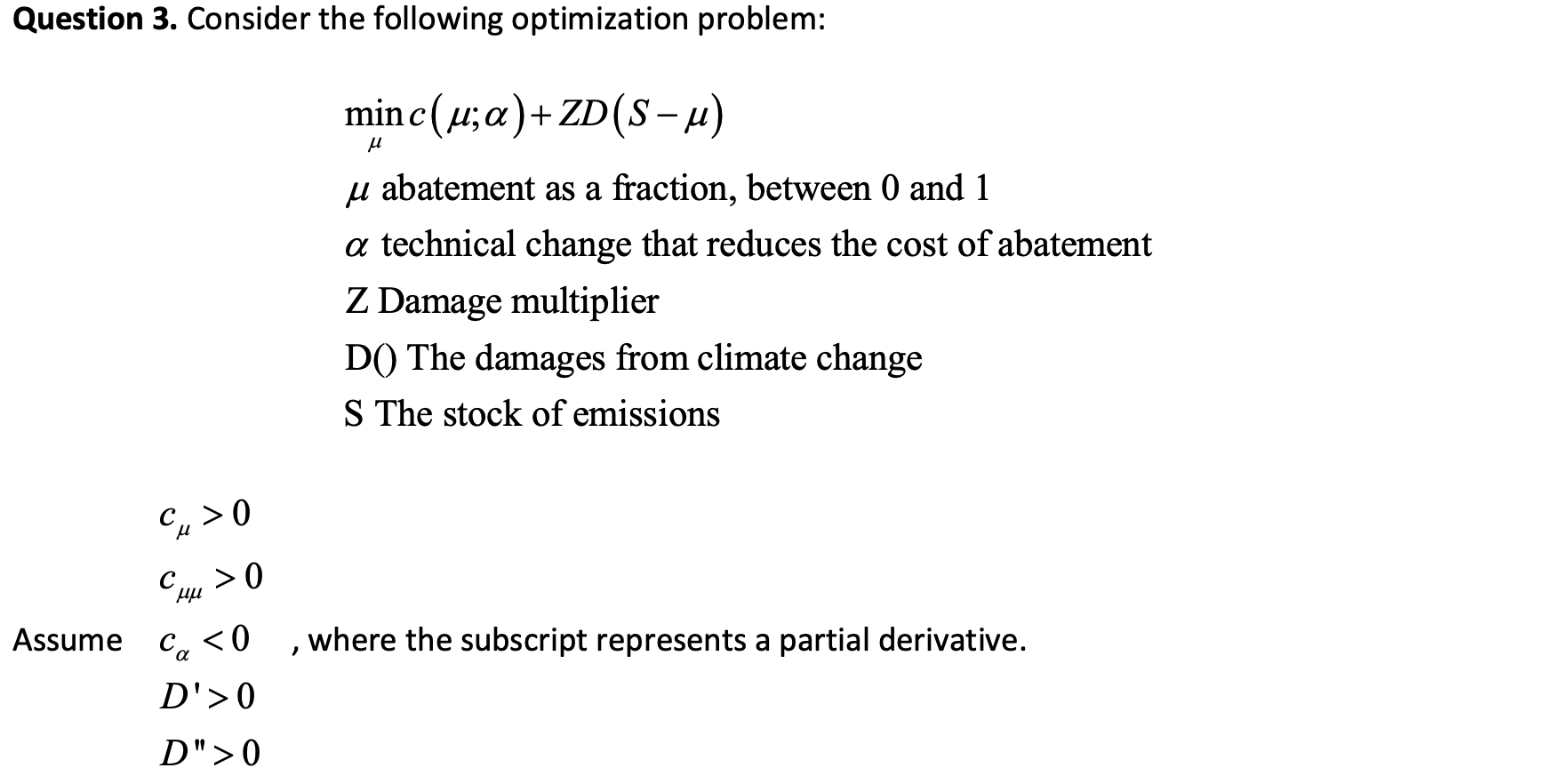
Question 7. For the optimization problem described at Question 3: - Explicitly consider the possibility of corner point solutions for mu that it might be equal to 0 or to 1 exactly. Apply KKT. (Note the variable here is mu, so you will have to use a different variable for your KKT multipliers: let's use m and m) 1. What are the FOC of the KKT problem? 2. What are the complementary slackness conditions? 3. 4. Itemize the three cases. Give the conditions that must hold for mu* = 0 and for mu* = 1. Sketch the solution to this problem, assuming an interior solution. The x-axis should be mu. The vertical axis is marginal costs and damages. Graph the marginal cost and the marginal damages. Identify the optimal interior point, based on your answer to question 1. 5. Now sketch the two other cases: (a) when the optimal mu is 0; (b) when optimal mu is 1. Question 3. Consider the following optimization problem: minc (; a) + ZD(S ) l abatement as a fraction, between 0 and 1 a technical change that reduces the cost of abatement Z Damage multiplier D() The damages from climate change S The stock of emissions CA > O C >0 C 0 D">0 Assume Question 7. For the optimization problem described at Question 3: - Explicitly consider the possibility of corner point solutions for mu that it might be equal to 0 or to 1 exactly. Apply KKT. (Note the variable here is mu, so you will have to use a different variable for your KKT multipliers: let's use m and m) 1. What are the FOC of the KKT problem? 2. What are the complementary slackness conditions? 3. 4. Itemize the three cases. Give the conditions that must hold for mu* = 0 and for mu* = 1. Sketch the solution to this problem, assuming an interior solution. The x-axis should be mu. The vertical axis is marginal costs and damages. Graph the marginal cost and the marginal damages. Identify the optimal interior point, based on your answer to question 1. 5. Now sketch the two other cases: (a) when the optimal mu is 0; (b) when optimal mu is 1. Question 3. Consider the following optimization problem: minc (; a) + ZD(S ) l abatement as a fraction, between 0 and 1 a technical change that reduces the cost of abatement Z Damage multiplier D() The damages from climate change S The stock of emissions CA > O C >0 C 0 D">0 Assume
Step by Step Solution
There are 3 Steps involved in it

Get step-by-step solutions from verified subject matter experts
 Study Help