







Question: QUESTION 7 In the linear model, V( u ) = OA. E( U2 ) . OB. O. OC. 42 OD. none of the above. QUESTION
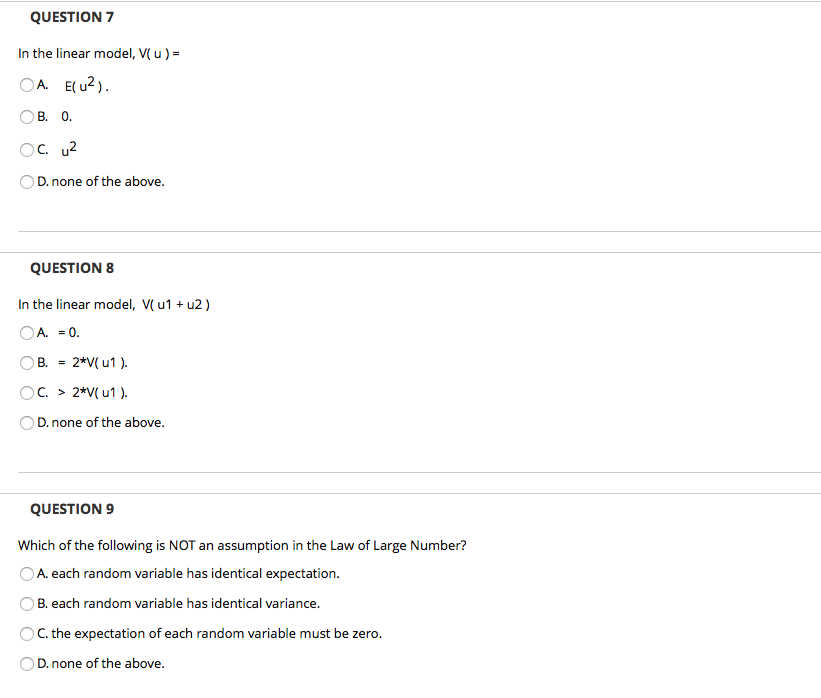
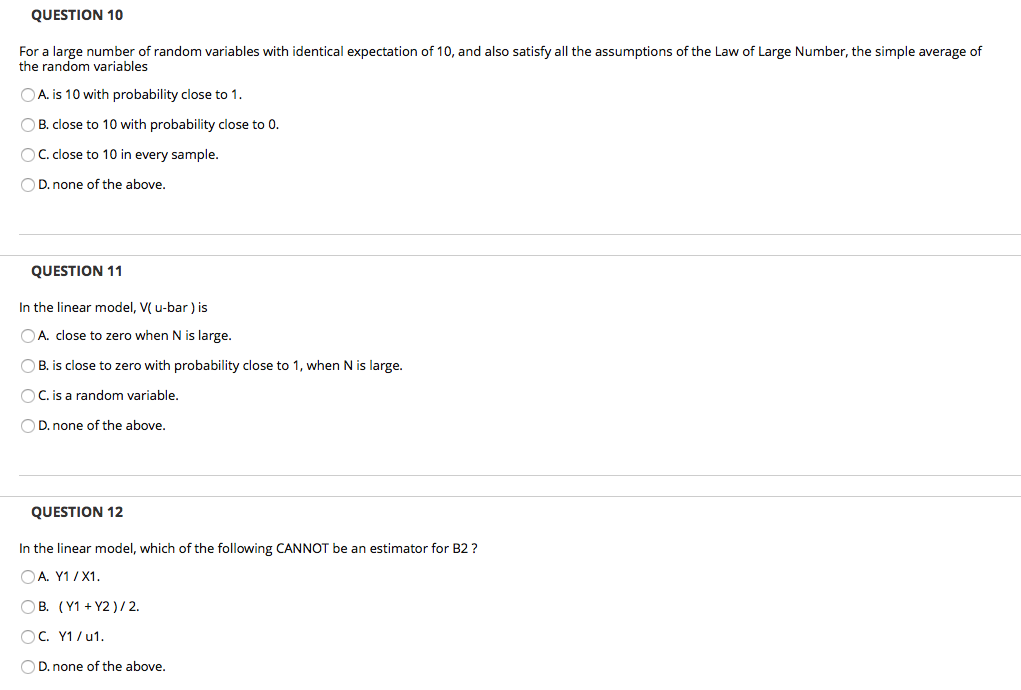
QUESTION 7 In the linear model, V( u ) = OA. E( U2 ) . OB. O. OC. 42 OD. none of the above. QUESTION 8 In the linear model, V( u1 + u2 ) OA. = 0. OB. = 2*V( u1 ). OC. > 2*V( 1 ). OD. none of the above. QUESTION 9 Which of the following is NOT an assumption in the Law of Large Number? OA. each random variable has identical expectation. OB. each random variable has identical variance. C. the expectation of each random variable must be zero. OD. none of the above.QUESTION 10 For a large number of random variables with identical expectation of 10, and also satisfy all the assumptions of the Law of Large Number, the simple average of the random variables OA. is 10 with probability close to 1. OB. close to 10 with probability close to 0. OC. close to 10 in every sample. OD. none of the above. QUESTION 11 In the linear model, V( u-bar ) is OA. close to zero when N is large. B. is close to zero with probability close to 1, when N is large. C. is a random variable. OD. none of the above. QUESTION 12 In the linear model, which of the following CANNOT be an estimator for B2 ? OA. Y1/ X1. OB. (Y1 + Y2) / 2. OC. Y1 / u1. OD. none of the above
Step by Step Solution
There are 3 Steps involved in it

Get step-by-step solutions from verified subject matter experts
 Study Help