







Question: question 7 please organic substrates may be empirically estimated by the following relationship: Kom=b(KO/W)a 14.15 where Ko is the partition coefficient between organic solids and

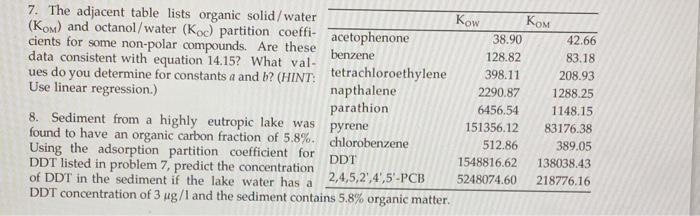
organic substrates may be empirically estimated by the following relationship: Kom=b(KO/W)a 14.15 where Ko is the partition coefficient between organic solids and water, Kow is the octanol/water 7. The adjacent table lists organic solid/water (KOM) and octanol/water (KOC) partition coefficients for some non-polar compounds. Are these data consistent with equation 14.15? What values do you determine for constants a and b ? (HINT: Use linear regression.) 8. Sediment from a highly eutropic lake was found to have an organic carbon fraction of 5.8%. Using the adsorption partition coefficient for DDT listed in problem 7, predict the concentration of DDT in the sediment if the lake water has a DDT concentration of 3g/1 and the sediment conta organic substrates may be empirically estimated by the following relationship: Kom=b(KO/W)a 14.15 where Ko is the partition coefficient between organic solids and water, Kow is the octanol/water 7. The adjacent table lists organic solid/water (KOM) and octanol/water (KOC) partition coefficients for some non-polar compounds. Are these data consistent with equation 14.15? What values do you determine for constants a and b ? (HINT: Use linear regression.) 8. Sediment from a highly eutropic lake was found to have an organic carbon fraction of 5.8%. Using the adsorption partition coefficient for DDT listed in problem 7, predict the concentration of DDT in the sediment if the lake water has a DDT concentration of 3g/1 and the sediment conta
Step by Step Solution
There are 3 Steps involved in it

Get step-by-step solutions from verified subject matter experts
 Study Help