



Question: QUESTION 7 Suppose the null hypothesis, Ho, is: a patient is not sick. Does Type I or Type II have the greater consequence? O Type
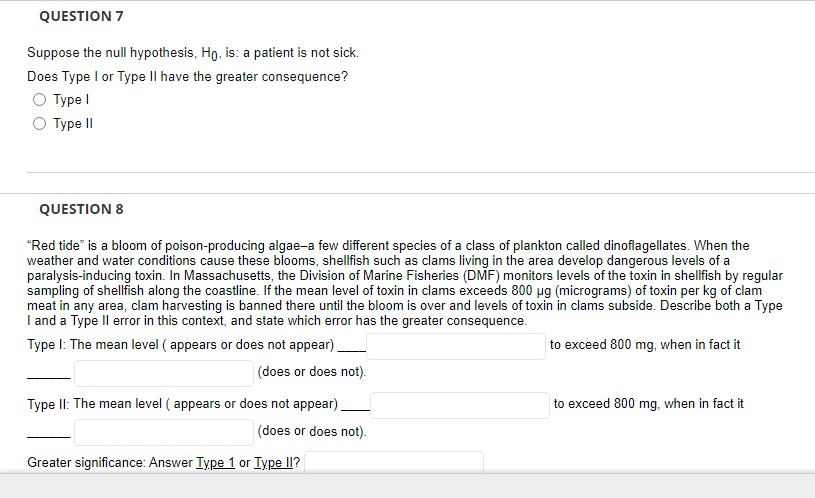
QUESTION 7 Suppose the null hypothesis, Ho, is: a patient is not sick. Does Type I or Type II have the greater consequence? O Type I O Type II QUESTION 8 "Red tide" is a bloom of poison-producing algae-a few different species of a class of plankton called dinoflagellates. When the weather and water conditions cause these blooms, shellfish such as clams living in the area develop dangerous levels of a paralysis-inducing toxin. In Massachusetts, the Division of Marine Fisheries (DMF) monitors levels of the toxin in shellfish by regular sampling of shellfish along the coastline. If the mean level of toxin in clams exceeds 800 pg (micrograms) of toxin per kg of clam meat in any area, clam harvesting is banned there until the bloom is over and levels of toxin in clams subside. Describe both a Type I and a Type II error in this context, and state which error has the greater consequence. Type I: The mean level ( appears or does not appear) to exceed 800 mg, when in fact it (does or does not). Type II: The mean level ( appears or does not appear) to exceed 800 mg, when in fact it (does or does not). Greater significance: Answer Type 1 or Type
Step by Step Solution
There are 3 Steps involved in it

Get step-by-step solutions from verified subject matter experts