







Question: Question 8 (1 point) Consider two prospects: Problem 1: Choose between Prospect A: $2,500 with probability .33, $2,400 with probability .66, Zero with probability .01.
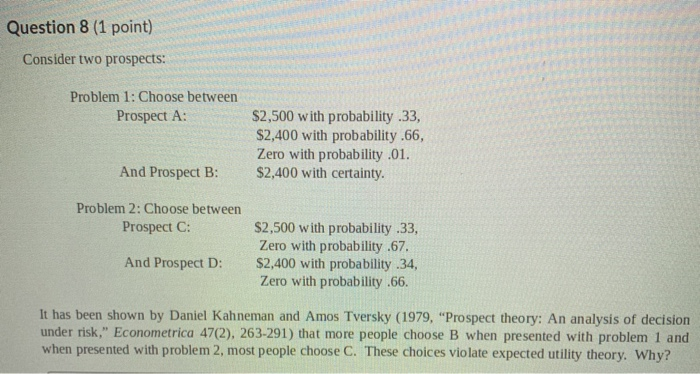
Question 8 (1 point) Consider two prospects: Problem 1: Choose between Prospect A: $2,500 with probability .33, $2,400 with probability .66, Zero with probability .01. $2,400 with certainty. And Prospect B: Problem 2: Choose between Prospect C: And Prospect D: $2,500 with probability .33, Zero with probability .67. $2,400 with probability .34, Zero with probability .66. It has been shown by Daniel Kahneman and Amos Tversky (1979, "Prospect theory: An analysis of decision under risk," Econometrica 47(2), 263-291) that more people choose B when presented with problem 1 and when presented with problem 2, most people choose C. These choices violate expected utility theory. Why? Question 8 (1 point) Consider two prospects: Problem 1: Choose between Prospect A: $2,500 with probability .33, $2,400 with probability .66, Zero with probability .01. $2,400 with certainty. And Prospect B: Problem 2: Choose between Prospect C: And Prospect D: $2,500 with probability .33, Zero with probability .67. $2,400 with probability .34, Zero with probability .66. It has been shown by Daniel Kahneman and Amos Tversky (1979, "Prospect theory: An analysis of decision under risk," Econometrica 47(2), 263-291) that more people choose B when presented with problem 1 and when presented with problem 2, most people choose C. These choices violate expected utility theory. Why
Step by Step Solution
There are 3 Steps involved in it

Get step-by-step solutions from verified subject matter experts
 Study Help