







Question: Question 8 (1 point) Though both are asymmetric information problems, moral hazard {whether ex-ante or ex-post} differs from adverse selection in that O A] the
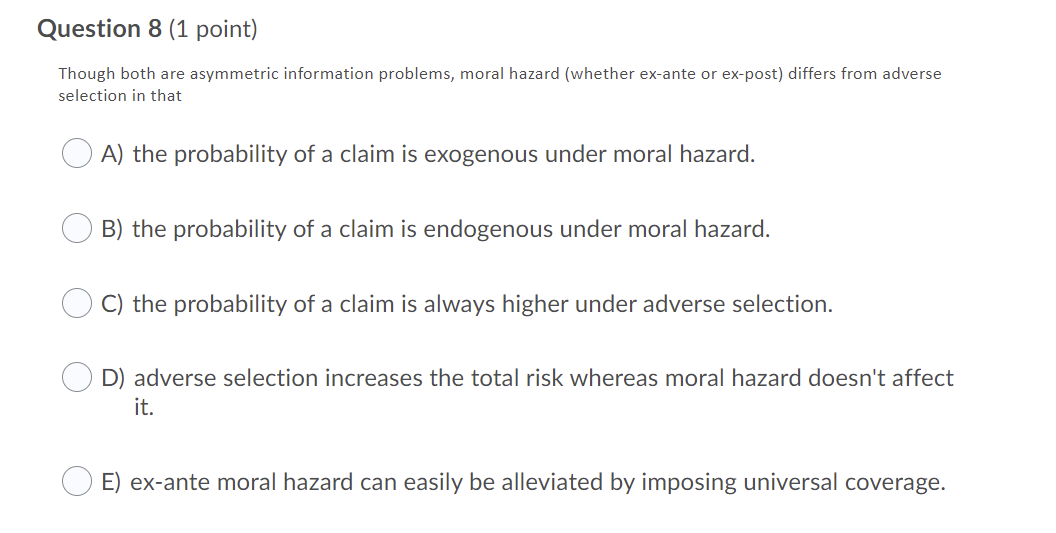
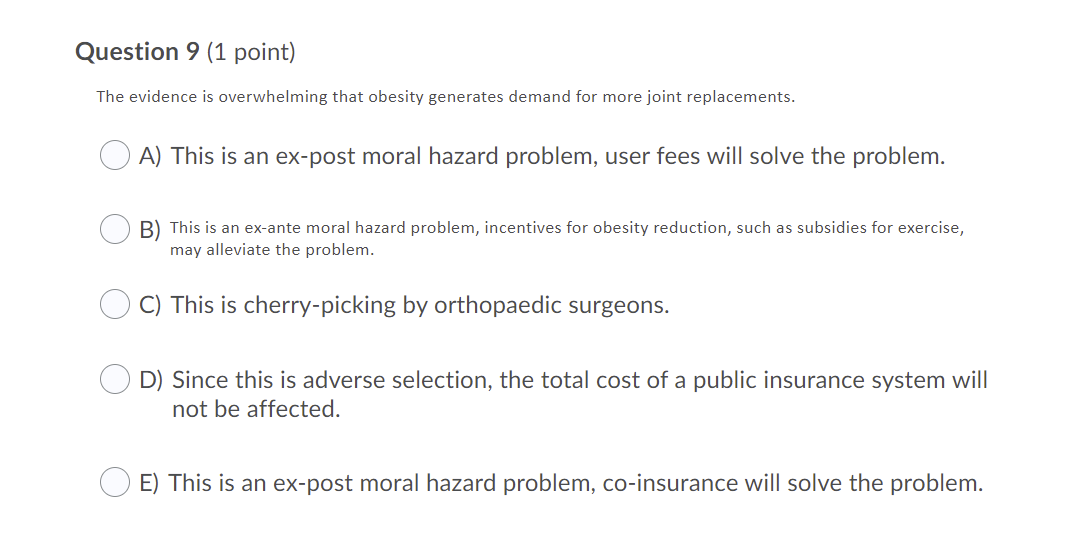
Question 8 (1 point) Though both are asymmetric information problems, moral hazard {whether ex-ante or ex-post} differs from adverse selection in that O A] the probability of a claim is exogenous under moral hazard. O B) the probability of a claim is endogenous under moral hazard. O C] the probability of a claim is always higher under adverse selection. 0 D) adverse selection increases the total risk whereas moral hazard doesn't affect it. Q E) ex-ante moral hazard can easily be alleviated by imposing universal coverage. Question 9 (1 point) The evidence is overwhelming that obesity generates demand for more joint replacements. O A) This is an ex-post moral hazard problem, user fees will solve the problem. 0 B) This is an exante moral hazard problem, incentives for obesityr reduction, such as subsidies for exercise, max.r alleviate the problem. 0 C) This is cherry-picking by orthopaedic surgeons. O D) Since this is adverse selection, the total cost of a public insurance system will not be affected. 0 E) This is an ex-post moral hazard problem, co-insurance will solve the
Step by Step Solution
There are 3 Steps involved in it

Get step-by-step solutions from verified subject matter experts
 Study Help