







Question: Question 8 Consider a cluster that has little availability support. Upon a node failure, the following sequence of events takes place: 1. The entire system
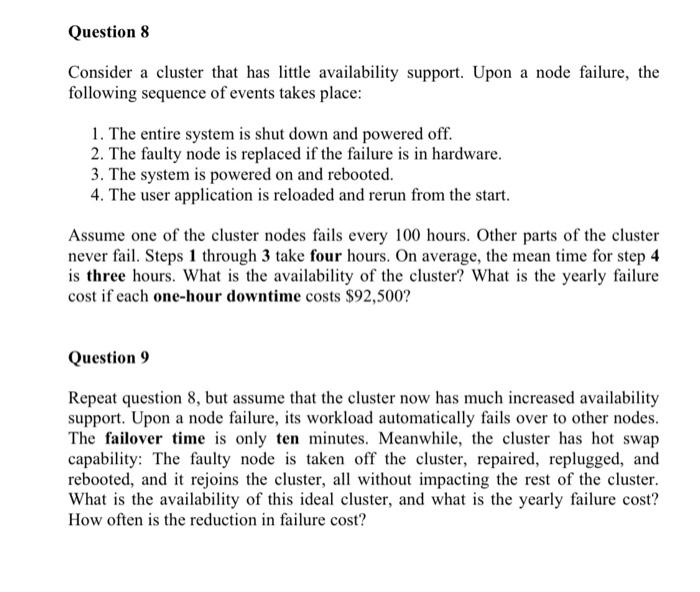
Question 8 Consider a cluster that has little availability support. Upon a node failure, the following sequence of events takes place: 1. The entire system is shut down and powered off. 2. The faulty node is replaced if the failure is in hardware. 3. The system is powered on and rebooted. 4. The user application is reloaded and rerun from the start. Assume one of the cluster nodes fails every 100 hours. Other parts of the cluster never fail. Steps 1 through 3 take four hours. On average, the mean time for step 4 is three hours. What is the availability of the cluster? What is the yearly failure cost if each one-hour downtime costs $92,500? Question 9 Repeat question 8, but assume that the cluster now has much increased availability support. Upon a node failure, its workload automatically fails over to other nodes. The failover time is only ten minutes. Meanwhile, the cluster has hot swap capability: The faulty node is taken off the cluster, repaired, replugged, and rebooted, and it rejoins the cluster, all without impacting the rest of the cluster. What is the availability of this ideal cluster, and what is the yearly failure cost? How often is the reduction in failure cost
Step by Step Solution
There are 3 Steps involved in it

Get step-by-step solutions from verified subject matter experts
 Study Help