







Question: Question 8: Identify the Lagrange dual problem in this primal problem: Given featuresViXNV, where V1Vw-1,1) Minimize W w+C i, the weighted sum between the squared
Question 8: Identify the Lagrange dual problem in this primal problem:
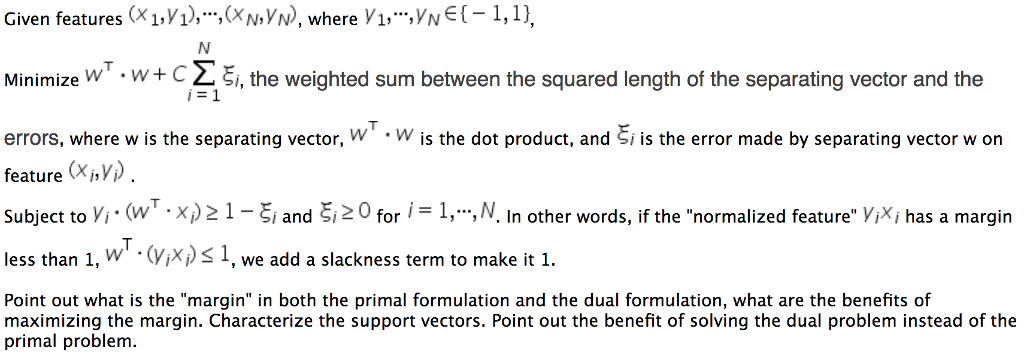
Given featuresViXNV, where V1"Vw-1,1) Minimize W w+C i, the weighted sum between the squared length of the separating vector and the errors, where w is the separating vector, W W is the dot product, and i is the error made by separating vector w on featureV Subject to y,' (w' . xi) 2 1- , and Si 2 0 for i-1, , N, In other words, if the "normalized feature" y,x, has a margin less than 1,W (VXDS1, we add a slackness term to make it 1 Point out what is the "margin" in both the primal formulation and the dual formulation, what are the benefits of maximizing the margin. Characterize the support vectors. Point out the benefit of solving the dual problem instead of the primal problem. Given featuresViXNV, where V1"Vw-1,1) Minimize W w+C i, the weighted sum between the squared length of the separating vector and the errors, where w is the separating vector, W W is the dot product, and i is the error made by separating vector w on featureV Subject to y,' (w' . xi) 2 1- , and Si 2 0 for i-1, , N, In other words, if the "normalized feature" y,x, has a margin less than 1,W (VXDS1, we add a slackness term to make it 1 Point out what is the "margin" in both the primal formulation and the dual formulation, what are the benefits of maximizing the margin. Characterize the support vectors. Point out the benefit of solving the dual problem instead of the primal
Step by Step Solution
There are 3 Steps involved in it

Get step-by-step solutions from verified subject matter experts
 Study Help