







Question: Question 8 Suppose that p is a value parameter ot type int*. What happens when a function does an assignment to *p When should a
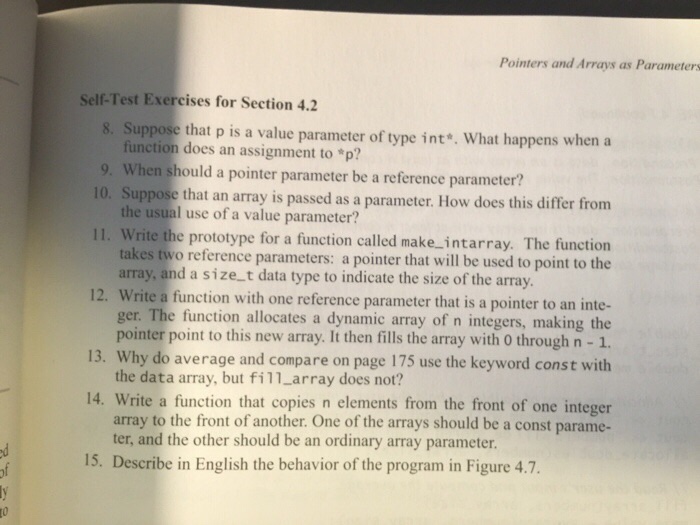
Suppose that p is a value parameter ot type int*. What happens when a function does an assignment to *p When should a pointer parameter be a reference parameter Suppose that an array is passed as a parameter. How does this differ from the usual use of a value parameter Write the prototype tor a function called make_ intarray. The function takes two reference parameters: a pointer that will be used to point to the array,and size_t data type to indicate the size of the array.Write a function with one reference parameter that is a pointer to an integer. The function allocates a dynamic array of n integers, making the pointer point to this new array. It then fills the array with 0 through n - 1.Why do average and compare on page 175 use the keyword const with the data array, but f fill_array does not Write a function that copies n elements from the front of one integer array to the front of another. One of the arrays should be a const parameter, and the other should be an ordinary array parameter.Describe in English the behavior of the program in Figure 4.7
Step by Step Solution
There are 3 Steps involved in it

Get step-by-step solutions from verified subject matter experts
 Study Help