







Question: Question 8.3 a * that the execution stage requires one step. Describe, and show in diagram form, what happens when an instruction that requires one
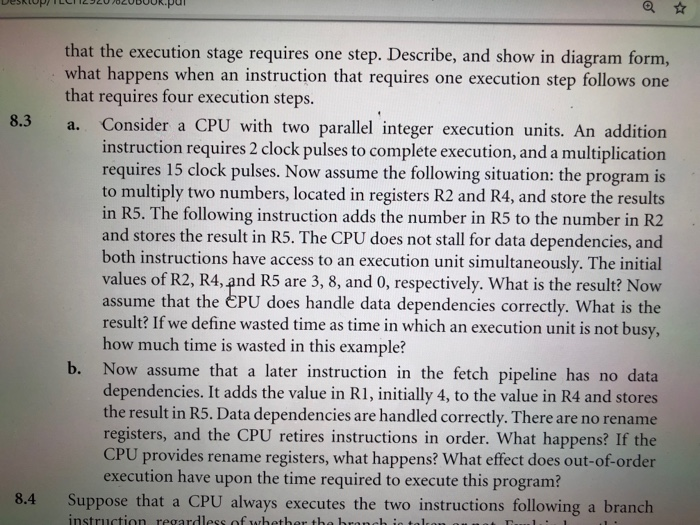
a * that the execution stage requires one step. Describe, and show in diagram form, what happens when an instruction that requires one execution step follows one that requires four execution steps. a. Consider a CPU with two parallel integer execution units. An addition instruction requires 2 clock pulses to complete execution, and a multiplication requires 15 clock pulses. Now assume the following situation: the program is to multiply two numbers, located in registers R2 and R4, and store the results in R5. The following instruction adds the number in R5 to the number in R2 and stores the result in R5. The CPU does not stall for data dependencies, and both instructions have access to an execution unit simultaneously. The initial values of R2, R4,and R5 are 3, 8, and 0, respectively. What is the result? Now assume that the EPU does handle data dependencies correctly. What is the result? If we define wasted time as time in which an execution unit is not busy how much time is wasted in this example? Now assume that a later instruction in the fetch pipeline has no data dependencies. It adds the value in R1, initially 4, to the value in R4 and stores the result in R5. Data dependencies are handled correctly. There are no rename registers, and the CPU retires instructions in order. What happens? If the CPU provides rename registers, what happens? What effect does out-of-order execution have upon the time required to execute this program? b. Suppose that a CPU always executes the two instructions following a branch instruction regardless of whether the broneh 8.4
Step by Step Solution
There are 3 Steps involved in it

Get step-by-step solutions from verified subject matter experts
 Study Help