







Question: Question 9 (1 point) At a point x = c where f'(c) = 0, f(c) is not guaranteed to be either a local maximum or
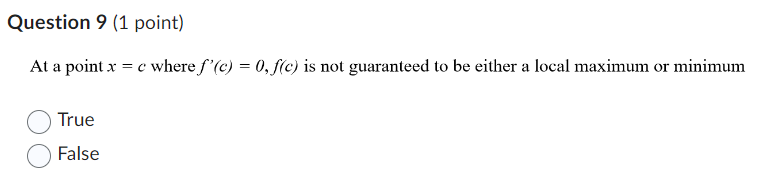
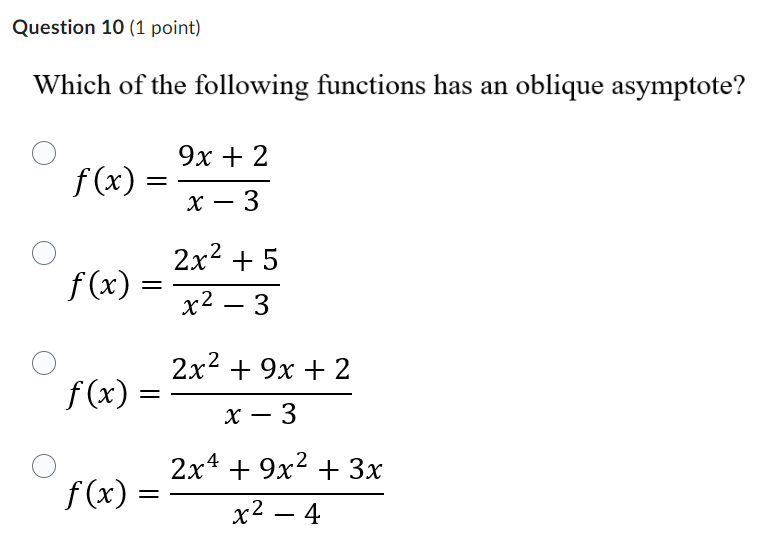
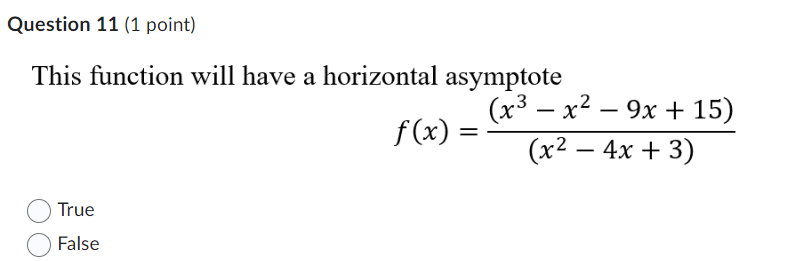
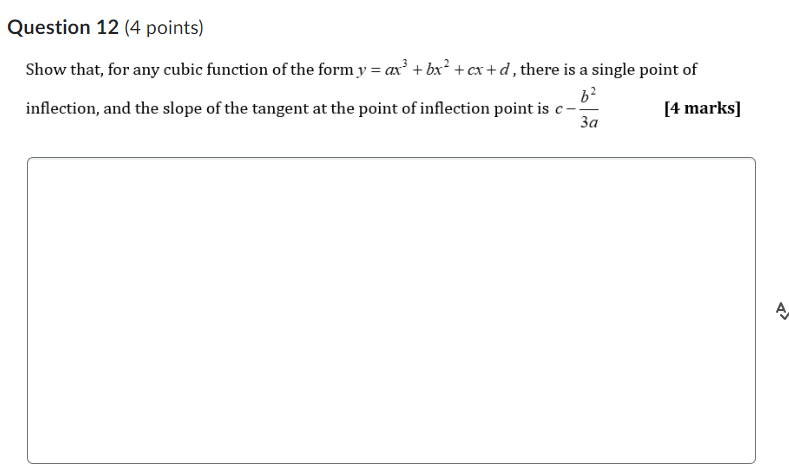
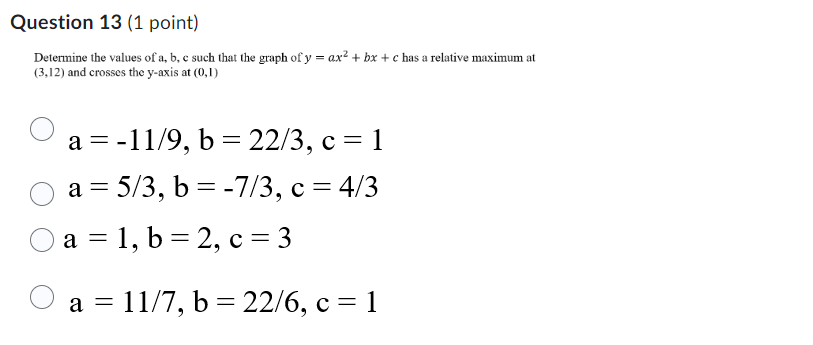
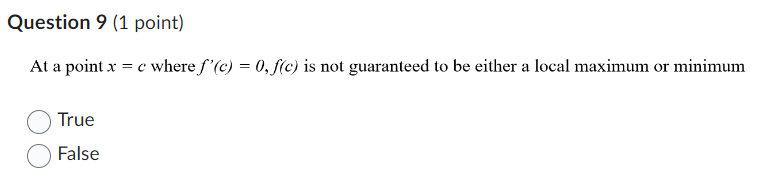
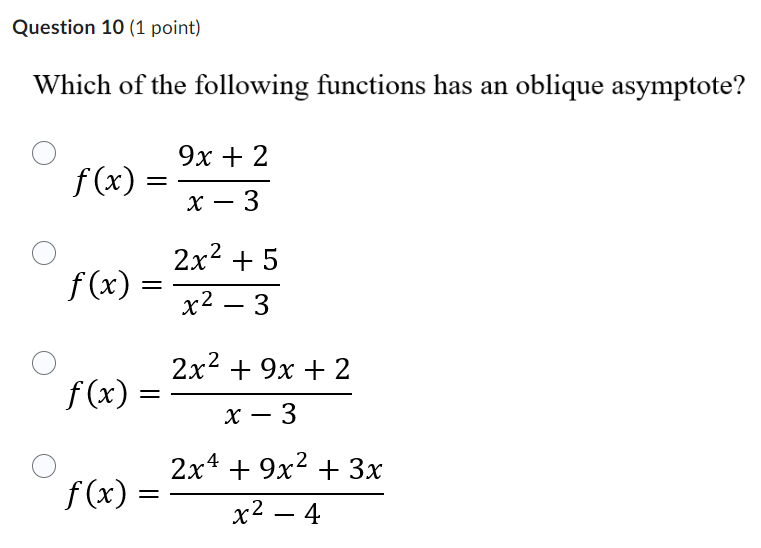
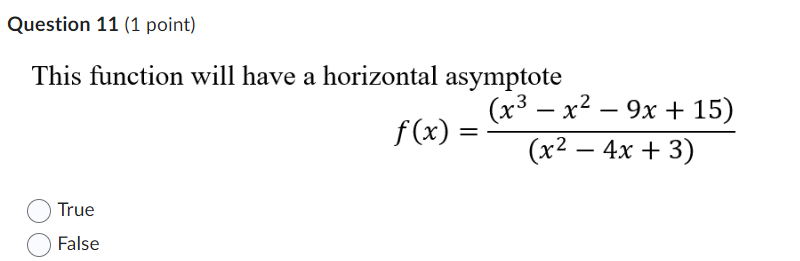
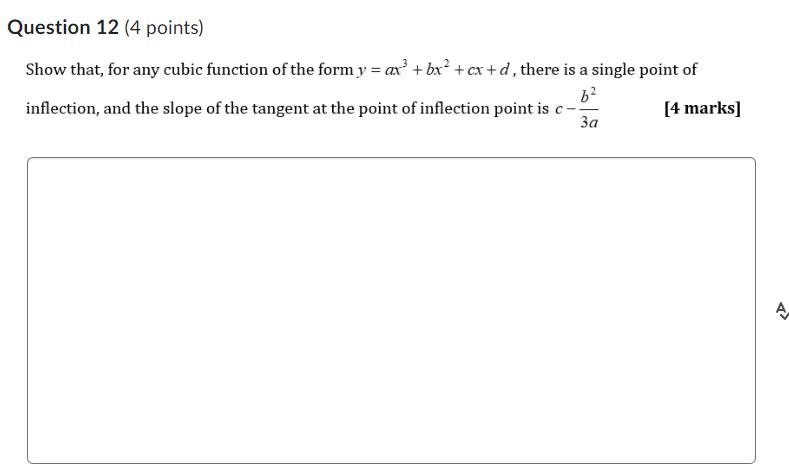
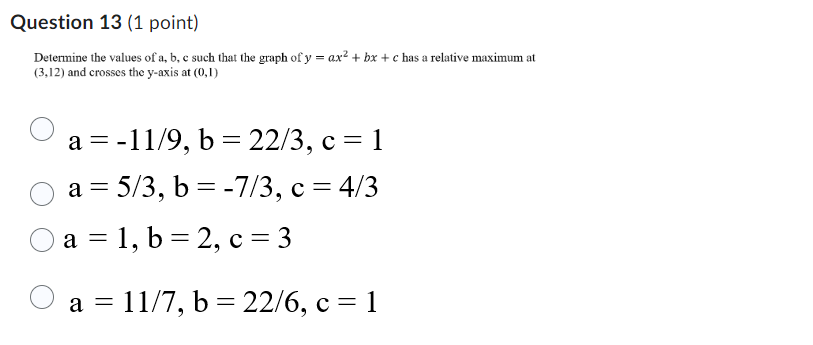
Question 9 (1 point) At a point x = c where f'(c) = 0, f(c) is not guaranteed to be either a local maximum or minimum O True O FalseQuestion 10 (1 point) Which of the following functions has an oblique asymptote? O 9x + 2 f (x) = x - 3 O 2x2 + 5 f ( x) = x2 - 3 O 2x2 + 9x + 2 f ( x ) = x - 3 O 2x4 + 9x2 + 3x f ( x) = x2 - 4Question 11 (1 point) This function will have a horizontal asymptote (x3 - x2 - 9x + 15) f ( x = (x2 - 4x + 3) True OFalseQuestion 12 (4 points) Show that, for any cubic function of the form y = ax + bx- + cx + d, there is a single point of inflection, and the slope of the tangent at the point of inflection point is c -- b2 [4 marks] 3a AQuestion 13 (1 point) Determine the values of a, b, c such that the graph of y = ax + bx + c has a relative maximum at (3,12) and crosses the y-axis at (0, 1) a =-11/9, b = 22/3, c = 1 O a= 5/3, b=-7/3, c =4/3 Oa = 1, b=2, c =3 O a = 11/7, b= 22/6, c = 1
Step by Step Solution
There are 3 Steps involved in it

Get step-by-step solutions from verified subject matter experts
 Study Help