







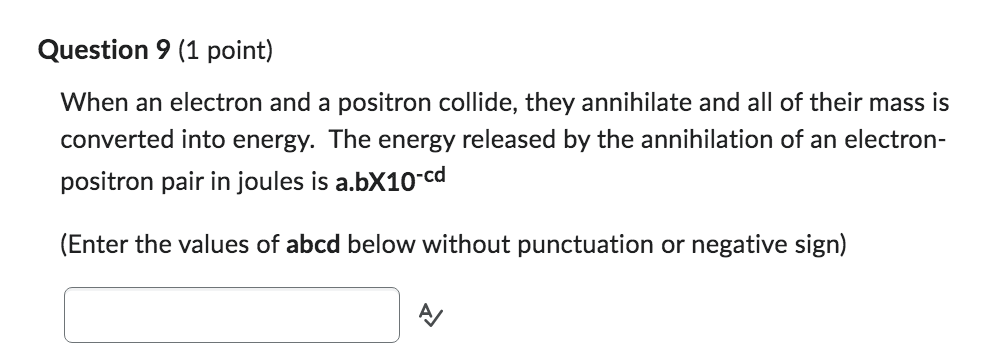
Question: Question 9 (1 point) When an electron and a positron collide, they annihilate and all of their mass is converted into energy. The energy released
![sign) 'E/ Question 10 (1 point] The binding energy for potassium-40 is:](https://s3.amazonaws.com/si.experts.images/answers/2024/06/6676ea0715de1_1906676ea06edc6a.jpg)
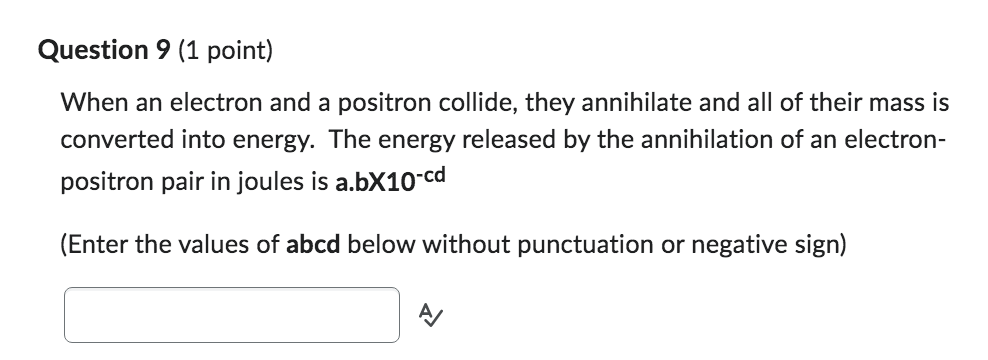
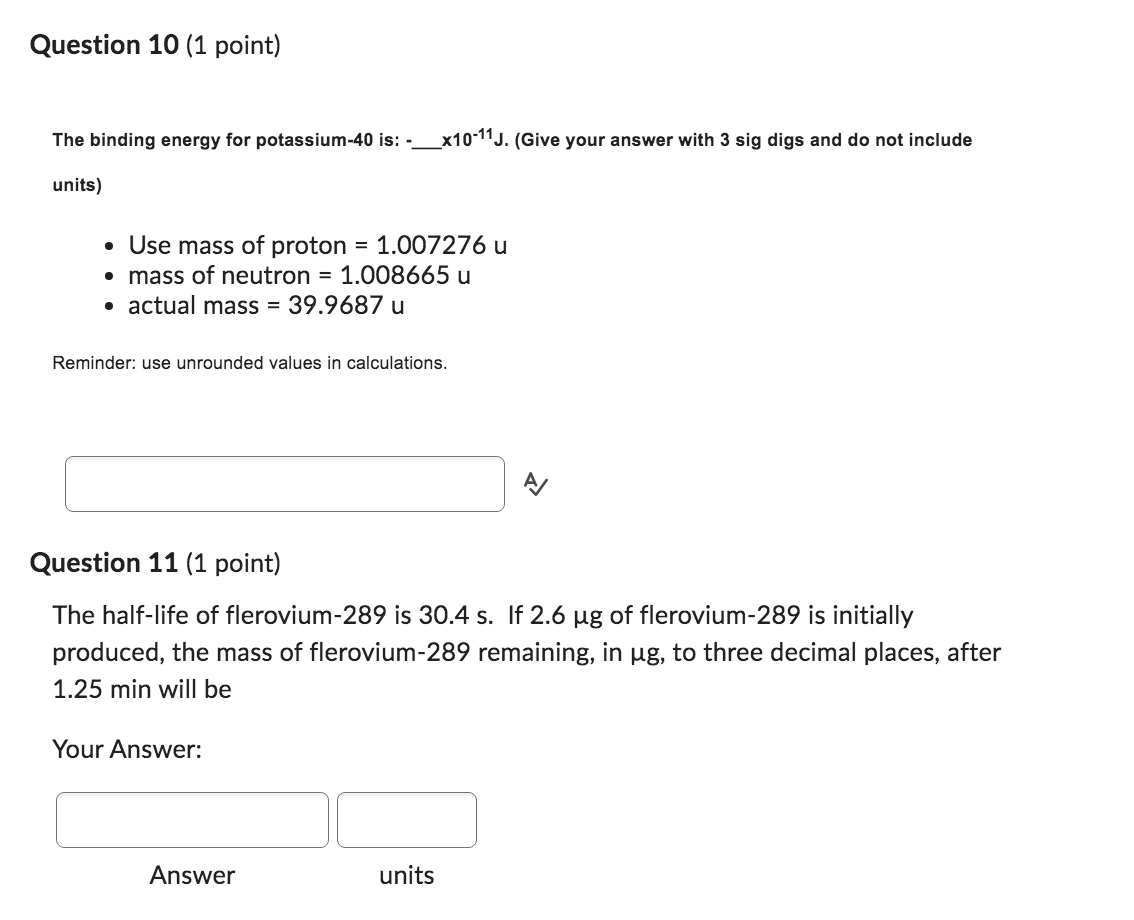
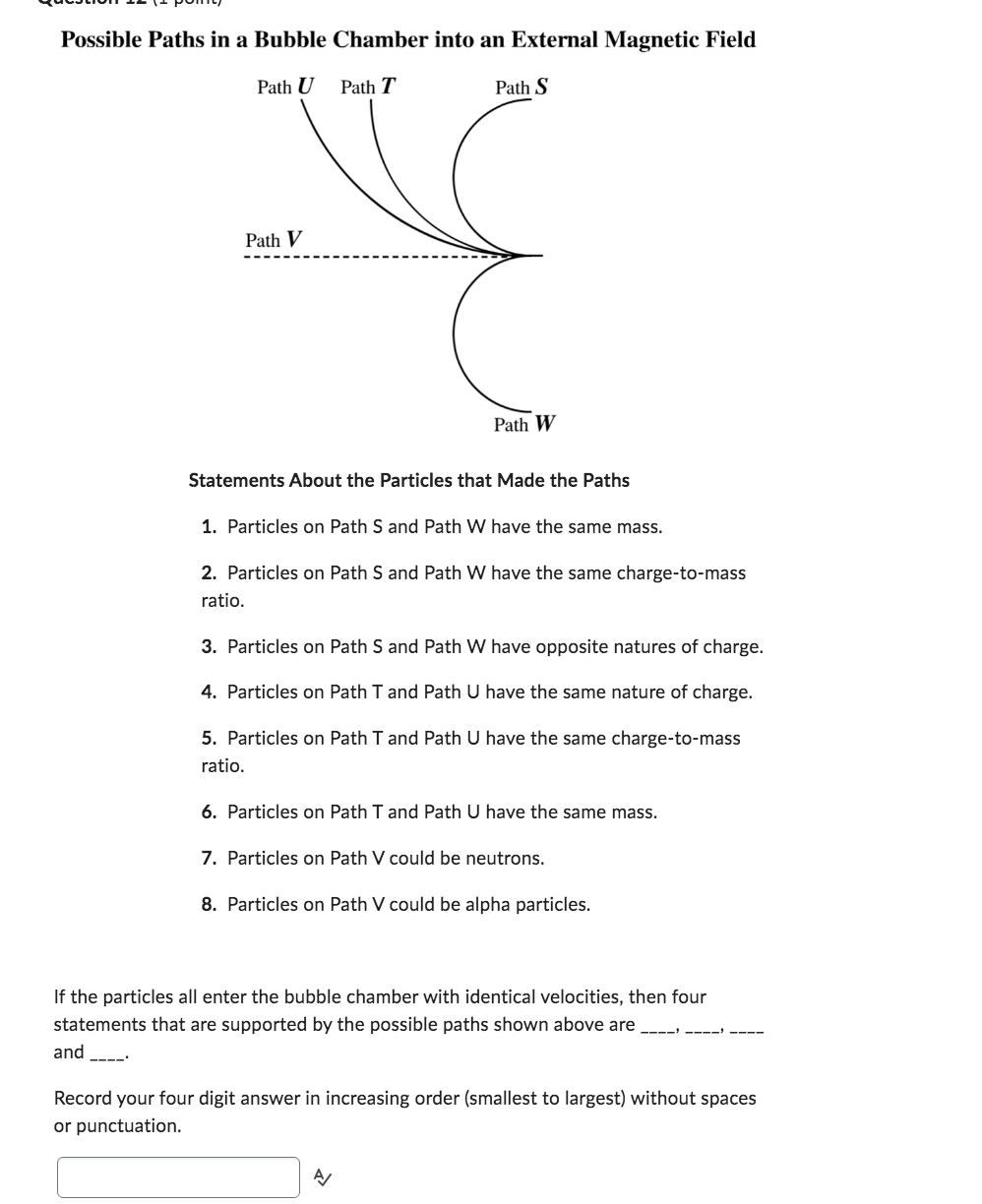
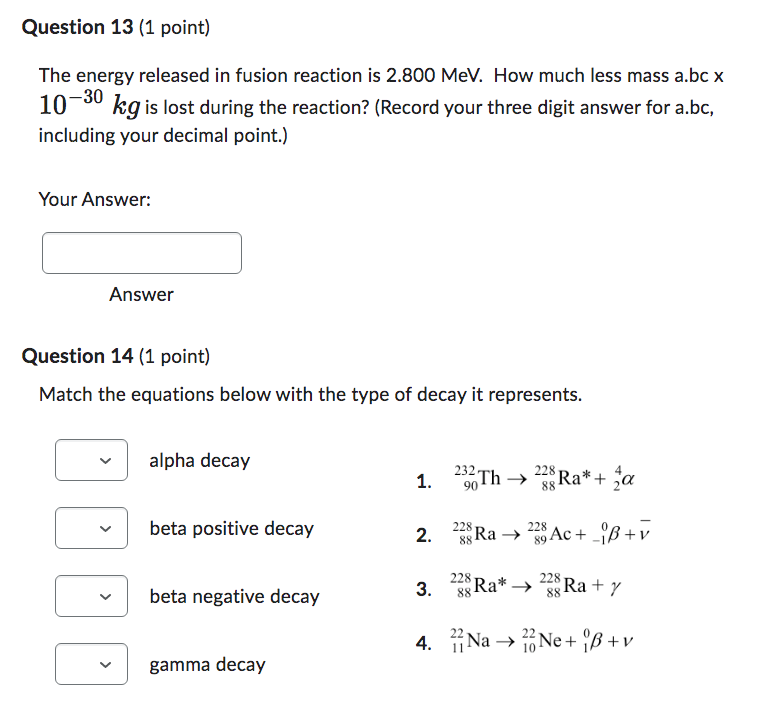
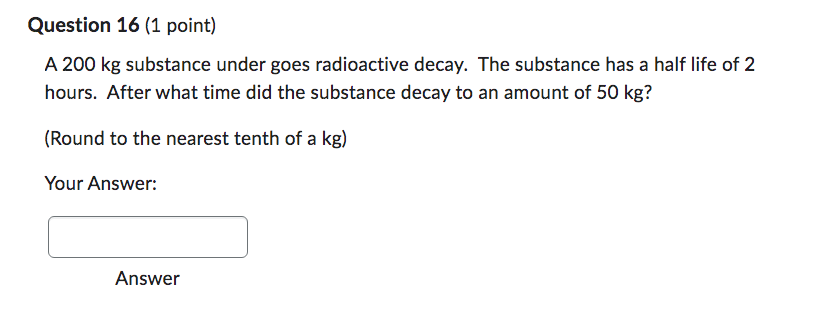
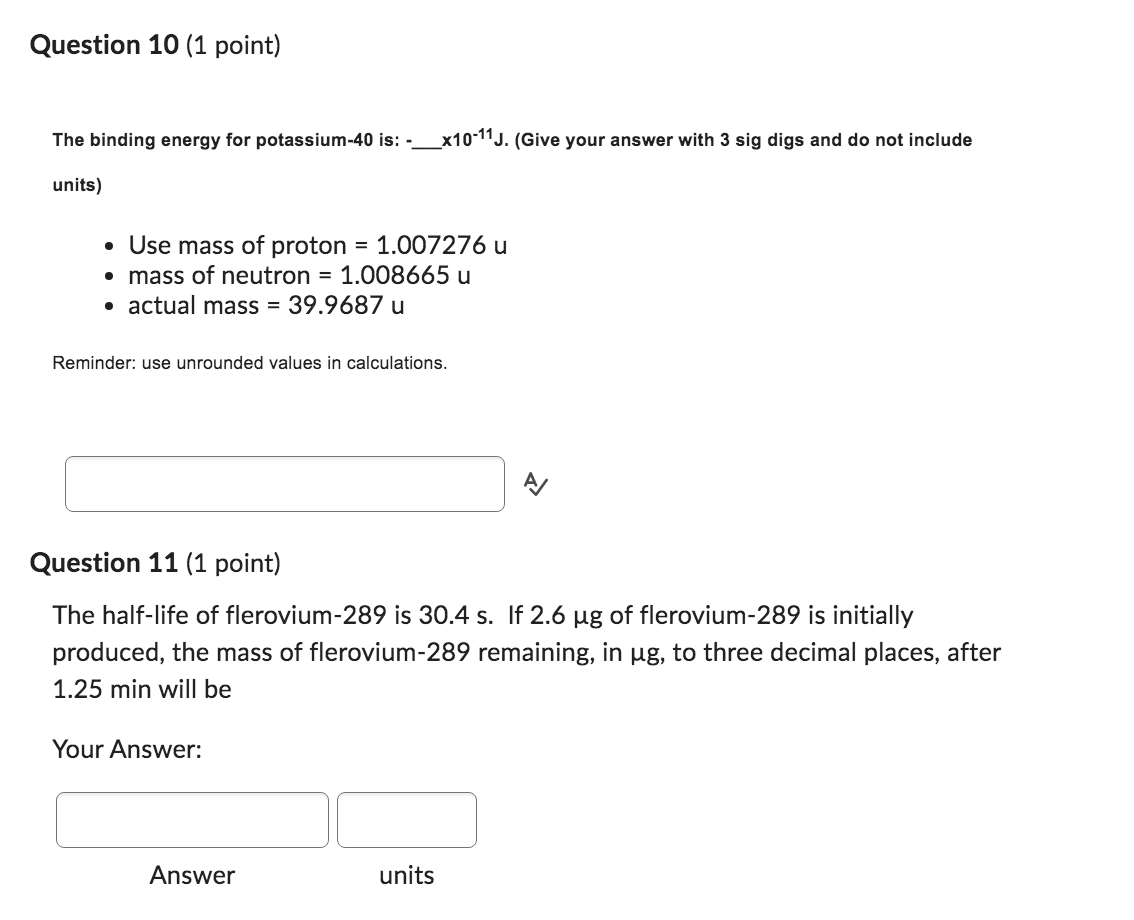
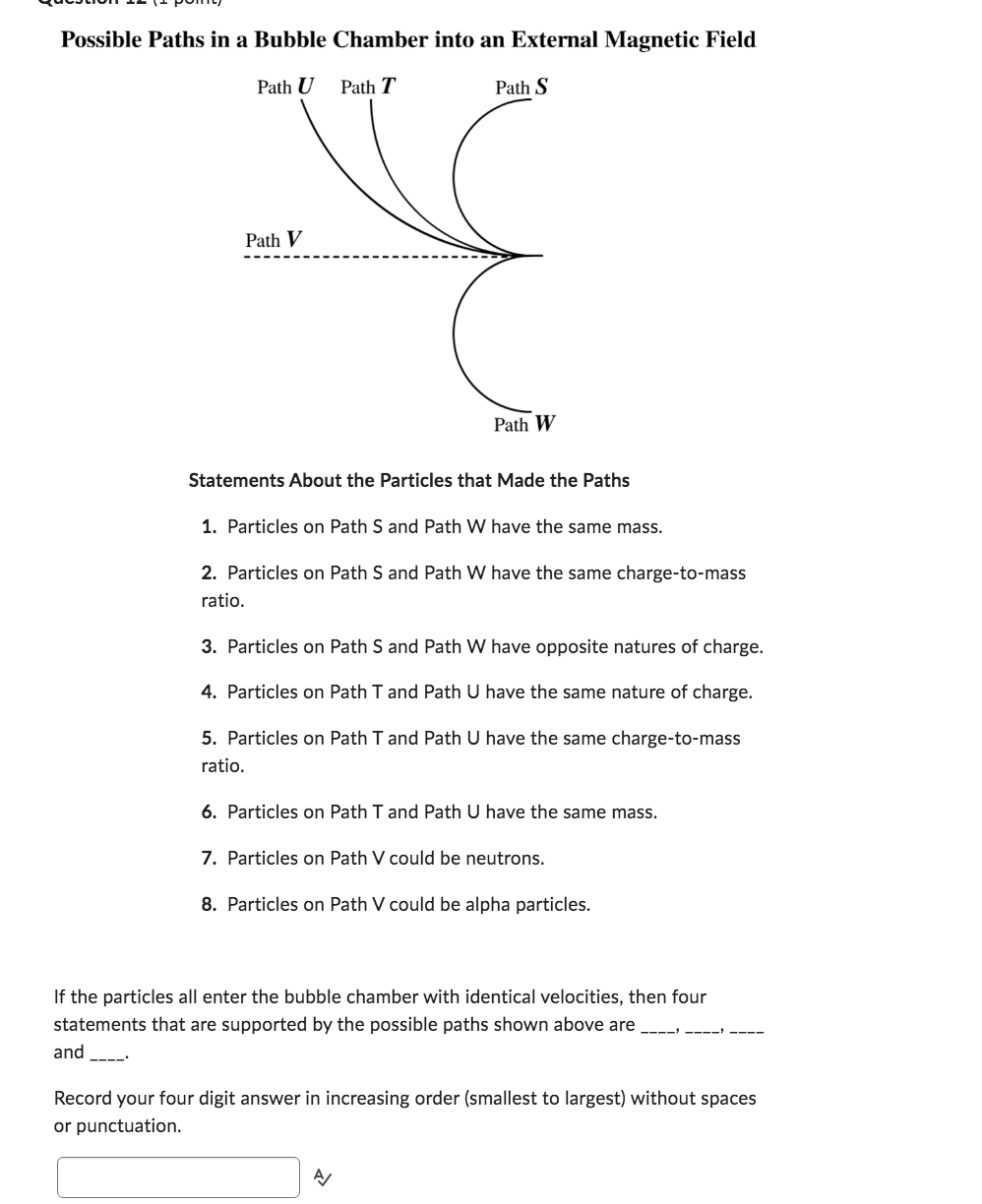
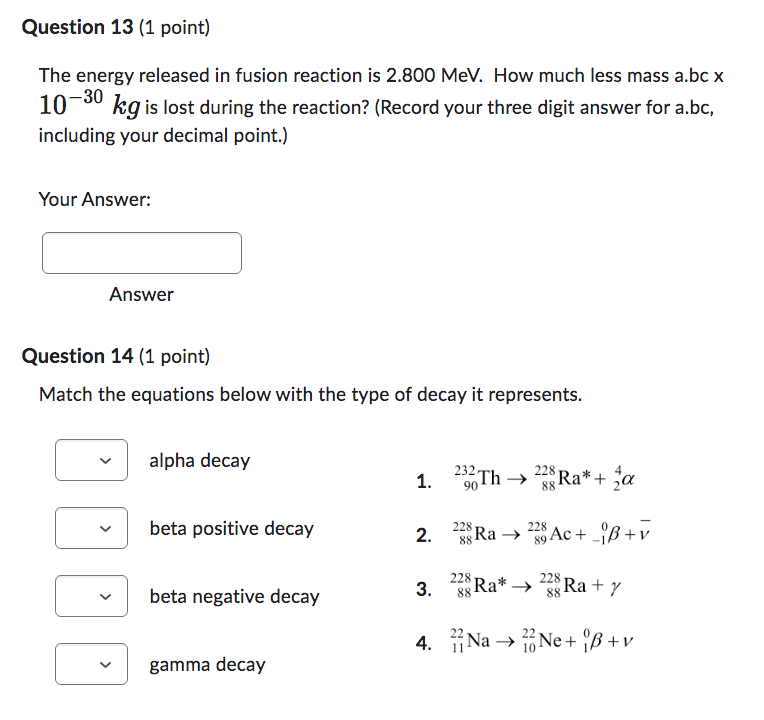
Question 9 (1 point) When an electron and a positron collide, they annihilate and all of their mass is converted into energy. The energy released by the annihilation of an electron- positron pair in joules is a.b)(10"""d (Enter the values of abcd below without punctuation or negative sign) 'E/ Question 10 (1 point] The binding energy for potassium-40 is: -_x10'11J. {Give your answer with 3 sig digs and do not include units) 0 Use mass of proton = 1.007276 u 0 mass of neutron = 1.008665 u 0 actual mass = 39.9687 u Reminder: use unrounded values in calculations. Question 11 (1 point) The half-life of flerovium-289 is 30.4 5. If 2.6 pg of flerovium-289 is initially produced, the mass of flerovium-289 remaining, in ug, to three decimal places, after 1.25 min will be Your Answer: Answer units Possible Paths in a Bubble Chamber into an External Magnetic Field Path U Path T Path S Path V Path W Statements About the Particles that Made the Paths 1. Particles on Path S and Path W have the same mass. 2. Particles on Path S and Path W have the same charge-to-mass ratio. 3. Particles on Path S and Path W have opposite natures of charge. 4. Particles on Path T and Path U have the same nature of charge. 5. Particles on Path T and Path U have the same charge-to-mass ratio. 6. Particles on Path T and Path U have the same mass. 7. Particles on Path V could be neutrons. 8. Particles on Path V could be alpha particles. If the particles all enter the bubble chamber with identical velocities, then four statements that are supported by the possible paths shown above are .___ _ ___ _--- and Record your four digit answer in increasing order (smallest to largest) without spaces or punctuation.Question 13 (1 point) The energy released in fusion reaction is 2.800 MeV. How much less mass a.bc x 1030 kg is lost during the reaction? (Record your three digit answer for a.bc. including your decimal point.) Your Answer: Answer Question 14 [1 point) Match the equations below with the type of decay it represents. l v l alpha decay 233\" 125 * 4 1_ an|1) 3KRa +20: l v l beta positive decay 2. 31121 _) 23A\" 95+; mg mg . " Ra*)" Ra+~x l v l beta negative decay 3' \"2' "l' ' 4_ 171% > TNe+ [[36 +V l v l gamma decay Question 16 {1 point) A 200 kg substance under goes radioactive decay. The substance has a half life of 2 hours. After what time did the substance decay to an amount of 50 kg? (Round to the nearest tenth of a kg) Your
Step by Step Solution
There are 3 Steps involved in it

Get step-by-step solutions from verified subject matter experts
 Study Help