







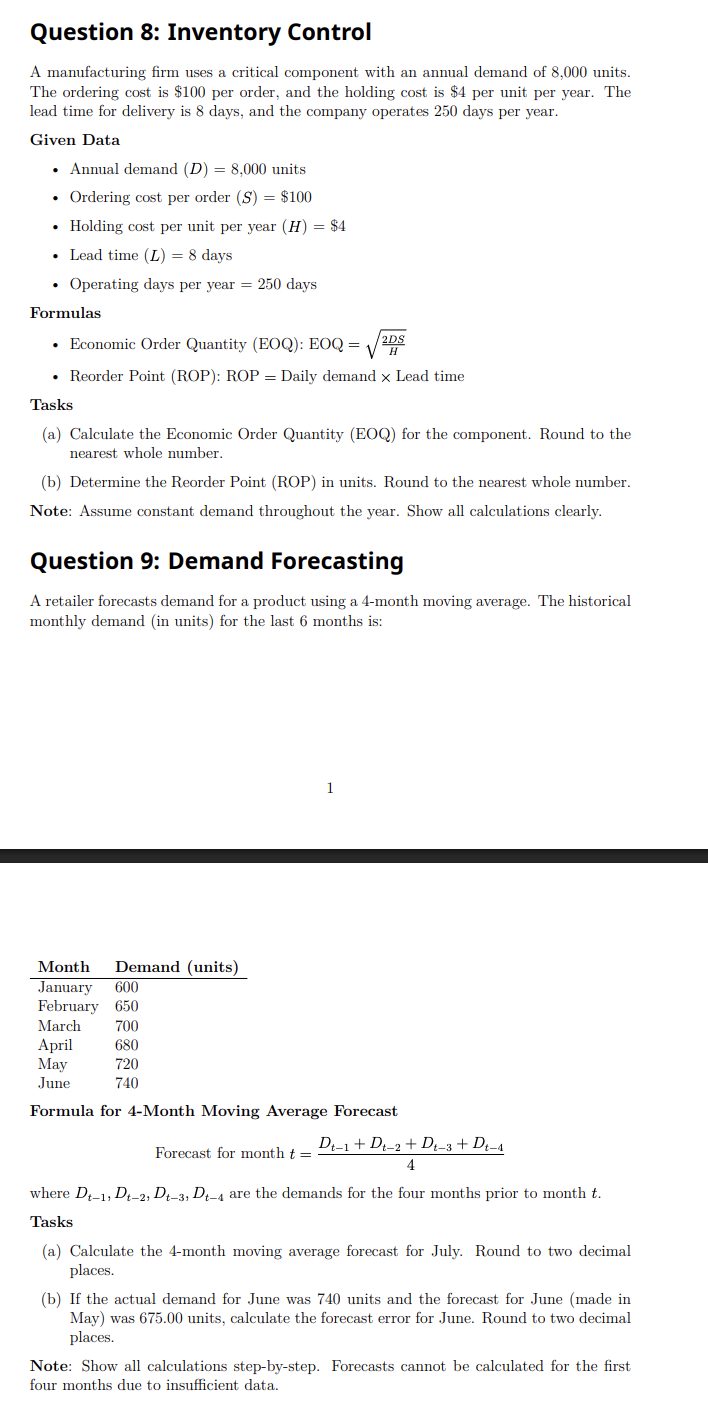
Question: Question 9 : Demand Forecasting A retailer forecasts demand for a product using a 4 - month moving average. The historical monthly demand ( i
Question : Demand Forecasting
A retailer forecasts demand for a product using month moving average. The historical
monthly demand units for the last months :
Formula for Month Moving Average Forecast
Forecast for month
where are the demands for the four months prior month
Tasks
Calculate the month moving average forecast for July. Round two decimal
places.
the actual demand for June was units and the forecast for June
May was units, calculate the forecast error for June. Round two decimal
places.
Note: Show all calculations stepstep. Forecasts cannot calculated for the first
four months due insufficient data. Question : Material Requirements Planning
A company produces a product requiring two components, A and with the following
details:
Additional Information
Planned production for week units
Current inventory: units, units
Tasks
Calculate the gross requirements for components A and for week
Determine the net requirements for components A and considering current
ventory, and the week which orders must placed meet week production.
Note: Show all calculations clearly. Assume safety stock. Question : Quality Control
A manufacturing process produces items with a defect rate A sample items
inspected daily.
Formulas
Expected number defects Sample size Defect rate
Standard deviation defects minutes Total available time per shift Orders per shift
Minimum number workers Total activity time Cycle time
Tasks
Calculate the cycle time required achieve the desired order rate. Round two
decimal places.
Determine the minimum number workers needed without exceeding the cycle
time.
Note: Show all calculations clearly.
Question : JustTime Inventory
A company implements a JIT system for a component with a daily demand units.
The setup cost per production run $ and the holding cost Question : JustTime Inventory
A company implements a JIT system for a component with a daily demand units.
The setup cost per production run $ and the holding cost $ per unit per day.
Given Data
Daily demand units
Setup cost per run $
Holding cost per unit per day $
Formula
Economic Production Quantity : EPQ
Tasks
Calculate the Economic Production Quantity for the component. Round
the nearest whole number.
Calculate the number production runs per year, assuming operating days.
Round the nearest whole numbe
Step by Step Solution
There are 3 Steps involved in it
1 Expert Approved Answer
Step: 1 Unlock

Question Has Been Solved by an Expert!
Get step-by-step solutions from verified subject matter experts
Step: 2 Unlock
Step: 3 Unlock
 Study Help