







Question: Question 9 please, data can be found at Regression modelling with actuarial and financial application data(EuroExchange.csv) The exchange rate that we consider is the amount
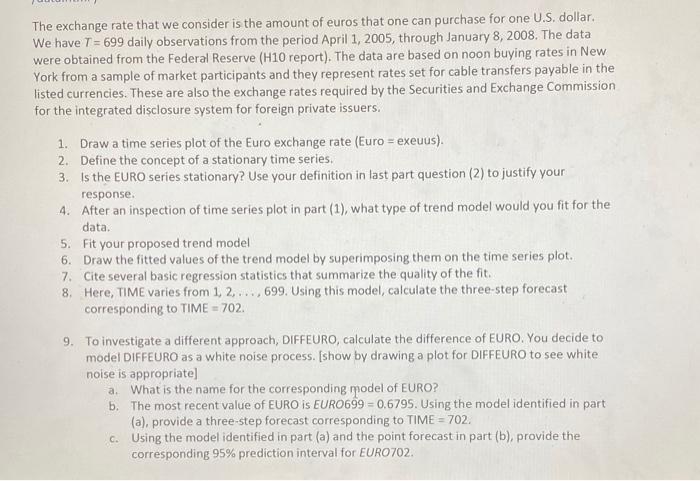
The exchange rate that we consider is the amount of euros that one can purchase for one U.S. dollar. We have T = 699 daily observations from the period April 1, 2005, through January 8, 2008. The data were obtained from the Federal Reserve (H10 report). The data are based on noon buying rates in New York from a sample of market participants and they represent rates set for cable transfers payable in the listed currencies. These are also the exchange rates required by the Securities and Exchange Commission for the integrated disclosure system for foreign private issuers. 1. Draw a time series plot of the Euro exchange rate (Euro = exeuus). 2. Define the concept of a stationary time series. 3. Is the EURO series stationary? Use your definition in last part question (2) to justify your response. 4. After an inspection of time series plot in part (1), what type of trend model would you fit for the data. 5. Fit your proposed trend model 6. Draw the fitted values of the trend model by superimposing them on the time series plot. 7. Cite several basic regression statistics that summarize the quality of the fit. 8. Here, TIME varies from 1, 2,..., 699. Using this model, calculate the three-step forecast corresponding to TIME = 702. 9. To investigate a different approach, DIFFEURO, calculate the difference of EURO. You decide to model DIFFEURO as a white noise process. Ishow by drawing a plot for DIFFEURO to see white noise is appropriate) a. What is the name for the corresponding model of EURO? b. The most recent value of EURO is EURO699 = 0,6795. Using the model identified in part (a), provide a three-step forecast corresponding to TIME = 702. C. Using the model identified in part (a) and the point forecast in part (b), provide the corresponding 95% prediction interval for EURO 702 The exchange rate that we consider is the amount of euros that one can purchase for one U.S. dollar. We have T = 699 daily observations from the period April 1, 2005, through January 8, 2008. The data were obtained from the Federal Reserve (H10 report). The data are based on noon buying rates in New York from a sample of market participants and they represent rates set for cable transfers payable in the listed currencies. These are also the exchange rates required by the Securities and Exchange Commission for the integrated disclosure system for foreign private issuers. 1. Draw a time series plot of the Euro exchange rate (Euro = exeuus). 2. Define the concept of a stationary time series. 3. Is the EURO series stationary? Use your definition in last part question (2) to justify your response. 4. After an inspection of time series plot in part (1), what type of trend model would you fit for the data. 5. Fit your proposed trend model 6. Draw the fitted values of the trend model by superimposing them on the time series plot. 7. Cite several basic regression statistics that summarize the quality of the fit. 8. Here, TIME varies from 1, 2,..., 699. Using this model, calculate the three-step forecast corresponding to TIME = 702. 9. To investigate a different approach, DIFFEURO, calculate the difference of EURO. You decide to model DIFFEURO as a white noise process. Ishow by drawing a plot for DIFFEURO to see white noise is appropriate) a. What is the name for the corresponding model of EURO? b. The most recent value of EURO is EURO699 = 0,6795. Using the model identified in part (a), provide a three-step forecast corresponding to TIME = 702. C. Using the model identified in part (a) and the point forecast in part (b), provide the corresponding 95% prediction interval for EURO 702
Step by Step Solution
There are 3 Steps involved in it

Get step-by-step solutions from verified subject matter experts
 Study Help